
How to Serve LTB Eviction Notices Ontario (N4, N12, N13): Complete 2026 Guide
To serve eviction notice Ontario correctly, landlords must follow strict Landlord and Tenant Board (LTB) procedures. Improper service is one of the top reasons applications are dismissed, delayed, or returned as incomplete. Notices such as the N4, N12, and N13 each have different rules, timelines, and service requirements. When landlords understand the right way to serve eviction notice Ontario, they reduce legal risk and keep their LTB applications on track.
Select Serve and File Process Server Inc. assists landlords, property managers, and paralegals across the province with delivering and filing LTB notices, applications, affidavits, and supporting documents. Our team provides reliable process serving, skip tracing, document retrieval, and rush filing services at competitive rates.
This comprehensive guide explains how to serve eviction notice Ontario properly for N4, N12, and N13 notices in 2026, including timelines, valid methods of service, and real-world examples.
Understanding LTB Eviction Notices in Ontario
There are several types of notices, but this guide focuses on the three most common:
N41: Notice to End Tenancy for Non-Payment of Rent
Issued when a tenant owes rent. The notice gives the tenant a deadline to pay before the landlord can file an L1.
N12: Notice to End Tenancy for Landlord’s or Purchaser’s Own Use
Used when a landlord, purchaser, or immediate family member needs to occupy the rental.
N13: Notice to End Tenancy for Renovation, Repairs, or Demolition
Used when the unit will undergo significant construction or is being converted or demolished.
Each of these requires landlords to properly serve eviction notice Ontario or risk rejection.
Why Proper Service of Eviction Notices Matters
Under the Residential Tenancies Act (RTA), a landlord must prove that the tenant received the notice. If the LTB finds that the landlord did not correctly serve eviction notice Ontario, the Board may:
- Dismiss the application
- Delay the hearing
- Require re-service
- Require a new notice period
Professional service helps landlords maintain timelines and avoid avoidable setbacks.
How to Serve Eviction Notice Ontario: Valid Service Methods
The LTB allows several service methods, but not all notices can be served in all ways. These are the standard, legally acceptable methods to serve eviction notice Ontario.
1. Hand Delivery to the Tenant
Delivering the notice directly to the tenant is one of the most reliable ways to serve eviction notice Ontario.
2. Leaving it in the Tenant’s Mailbox or Mail Slot
This method is valid if the mailbox or slot is accessible to the tenant.
3. Sliding it Under the Tenant’s Door
A common method in apartment buildings.
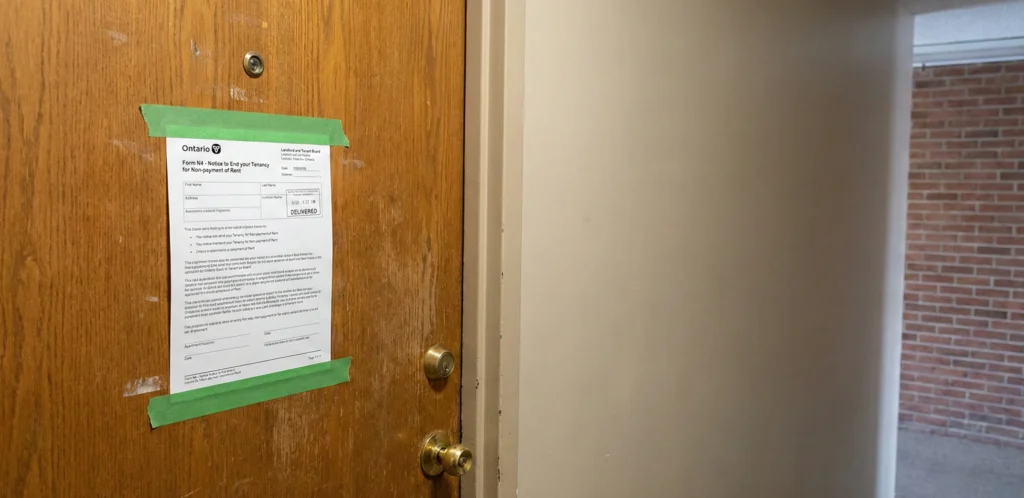
4. Posting the Notice on the Tenant’s Door
This is allowed by the LTB, but landlords should document the posting for proof.
5. Courier or Registered Mail
The LTB adds extra days for service when using mail or courier, so timing is important.
6. Email Service (Only if Tenant Consented in Writing)
A landlord may email the notice only if the tenant provided written consent for email service.
Professional process servers regularly help verify the best method to serve eviction notice Ontario, especially when deadlines are tight.
N4: How to Serve an Eviction Notice for Non-Payment of Rent in Ontario
The N4 is one of the most misunderstood notices, and mistakes here can invalidate an entire L1 application.
Key Rules for N4
- You must list the exact rent owing.
- You must include the correct termination date.
- You must serve eviction notice Ontario using an LTB-approved method.
- You must wait until the notice period expires before filing the L1.
How to Serve the N4 Properly
Valid methods to serve eviction notice Ontario for an N4 include:
- Personal service
- Sliding under the door
- Mailbox or mail slot
- Posting on the door
- Courier
- Email (with consent)
Notice Period for N4
Typically 14 days, except in monthly/weekly tenancies with special circumstances.
Common N4 Errors
- Incorrect amount owed
- Wrong termination date
- Using a non-approved service method
- Filing the L1 too early
Using a professional server helps avoid these mistakes.
N12: How to Serve an Eviction Notice for Landlord’s Own Use in Ontario
An N12 is a high-risk notice because the LTB examines it closely for legitimacy.
Key Rules for N12
- Must be served in good faith
- Requires compensation (1 month rent or equivalent unit offer)
- Must provide 60 days notice
- Must use an LTB-approved service method
How to Serve an N12 Properly
To legally serve eviction notice Ontario for an N12, landlords may:
- Hand-deliver
- Slide under the door
- Leave in mailbox
- Post on the door
- Send via courier
- Email (only with consent)
Registered mail is allowed but adds extra days to the notice period.
N13: How to Serve an Eviction Notice for Renovations or Demolition in Ontario
An N13 is complex because it requires proof of major renovations or demolition.
Key Rules for N13
- Must be based on genuine structural work, not cosmetic upgrades
- Tenant may have the right of return
- Notice period depends on the type of renovation
- Must include supporting documentation if requested
How to Serve an N13 Properly
To serve eviction notice Ontario for an N13, landlords must use:
- Hand delivery
- Mailbox/mail slot
- Posting
- Courier
- Email (if consented)
Because N13 disputes are common, accurate service is critical.
How to Confirm Proper Service for Eviction Notices
When landlords serve eviction notice Ontario, they should document:
- Date and time of service
- Method of service
- Location (door, mailbox, etc.)
- Photos (optional but helpful)
- Any interactions or confirmations
If a process server handles the job, they provide:
- Detailed attempt logs
- Proof of service
- A commissioned Certificate of Service
Select Serve and File prepares, serves, and files LTB documents daily across Ontario.
Real Example: Serving an N4 for a Tenant Who Avoided the Door
A landlord in Brampton needed to serve eviction notice Ontario for unpaid rent. The tenant avoided answering the door despite clear occupancy.
Our process server:
- Made three attempts at varied times
- Spoke lawfully with neighbours to confirm occupancy
- Posted the N4 notice on the door with timestamped documentation
- Provided a Certificate of Service
- The landlord successfully filed the L1
This is a standard example of how professional service keeps files on track.
How Professional Servers Help With LTB Notices
Hiring a professional to serve eviction notice Ontario provides:
- Fast, accurate service
- Lawful service methods
- Proof of service
- Support with LTB filing
- Rush options for urgent cases
- Skip tracing for unknown tenant locations
- Document retrieval from LTB or court
Select Serve and File has trained staff experienced with landlord–tenant files province-wide.
Disclaimer
This article provides general information only and is not legal advice. Always consult a licensed paralegal or lawyer for guidance specific to your case.
Take Action Today
If you need to properly serve eviction notice Ontario, including N4, N12, or N13 notices, Select Serve and File Process Server Inc. can assist with professional service, documentation, and LTB filing. Contact us today.
FAQ
Valid methods include hand delivery, mailbox, door posting, courier, and email with consent.
Only if the tenant has given written consent to email service.
Yes. Improper service is one of the most common reasons for dismissal.