
Court Filing Ontario: Continuing Record & Endorsements Explained (2026 Guide)
Understanding court filing Ontario rules is essential for lawyers, paralegals, and self-represented individuals. Filing in the wrong section, preparing incomplete Continuing Record tabs, or mishandling Endorsements can lead to rejected documents, adjournments, or unnecessary delays. Because Ontario courts require precise organization of case materials, especially in Family Court and Civil matters, it is crucial to know how Continuing Records and Endorsements function.
Select Serve and File Process Server Inc. assists clients across the province with court filing Ontario, including Continuing Record preparation, Endorsement organization, document retrieval, and rush filing for urgent matters. Our team provides fast, accurate, and cost-effective filing services at numerous Ontario courthouses.
This guide breaks down the entire court filing Ontario process, focusing on Continuing Records and Endorsements, two of the most misunderstood requirements.
What Is Court Filing Ontario?
Court filing Ontario refers to submitting legal documents to the appropriate courthouse in compliance with procedural rules. Documents may include:
- Applications
- Motion Records
- Case Conference Briefs
- Financial Statements
- Responses and Confirmations
- Affidavits of Service
- Orders and Endorsements
- Evidence and Exhibits
- Small Claims documents
Whether in person or electronically, filings must meet format requirements before they are accepted.
Select Serve and File has trained staff in court filing, continuing record updates, and document retrieval across many Ontario courts.
What Is a Continuing Record?
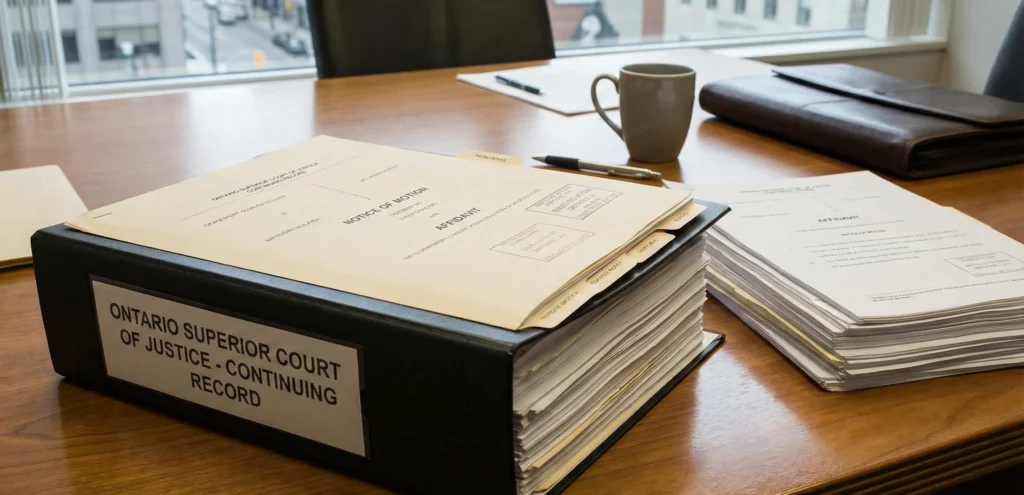
A Continuing Record is a mandatory court file that organizes all documents submitted in a case. It acts as the official record of everything filed, making it easy for judges and clerks to reference case history.
A Continuing Record is required in:
- Family Court
- Civil actions
- Some Small Claims matters (motion-heavy)
A professional handling court filing Ontario must understand how to maintain and update Continuing Records.
Sections of a Continuing Record in Ontario
A standard Continuing Record contains:
1. Table of Contents (TOC)
Lists all documents filed to date, organized by tab and date.
2. Documents Served
All materials served on other parties.
3. Documents Filed
All materials filed with the court.
4. Endorsements and Orders
Judge’s handwritten notes
Clerk’s endorsements
Typed orders issued by the court
5. Exhibits
Attached evidence.
A professional in court filing Ontario ensures each section is accurately updated with every new filing.
Why the Continuing Record Matters
Ontario courts rely on Continuing Records to:
- Track the progress of a case
- Confirm compliance with service rules
- Review past endorsements and orders
- Ensure documents are properly indexed
- Avoid duplicate filings
- Provide clear navigation for hearings
If a Continuing Record is poorly maintained, the court may reject filings or delay the hearing.
Understanding Endorsements in Court Filing Ontario
Endorsements are written notes by judges or clerks. They appear:
- Handwritten on the backsheet
- Typed as part of a formal order
- In court’s internal system
These notes direct the next steps in the case.
Types of Endorsements
- Procedural Endorsements
Details about timelines, next steps, or required filings. - Substantive Endorsements
Decisions that impact the rights of parties. - Administrative Endorsements
Clerical or scheduling notes.
A professional in court filing Ontario must know exactly where to place endorsements in the Continuing Record so future filings are organized correctly.
How to Create and Maintain a Continuing Record
Below is the step-by-step process.
Step 1: Prepare the Front Cover
- Case name
- Court location
- Court file number
- Applicant vs. Respondent
- Type of matter
This front sheet identifies the case for judges and clerks.
Step 2: Create Tab Dividers
Tabs typically include:
- Tab 1: Application
- Tab 2: Answer/Response
- Tab 3: Motion Materials
- Tab 4: Financial Statements
- Tab 5: Affidavits
- Tab 6: Case Conference Briefs
- Endorsements Section
- Orders Section
A court filing Ontario professional ensures every new document is placed behind its correct tab.
Step 3: Update the Table of Contents
Every time new documents are filed, the Table of Contents must:
- List the document name
- Include the date filed
- Include the tab number
- Show page numbers (in some courts)
The TOC keeps the record easy to navigate.
Step 4: Insert New Documents Properly
Documents must:
- Be numbered
- Include a backsheet
- Be hole-punched
- Be tabbed correctly
Incorrect formatting often results in rejection at filing counters.
Step 5: Add Endorsements
Endorsements must be placed in the designated section of the Continuing Record.
Common mistakes include:
- Filing them in the wrong section
- Not copying them for all parties
- Missing handwritten notes
Select Serve and File’s filing team ensures endorsements are properly indexed and inserted.
Step 6: Add Orders
Orders must include:
- The judge’s signature
- Court seal (if added)
- The correct date of issuance
- Updated TOC placement
Order errors are common and often lead to delays.
Common Mistakes in Court Filing Ontario
Below are the mistakes that cause filings to be rejected:
- Missing or outdated forms
- Incorrect tabbing in Continuing Record
- No backsheet
- Missing endorsements or orders
- Not enough copies
- Incorrect file number
- Wrong courthouse location
- Failing to update TOC
- Missing commissioning on affidavits
Professionals help avoid these issues.
How Select Serve and File Helps with Court Filing Ontario
Select Serve and File offers:
- Continuing Record preparation
- TOC updates
- Endorsement and order insertion
- Same-day and rush filing
- Document retrieval
- E-filing where applicable
- Process serving + filing combinations
- Competitive pricing with no hidden fees
Our trained staff understand courthouse procedures and ensure your filings are accepted the first time.
Act Today
If you need help with court filing Ontario, Continuing Record updates, endorsements, or rush filing, Select Serve and File Process Server Inc. is ready to assist. Contact us today.
FAQ
A mandatory court file that organizes all documents in a case.
Handwritten or typed notes by judges or clerks directing case actions.
Mainly Family and Civil. Some Small Claims matters require organized records for motions.