
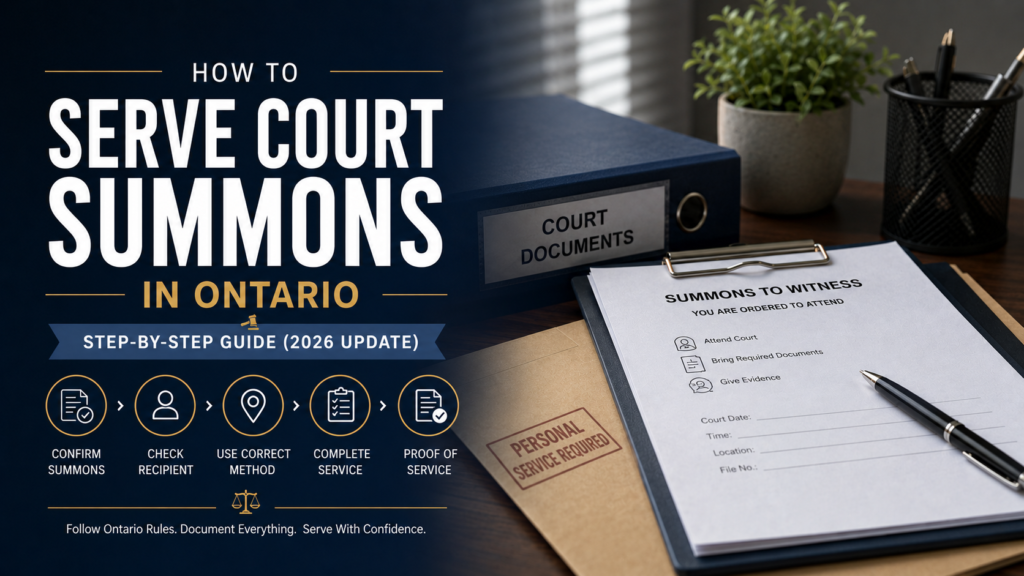
How to Serve Court Summons in Ontario (2026 Update): Step-by-Step Guide
To serve court summons Ontario correctly, you must follow the service rules that apply to the specific proceeding. A summons to witness may require personal service and proof of service. The exact requirements can differ between civil, family, and other court matters, so always check the applicable rules first.
1. Confirm the Summons Before You Serve Court Summons Ontario
Start by reviewing the summons and the proceeding it belongs to.
A summons to witness may require someone to attend court and may also require them to bring specified documents or things. For civil proceedings, the Ontario Rules of Civil Procedure (O. Reg. 194) address summonses to witnesses and their service.
Check:
- The full name of the person being summoned
- Court file information
- Court date, time, and location
- Documents or things the witness must bring
- The applicable service requirements
Do not assume that the same rules apply to every type of summons.
2. Check Who Must Receive the Summons
Before you serve court summons Ontario, confirm exactly who must receive it.
A summons to witness is directed to the person whose attendance is required. The correct recipient matters because service must be properly connected to the person named in the summons.
If you have an outdated address or incomplete contact information, consider whether a locate search is needed before attempting service.
3. Use the Correct Service Method
For civil proceedings, a summons to witness must generally be served personally. The Ontario Rules of Civil Procedure state that a summons to witness is served personally rather than by an alternative to personal service.
This means you should not assume that leaving the summons with another person, placing it in a mailbox, or sending it by email will satisfy the requirement.
The applicable rules may differ for other proceedings. Check the current rules before you serve court summons Ontario.
4. Plan the Service Attempt
Prepare before you serve court summons Ontario.
Give the process server the complete document package and the best available information about the recipient. Useful information can include an address, workplace details, known contact information, and any relevant access instructions.
A practical observation from process serving work is that incomplete recipient information often creates avoidable delays. [CONFIRM] Confirm this observation against your team’s current operating experience.
If the person has moved or cannot be located, a locate search or skip tracing may help identify a current address.
5. Complete Personal Service
When you serve court summons Ontario in a civil matter, personal service means delivering the summons directly to the witness.
The server should carefully record what happened during the attempt. This can include the date, time, location, and information used to identify the person served.
If the recipient refuses to accept the document, do not assume the service is automatically invalid or valid. The circumstances should be documented and assessed against the applicable rules.
6. Prepare Proof After You Serve Court Summons Ontario
After you serve court summons Ontario, document the service properly.
For civil proceedings, the Rules of Civil Procedure provide that service of a summons to witness and payment or tender of the required attendance money may be proved by affidavit.
The completed proof should accurately reflect what happened. Avoid adding assumptions or details that the server cannot personally confirm.
Review the document before filing it with the court.
7. Protect Personal Information
Court summonses can contain personal information about witnesses and legal proceedings.
Handle documents carefully during preparation, transportation, service, and storage. The Office of the Privacy Commissioner of Canada guidance on protecting personal information provides useful general information about privacy responsibilities.
Good document handling is part of a professional process serving workflow.
What If the Witness Avoids Service?
If you cannot serve court summons Ontario after an attempt, record each attempt accurately.
Do not simply state that the person was unavailable. Record relevant facts that the server personally observed.
Further attempts may be appropriate depending on the circumstances. A locate search may also be considered if the available address appears outdated.
For civil summonses, the rules specifically address personal service, so do not assume that an alternative method can be used without checking whether the court has authorized it.
How Much Time Do You Have to Serve a Court Summons?
Do not rely on a general serve court summons Ontario deadline.
The required timing depends on the type of proceeding and the applicable rules. For example, the current Family Law Rules state that a summons to witness must generally be served at least seven days before the person is required to attend, subject to the rule’s qualifications.
Civil proceedings can have different requirements. Check the current rules for your matter before arranging service.
Why Use a Professional Process Server?
A professional can help you serve court summons Ontario by handling the physical delivery, documenting attempts, and preparing service information based on what occurred.
Select Serve and File Process Server Inc. has served Ontario since 2005. Its services include process serving, skip tracing, locate searches, court filing, document retrieval, and related legal support services.
If you need to serve court summons Ontario, provide the server with the correct summons and clear instructions for the assignment.
Need documents served in Ontario? Request a quote or call (647) 568-5700.
“This article provides general information about process serving and court procedure in Ontario. It is not legal advice and does not create a solicitor client relationship. Court rules and procedures change. Confirm current requirements with the relevant court or consult a licensed Ontario lawyer or paralegal before acting.”