
How Sheriff’s Offices Handle Enforcement Documents in Ontario
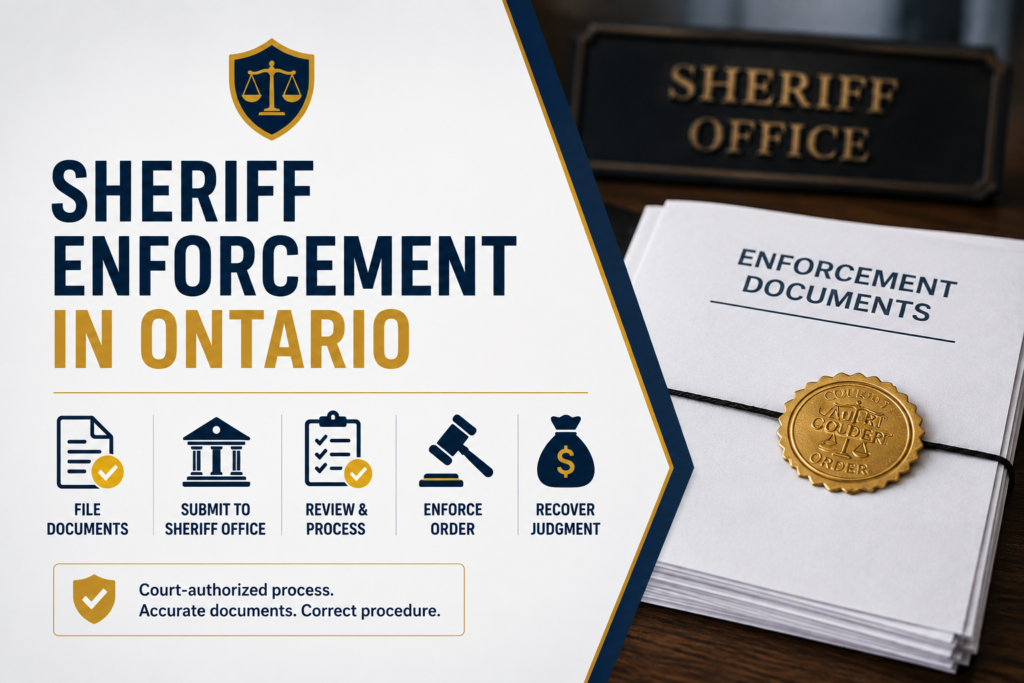
Sheriff office enforcement in Ontario is part of the court enforcement system used to carry out certain enforcement steps after a judgment or order. The sheriff may receive enforcement documents, register or process them, and take action under the applicable rules. The exact process depends on the judgment, document, and enforcement request.
Why it matters in Ontario
Understanding sheriff office enforcement in Ontario helps you know what happens after you obtain a judgment.
A judgment does not always result in automatic recovery. In some cases, you may need to take an additional enforcement step and provide documents to the appropriate enforcement office.
The Ontario Rules of Civil Procedure contain provisions dealing with enforcement of judgments. Rule 60 covers several enforcement processes, including writs of seizure and sale and other enforcement procedures. You can review the Ontario Rules of Civil Procedure, Rule 60 for the current rules.
The sheriff is an officer involved in enforcing certain court orders and writs. The sheriff’s role is different from that of a process server.
A process server generally delivers documents and records what happened. A sheriff may carry out specific enforcement functions authorized by the court rules and applicable legislation.
This distinction matters if you are researching sheriff office enforcement in Ontario. Filing an enforcement document with the sheriff does not mean that a private process server is taking over the sheriff’s statutory role.
The Ministry of the Attorney General also provides information about Ontario’s court and justice system. The Ministry of the Attorney General is another official source for current court-related information.
The exact steps can vary. You should confirm the current requirements that apply to your judgment and enforcement method. [VERIFY]
What it involves in practice
The sheriff enforcement process usually starts with identifying the enforcement method available for your judgment.
One possible process involves a writ. A writ is a court document that can authorize certain enforcement actions. Depending on the type of writ, it may allow enforcement against property or other interests covered by the applicable rules.
- Writ filing is therefore an important part of some enforcement matters. The required document must be prepared correctly and submitted through the appropriate court or enforcement process.
- Once the relevant document reaches the appropriate enforcement office Ontario, the office handles it according to the rules and procedures that apply.
- The role of the sheriff can include enforcing a writ through processes such as seizure and sale, where the applicable requirements are met.
- Seizure means taking property or another specified interest under legal authority for the purpose permitted by the enforcement process. It is not simply a private collection action.
- You should not assume that filing a writ guarantees that property will be seized or that a judgment will be recovered.
- The sheriff may need to follow specific procedures before taking enforcement action. The outcome can also depend on whether there is property available and whether other claims or enforcement interests exist.
The filing with the sheriff Ontario process can also involve documents, instructions, and information that must be accurate.
This is one reason to check the current court forms before submitting an enforcement request. Requirements can change, and the correct documents depend on the type of enforcement being pursued.
Some enforcement matters involve garnishment instead of seizure. Garnishment generally involves money owed to the judgment debtor by another person or organization.
If garnishment is relevant to your matter, you can read what is a notice of garnishment in ontario for a general explanation.
Where people commonly go wrong
One common mistake is assuming that every judgment should be sent directly to the sheriff.
The correct enforcement method depends on the judgment, the type of property or money involved, and the rules that apply.
Another mistake is using outdated forms or incomplete information.
An enforcement request may depend on accurate information about the judgment debtor, the judgment, and the property or interest involved. Missing information can create problems during processing.
[CONFIRM] From practical operating experience, one of the most common problems is treating enforcement filing as a single step rather than a process that requires accurate documents and follow-up. A filing may be accepted, but that does not necessarily mean the enforcement objective has been achieved.
It is also important to understand the difference between filing and enforcement action.
Submitting a document to the sheriff is one step. Any later action must follow the applicable legal process.
Another common issue is assuming that the sheriff will locate assets or solve every information problem. The information available to the enforcement office can affect what action is possible.
If you do not know where the debtor’s property is located, you may need appropriate searches or other information before choosing an enforcement approach.
You should also keep copies of documents submitted and records of relevant communications. This can make it easier to track the status of the matter.
If you are unsure which enforcement process applies, do not assume that one method can simply be substituted for another. Check the current rules or consult a licensed Ontario lawyer or paralegal.
When to use a professional
Sheriff office enforcement in Ontario can involve detailed paperwork and court procedures. Professional assistance may be useful when you need help with document preparation, filing, document retrieval, or related court services.
A process serving and court filing company can assist with certain administrative and filing tasks. It does not replace the sheriff and cannot make enforcement decisions on your behalf.
Select Serve and File Process Server Inc has served Ontario since 2005. The company provides process serving, court filing, document retrieval, locate searches, skip tracing, and related services for individuals, law firms, financial institutions, corporations, and other organizations.
Professional assistance can be useful when you need documents filed correctly or require help obtaining court records connected with an enforcement matter.
However, a process server is not a law firm. The company can provide the requested service, but it cannot advise you on which enforcement strategy is best for your case.
You should also allow enough time for the enforcement process. Do not assume that filing immediately produces a result.
The key point is that sheriff office enforcement in Ontario is a formal court process. The sheriff handles enforcement functions provided by law, while process servers and court filing companies can assist with related services.
If you are dealing with an enforcement matter, start by identifying the judgment, the enforcement method, and the documents required. Then confirm the current procedure before filing.
Understanding sheriff office enforcement in Ontario can help you distinguish between filing an enforcement document and the later enforcement action itself.
Need documents served in Ontario? Request a quote or call (647) 568-5700.
“This article provides general information about process serving and court procedure in Ontario. It is not legal advice and does not create a solicitor client relationship. Court rules and procedures change. Confirm current requirements with the relevant court or consult a licensed Ontario lawyer or paralegal before acting.”
“Deadlines and service requirements vary by document type, court and proceeding. Missing a deadline can result in your matter being delayed or dismissed. Verify all timelines against the applicable rules and the practice direction of the court or tribunal where your matter is filed.”