
What Happens When Someone Is Avoiding Service in Ontario? Complete 2026 Guide
When someone is avoiding service Ontario, the legal process becomes significantly more complex. Many litigants assume that if a person refuses to answer the door, hides inside their home, or simply relocates without notice, the case cannot move forward. Fortunately, Ontario law provides several mechanisms to deal with respondents who are intentionally or unintentionally avoiding service. The key is understanding the proper procedures and using trained professionals who know how to navigate these challenges.
Select Serve and File Process Server Inc. deals with avoiding service Ontario scenarios daily. Our team provides process serving, skip tracing, court filing, and document retrieval across the province at competitive rates, helping law firms, landlords, corporations, and individuals keep their cases on track.
This article explains exactly what happens when someone is avoiding service Ontario, how professionals handle these cases, and what legal remedies are available.
Why People Avoid Service in Ontario
There are many reasons someone may be avoiding service Ontario, including:
- Fear of legal consequences
- Attempting to delay proceedings
- Past disputes with landlords or creditors
- Unresolved family matters
- Eviction notices
- Debt lawsuits
- Misunderstanding the legal process
- Mental health or safety concerns
Regardless of motive, Ontario courts require proof that reasonable efforts were made to serve the individual.
How to Tell If Someone Is Avoiding Service in Ontario
Professionals identify avoidance through common patterns:
- Respondent visibly present but refusing to answer
- Lights/electronics turning off when server knocks
- Neighbours reporting the person is home
- Respondent fleeing through side or back exits
- Delivery history confirming occupancy
- Social media activity confirming the person still resides there
- Workplace attendance despite “not home” claims
When these signs appear, the case often requires advanced avoiding service Ontario strategies such as skip tracing or alternative service motions.
Step-by-Step: What Happens When Someone Avoids Service in Ontario
Below is the exact process professional servers follow.
Step 1: Multiple Service Attempts
Courts expect reasonable effort. A trained server makes attempts:
- Morning
- Evening
- Weekends
- Workplace (if allowed)
- At various access points
These attempts demonstrate diligence when dealing with avoiding service Ontario cases.
Select Serve and File uses structured attempt logs and time-stamped notes to support affidavits.
Step 2: Confirmation of Occupancy
Before proceeding to advanced measures, the server verifies that the respondent still lives or works at the address.
Common verification tools:
- Mailbox name
- Delivery activity
- Neighbour confirmation (lawfully)
- Building entry logs (if shared by management lawfully)
- Vehicle presence
- Skip tracing address checks
If occupancy cannot be confirmed, the matter moves into skip tracing.
Step 3: Skip Tracing for Avoiding Service Ontario
Skip tracing is often the most effective solution when dealing with avoiding service Ontario.
A skip tracing investigation may include:
- Address history
- Phone numbers
- Email searches
- Social media mapping
- Corporate records
- Court filings
- Property registry
- Workplace identification
Select Serve and File performs professional skip tracing to locate updated addresses throughout Ontario and Canada.
Step 4: Attempting Service at Alternate Locations
If new information is obtained, servers attempt:
- Workplace service
- Alternate residences
- Family homes
- Community locations
- Rural properties
Ontario courts accept workplace personal service for many document types, making this a strong strategy when dealing with avoiding service Ontario situations.
Step 5: Leaving Documents Strategically (If Allowed)
Some documents do not require personal service. For example:
- Many Small Claims documents
- Certain Family Court materials
- Some landlord–tenant notices
For these, lawful alternatives include:
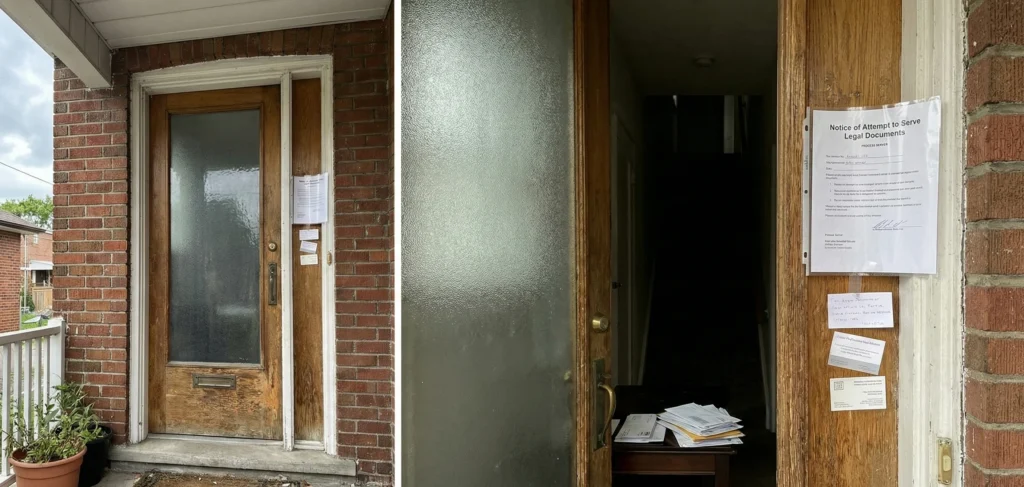
- Posting on the door
- Sliding under the door
- Mailbox delivery
- Registered mail
A professional server will apply the method that is legally valid for the specific document type.
Step 6: Motion for Substituted or Alternative Service
If the respondent is clearly avoiding service Ontario, and all reasonable attempts have failed, the next step is a court motion requesting permission for alternative service.
Courts may allow:
- Service by email
- Service by text message
- Service through social media (Facebook, Instagram, LinkedIn)
- Service to a family member
- Posting the document at the last known address
- Mailing to the last known address
- Service to a workplace
- Service by publication in a newspaper
A detailed affidavit from a server summarizing attempts and findings is essential for this motion.
What the Court Considers in Avoiding Service Ontario Cases
Judges and adjudicators examine:
- Number of attempts
- Times and dates of attempts
- Evidence of occupancy
- Server’s notes
- Skip tracing results
- Respondent’s online presence
- History of avoidance
- Safety or access issues
If effort is proven, judges are willing to grant alternative service so the matter can proceed.
Real Example: Family Law Respondent Avoiding Service in Toronto
A paralegal contacted Select Serve and File because the respondent:
- Lived in a secured condo
- Refused to answer the door
- Ignored concierge calls
- Blocked emails
Our team followed the avoiding service Ontario protocol:
- Completed three varied-time attempts
- Verified occupancy through mail and neighbour confirmation
- Identified workplace through LinkedIn
- Served the respondent at his downtown office
- Prepared and commissioned the affidavit
- Filed the materials at 47 Sheppard the same day
The case proceeded without delay.
Real Example: Tenant Avoiding Service of N12 Notice
A landlord needed to serve an N12 notice. The tenant was clearly avoiding service Ontario by not answering the buzzer and pretending not to be home.
Our server:
- Posted the notice on the door
- Took time-stamped photos
- Completed a Certificate of Service
- Guided the landlord through filing the L2
The LTB accepted the service.
How Process Servers Handle Avoiding Service Ontario Cases
Professional servers offer major advantages:
- They understand court rules
- They use multi-attempt strategies
- They conduct skip tracing
- They lawfully gather occupancy evidence
- They provide detailed attempt logs
- They complete affidavits and have them commissioned
- They file documents at court
- They work quickly under deadlines
Select Serve and File specializes in complex serving situations, including severe avoidance.
Consequences for Individuals Avoiding Service in Ontario
Contrary to common belief, avoiding service Ontario does not stop a case. Instead, it may result in:
- Court granting alternative service
- Case proceeding without the respondent
- Judgments issued in the absence
- Eviction applications moving forward
- Support or custody decisions being made
- Enforcement actions initiated
Avoidance delays the process but does not prevent it.
Contact Us Today
If someone is avoiding service Ontario, Select Serve and File Process Server Inc. can help with professional service, skip tracing, affidavits, and court filing. Contact us today for fast, effective results.
FAQ
Servers use multiple attempts, skip tracing, and alternative service motions.
Yes. Courts can authorize substituted or alternative service.
No. It only delays the process; the court will eventually move forward.