
What Is a Certificate of Service at the LTB?
A certificate of service LTB Ontario is a record showing the Landlord and Tenant Board when, where, and how a document was served. It is completed and signed by the person who served the document when required by the LTB Rules of Procedure or directed by the Board.
Why it matters in Ontario
The certificate of service LTB Ontario helps show that a required document was actually served.
At the Landlord and Tenant Board, “serving” means giving documents related to a case to another party. The LTB permits different service methods depending on the situation. These can include hand delivery, courier, mail, fax, email with consent, and other permitted methods.
The certificate creates a written record of that service. It identifies the document, the person served, and the date and method used.
This matters because the service method can affect when the LTB considers a document received. For example, hand delivery and mailing have different effective service dates under the current rules.
The LTB’s current rules state that, where required by the rules or directed by the Board, service must be confirmed with a Certificate of Service signed by the person who served the document. The current rule also requires the certificate to be filed with the LTB within the applicable period.
You can review the current Landlord and Tenant Board rules and service information before relying on a particular service method.
The proof of service Landlord Tenant Board process is not simply about having a copy of the document. You also need an accurate record showing how service occurred where a certificate is required.
What it involves in practice
An LTB certificate of service records the basic facts about service.
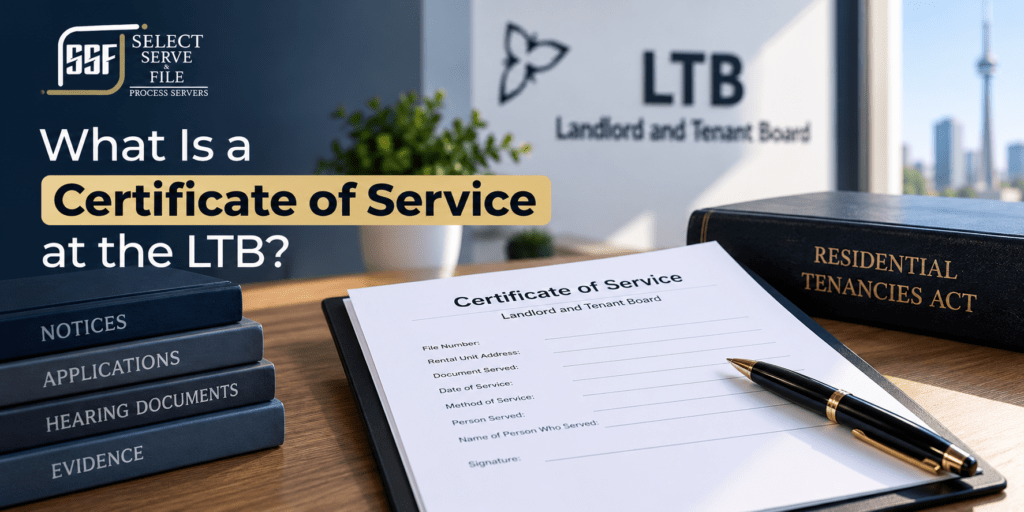
The current LTB Certificate of Service asks for information such as the file number, rental unit address, date of service, documents served, person served, and method of service. It also identifies the person who served the documents and requires that person to sign the certificate.
This means you should complete the certificate based on what actually happened.
For example, if documents were handed directly to the tenant, the certificate should accurately identify that method. If documents were delivered using another permitted method, the certificate should record that method instead.
The certificate should not be treated as a general statement that documents were sent. It is a record of the specific service event.
What the certificate normally records
Depending on the document and circumstances, the record can include:
- The LTB file number.
- The rental unit information.
- The date the document was served.
- The document or documents served.
- The person who received them.
- The method used for service.
- The name and signature of the person who served them.
The LTB’s current form provides several service-method options, including handing documents to the person, giving them to an authorized landlord employee, delivering them to an adult in the rental unit, leaving them in a mailbox, courier, mail, fax, and other methods where permitted.
Not every method is available in every situation. Email, for example, has specific consent requirements under the LTB rules. Alternative service may also require permission from the Board.
When it is filed with the Board
A certificate may need to be filed with the Board after service.
For applications and other documents, the exact requirement depends on the type of proceeding and the LTB’s directions. The Board’s rules specifically address certificates for documents that a party is required or directed to serve.
For some applications connected with a notice of termination, the LTB requires the applicant to provide the notice served and a Certificate of Service completed by the person who served it.
An N4 certificate of service is therefore part of documenting service of an N4 notice where the LTB requires that proof. The certificate does not replace the notice itself.
The current LTB forms page also lists Certificate of Service forms and identifies them as documents that can be filed through the Tribunals Ontario Portal.
Where people commonly go wrong
The most common problems are often basic recordkeeping issues.
A person may remember delivering the document but forget the exact date or method. Another common issue is providing incomplete recipient information or describing a service method too generally.
Another mistake is assuming that every document can be served the same way.
The LTB Rules of Procedure contain different requirements for service methods and specific circumstances. Written consent may be required for email service. The Board may also need to approve an alternative method.
Effective service dates can also cause confusion. Mailing a document does not necessarily mean the document is considered served on the day it enters the mail. The current LTB rules set different effective dates for different methods.
Always Confirm the current effective service date for the method used before relying on a particular date.
Another issue is signing the certificate incorrectly. The current LTB certificate states that the person who served the documents must sign it.
Finally, do not confuse an LTB Certificate of Service with proof used in family court.
Family court proceedings have separate service rules. The Family Law Rules (O. Reg. 114/99) contain their own provisions for service and proof of service. The rules recognize methods such as an affidavit of service as proof in appropriate circumstances.
If your matter involves both tenancy and family court documents, check the requirements for each proceeding separately.
For more information, see serving landlord and tenant board documents in Ontario.
When to use a professional
You may be able to serve some LTB documents yourself. However, a professional process server can handle the service assignment and create a clear record of what happened.
This can be useful when the recipient is difficult to locate, when several attempts may be needed, or when you want an independent person to document the service.
A professional server does not decide your legal strategy or determine which notice you should use. Your responsibility is to provide the correct documents and instructions.
Select Serve and File Process Server Inc has served Ontario since 2005. The company provides process serving, court filing, document retrieval, locate searches, and related services.
If you need documents served for another proceeding, you can also read how to serve a restraining order in Ontario.
The main purpose of a certificate of service LTB Ontario is simple. It creates a record showing what was served, who received it, and how and when service took place. When the LTB requires this proof, accurate completion and filing can form an important part of your tenancy file.
Need documents served in Ontario? Request a quote or call (647) 568-5700.
“This article provides general information about process serving and court procedure in Ontario. It is not legal advice and does not create a solicitor client relationship. Court rules and procedures change. Confirm current requirements with the relevant court or consult a licensed Ontario lawyer or paralegal before acting.”
“Deadlines and service requirements vary by document type, court and proceeding. Missing a deadline can result in your matter being delayed or dismissed. Verify all timelines against the applicable rules and the practice direction of the court or tribunal where your matter is filed.”