
Ontario Probate Searches & Estate Document Retrieval: Complete 2026 Guide
Estate matters often depend on accurate records. Whether a lawyer needs proof of a Certificate of Appointment, a bank needs confirmation for releasing assets, or a beneficiary wants to verify whether an estate has been opened, a probate search Ontario is an essential step. Probate records help identify whether a will has been filed, whether an estate trustee has been appointed, and which documents have been issued by the Superior Court of Justice.
Select Serve and File Process Server Inc. performs probate search Ontario services for law firms, trust departments, financial institutions, real estate lawyers, paralegals, and individuals. Our team retrieves estate certificates, wills filed with the court, affidavit materials, endorsements, and archived estate records. We handle in-person courthouse searches, certified copies, document retrieval, and rush processing across Ontario.
This guide explains how a probate search Ontario works, what documents can be retrieved, where probate files are stored, associated costs, and how professionals ensure accuracy.
What Is a Probate Search in Ontario?
A probate search Ontario is the process of reviewing court records to determine:
- Whether a will has been filed with the court
- Whether a Certificate of Appointment has been issued
- Who the estate trustee is
- Whether the estate is being litigated
- Whether an application is pending
- Whether multiple estate files exist
A probate search is conducted at the Superior Court of Justice, where all estate files are managed.
Why Probate Searches Matter
A probate search Ontario is used for:
- Real estate transactions involving deceased owners
- Banking and financial account releases
- Insurance payouts
- Estate litigation
- Will challenges
- Beneficiary inquiries
- Distribution of assets
- Trust administration
- Estate planning verification
Delays or missing documents can impact closings, payouts, or legal timelines.
Where Ontario Probate Records Are Stored
Probate and estate files are kept at:
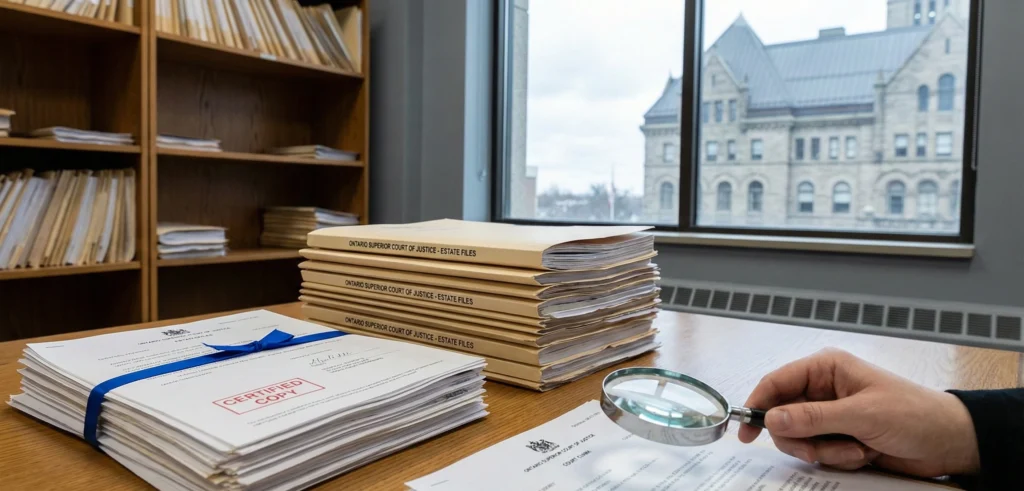
- Superior Court of Justice (Estates Office)
- Ontario court archives (for older files)
- Some documents are digitized, but many are still paper-only
Each courthouse follows its own retrieval timeline depending on how far back the file goes.
Select Serve and File provides probate search Ontario services across all Ontario estate offices.
What Documents Can Be Retrieved from a Probate File?
A professional probate search can retrieve:
1. Certificate of Appointment of Estate Trustee (With or Without a Will)
The primary document authorizing the estate trustee.
2. Filed Will & Codicils
The original or court-filed copy of the will.
3. Estate Application Materials
- Form 74 series applications
- Affidavits
- Renunciations
- Consents
- Notices of objection
- Supporting schedules
4. Judge’s Endorsements & Orders
Including estate disputes, motions, caveats, and freezes.
5. Estate Notices & Filings
Notices to creditors, notices of application, and related materials.
6. Estate Accounting & Inventory
Where filed, these records show assets and liabilities.
7. Archived Estate Files
Older probate records from the 1980s–1990s are often stored offsite.
Select Serve and File retrieves all categories of probate search Ontario records, including certified copies.
How a Probate Search Works in Ontario (Step-by-Step)
Step 1: Intake & Information Verification
Professionals confirm:
- Deceased’s full legal name
- Date of birth
- Date of death
- Last known residence
- Approximate probate date
- Court location (if known)
If no file number exists, a full-name search is conducted.
Step 2: Probate Index Search (Name Search)
All probate offices maintain indexes that allow:
- Name search
- Year search
- Address verification
- Will filing review
This determines whether an estate exists and at which courthouse.
Step 3: Pulling the Probate File
If a file exists, the clerk retrieves:
- Full probate bundle
- Filed will
- Certificate of Appointment
- Support documents
If the file is stored off-site, retrieval may take 3–10 business days.
Step 4: Identifying and Extracting Specific Documents
Professionals look for:
- Will
- Estate certificate
- Orders
- Affidavits
- Application materials
- Notices
Files are often large; accuracy is crucial.
Step 5: Obtaining Certified or Non-Certified Copies
Depending on the purpose, clients may need:
- Certified true copies
- Copies with court seal
- Regular photocopies
Banks, real estate lawyers, and insurance companies typically require certified documents.
Select Serve and File retrieves certified copies and delivers them electronically or physically.
Step 6: Delivery of Documents
Clients receive:
- Scanned PDFs
- Couriered originals
- Combined retrieval + filing services if needed
Same-day delivery is often available for urgent matters.
Turnaround Times for Probate Search Ontario
Standard (Local File Available): 1–3 business days
Rush Service: Same day or 24 hours (if file is onsite)
Archived File Retrieval: 3–10 days, depending on storage location
Complex Estate Files: 5–12 days (large or litigated estates)
Select Serve and File offers a rush probate search Ontario across all major courts.
Common Reasons to Request a Probate Search
1. Real Estate Transactions: Property cannot be transferred until the estate trustee is confirmed.
2. Probate Verification for Banks: Banks require proof of executor authority.
3. Estate Litigation or Will Challenges: Lawyers need the full file.
4. Beneficiary Information Requests: Beneficiaries confirm whether probate has been granted.
5. Financial Institution Compliance: Used for account releases, investment transfers, and insurance payouts.
6. Avoiding Fraud: Verifies the legitimacy of individuals claiming to be estate trustees.
Cost Breakdown for Probate Search Ontario
Typical price ranges include:
1. Court Search Fee: $10–$20 (varies by location)
2. Document Retrieval Fee: $40–$95, depending on courthouse and urgency
3. Certified Copy Fee: $10–$25 per document
4. Archive Retrieval Fee: $35–$75 for off-site files
5. Rush Service Add-On: $25–$75 for same-day retrieval where possible
Select Serve and File provides clear, transparent pricing with no hidden fees, a major advantage for large estate law firms and financial institutions.
Why Work With Professionals for Probate Searches
Professionals provide:
- Faster retrieval
- Accurate file identification
- Certified copies
- Access to archived records
- Court filing support
- Province-wide coverage
- Reduced delays
Select Serve and File specializes in probate search Ontario and estate document retrieval for law firms, trust companies, and individuals.
Disclaimer
This article provides general information only and not legal advice. For estate-specific guidance, consult a lawyer or licensed paralegal.
Connect With Us Today
If you need a probate search Ontario or estate document retrieval, certified copies, wills, court records, or archived materials, Select Serve and File Process Server Inc. provides fast, accurate, and affordable support. Contact us today.
FAQ
1. What is a probate search Ontario used for?
To confirm whether an estate has been opened and obtain related court documents.
2. Can I retrieve a copy of the will?
Yes. Filed wills and codicils can be retrieved unless sealed by the court.
3. How long does a probate search take?
1–3 days for local files; up to 10 days for archived files.