
Regular vs Rush Process Serving in Ontario: Which One Do You Need? (2026 Guide)
Choosing between regular service and rush process serving is one of the most important decisions in the legal workflow. Whether you are a lawyer, paralegal, property manager, lender, corporate litigant, or private individual, the service speed you select will determine how quickly the case moves forward, and whether you meet crucial deadlines.
Select Serve and File Process Server Inc. completes both regular service and rush process serving across Ontario. We work with law firms, corporations, landlords, lenders, and individuals who need fast, reliable delivery of legal documents and same-day filing support. Our team offers competitive pricing, skip tracing, document retrieval, and affidavit commissioning with no hidden fees.
This guide breaks down the differences between regular service and rush process serving, the timelines involved, when to choose each option, and the risks of choosing the wrong service speed.
What Is Regular Process Serving?
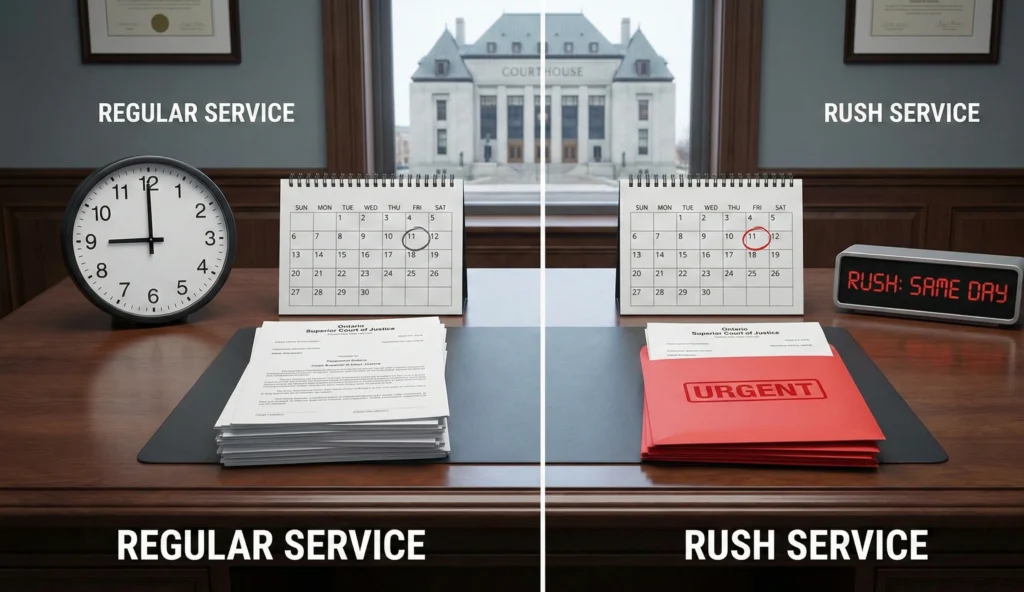
Regular service is the standard, non-urgent method for serving legal documents in Ontario.
Typical Timelines
1–5 business days depending on:
- Respondent’s availability
- Address type (house, condo, business)
- Geographic area
- Building access
- Document type
What’s Included
Regular service typically includes:
- Three attempts at varied times
- Attempted service at the address provided
- Preparation of Affidavit of Service
- Commissioning (if requested)
- Optional filing after service
This is the most cost-effective option when time permits.
What Is Rush Process Serving?
Rush process serving is expedited service used when documents must be served urgently to meet legal or court-imposed deadlines.
Typical Timelines
- Same-day service (completed within 4–8 hours)
- Immediate service (2–4 hours)
What’s Included in Rush Service
Rush service includes:
- Immediate dispatch of a process server
- Priority over all regular files
- Multiple rapid attempts
- Same-day affidavit preparation
- Same-day commissioning
- Same-day court filing (if required)
Select Serve and File offers full rush process serving support for urgent filings and last-minute deadlines.
Differences Between Regular vs Rush Process Serving
Below is a comparison table showing key distinctions.
| Feature | Regular Service | Rush Process Serving |
| Timeline | 1–5 business days | 2–8 hours |
| Priority | Standard | Highest priority |
| Court deadlines | Not guaranteed | Guaranteed (if feasible) |
| Attempts | Morning/evening/weekend | Immediate + repeated same-day |
| Fees | Lower | Higher |
| Affidavit | Next-day or scheduled | Same-day |
| Filing | Next-day | Same-day |
| Suitable for | Non-urgent matters | Immediate deadlines or court requirements |
Understanding these differences helps clients select the right option for their case.
When You Should Choose Regular Process Serving
Regular service is ideal when:
1. Deadlines Are Flexible
If the court or LTB does not require same-day service, regular service is sufficient.
2. Documents Are Non-Urgent
Examples:
- Demand letters
- Non-urgent Small Claims documents
- General notices
- Corporate documents without deadlines
3. You’re Managing Costs
Regular service is more budget-friendly.
4. The Respondent Is Easy to Reach
If service is expected to complete smoothly, regular service meets the goal.
When You Should Choose Rush Process Serving
Rush process serving is necessary when:
1. There Is a Court Deadline
Examples:
- Motion Records due today
- Case Conference Briefs due today
- Urgent Civil or Family filings
- Ex parte motions
- LTB applications requiring time-sensitive service
2. Court Filing Must Happen the Same Day
Rush service ensures both delivery and filing before cut-off times.
3. Respondent Is Known to Avoid Service
Immediate action improves success rates.
4. You Are Close to a Hearing Date
Many matters require proof of service by a strict deadline.
5. Service Outside Normal Hours Is Needed
Rush process serving can accommodate last-minute instructions.
How Rush Process Serving Works (Step-by-Step)
Step 1: Immediate Assignment
As soon as the file arrives, it is dispatched instantly to the nearest available server.
Step 2: First Attempt Within 1–2 Hours
Servers prioritize the address and aim to complete service as quickly as possible.
Step 3: Multiple Attempts Same Day
Unlike regular service, rush files receive:
- Back-to-back attempts
- Alternate location checks
- Workplace attempts when helpful
Step 4: Affidavit Preparation
Once completed, affidavits are:
- Prepared immediately
- Completed in detail
- Commissioned the same day
Step 5: Same-Day Filing (If Required)
Select Serve and File offers combined rush process serving + rush court filing for maximum efficiency.
Factors That Affect Time for Both Regular and Rush Service
1. Document Type
Some documents require personal service, which affects timelines.
2. Respondent Availability
Shift workers, commuters, or respondents who avoid service may require extra attempts.
3. Access Barriers
- Condo concierge restrictions
- Locked buildings
- Industrial complexes
- Multi-family homes
4. Address Accuracy
Incorrect or outdated addresses slow both regular and rush process serving. Skip tracing solves this issue.
5. Geographic Distance
Urban areas are faster than rural or remote townships.
How Much Do Regular and Rush Process Serving Cost?
Regular Service
$60–$95 on average depending on region.
Rush Process Serving
$120–$180 for same-day
$150–$225 for immediate 2–4 hour service
Select Serve and File offers no mileage fees, no hidden charges, and competitive flat-rate pricing, which keeps costs transparent.
Real Examples
Example 1: Same-Day Rush Service Completed in 3 Hours
A Toronto law firm required service before a 4:00 PM deadline. Our rush process serving team:
- Dispatched within 15 minutes
- Completed service at the respondent’s workplace
- Prepared and commissioned an affidavit
- Filed documents at 361 University Ave before the cut-off
Case moved forward with no delays.
Example 2: Regular Service Completed Smoothly
A property manager needed to serve a demand letter. Regular service was chosen:
- First attempt at 6 PM
- Personal service successful
- Affidavit prepared next day
No urgency meant regular service was the right choice.
Example 3: Avoiding Service Required Rush + Skip Tracing
A respondent had moved twice. We used rush service combined with skip tracing:
- Verified updated address
- Afternoon service attempt successful
- Filing completed the same day
This would have failed under regular timelines.
Choosing the Right Option: Decision Checklist
You should choose rush process serving if:
- You have a court deadline today
- Filing must occur today
- Respondent is known to avoid service
- Missed deadlines would harm your case
- The matter is urgent (family law, motions, LTB)
You should choose regular service if:
- No urgent timelines exist
- Cost is a consideration
- The respondent is cooperative or easy to reach
- You are preparing early in the process
Need Regular or Rush Process Services?
If you need regular or rush process serving in Ontario, Select Serve and File Process Server Inc. provides fast, accurate, and affordable solutions with full affidavit and court filing support. Contact us today.
FAQ
Regular takes 1–5 days; rush is same-day or within hours.
When court deadlines, urgency, or avoidance issues exist.
Yes, due to priority handling and immediate dispatch.