
Serving Family Court Documents in Ontario: Complete 2026 Guide
Knowing how to serve family court documents in Ontario is essential for anyone involved in a parenting dispute, support matter, divorce, motion to change, or any Family Court application. The Family Law Rules require strict compliance with service methods, timelines, affidavit requirements, and proof of delivery. If documents are served incorrectly, the court may reject your filing, adjourn your hearing, or request re-service, which causes delays and additional costs.
Select Serve and File Process Server Inc. assists lawyers, paralegals, self-represented individuals, parents, and spouses across the province with service, filing, skip tracing, and document preparation. Our team has extensive experience serving urgent Family Court materials, preparing Form 6B affidavits, updating Continuing Records, filing at 47 Sheppard, Brampton, Hamilton, and all Ontario courthouses, and supporting motions for substituted service when required.
This step-by-step guide explains how to properly serve family court documents in Ontario, including service types, timelines, rules, examples, and tips from professional process servers.
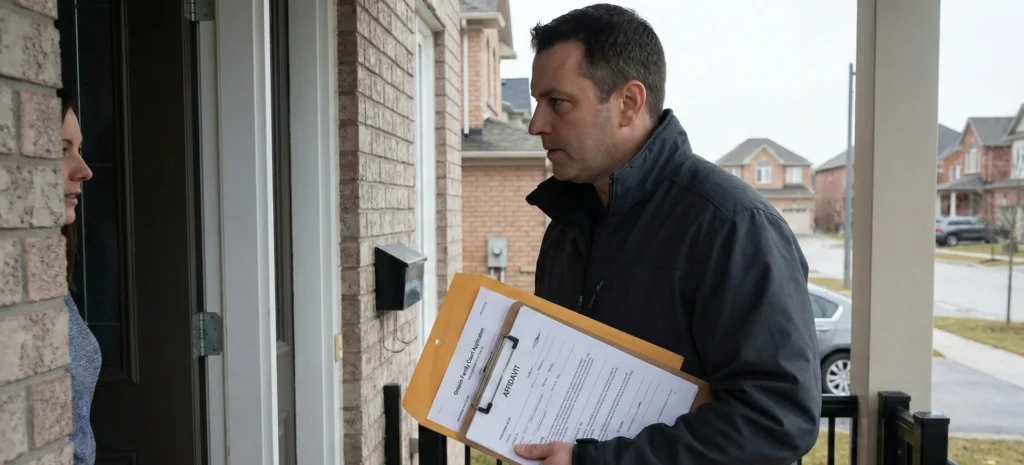
What Does It Mean to Serve Family Court Documents?
To serve family court documents means delivering the documents to the other party following the exact service method required by the Family Law Rules.
Documents must be served:
- on time
- using the correct method (personal, special service, regular service)
- with proper proof (Form 6B Affidavit of Service)
- before filing with the court
Failure to properly serve family court documents can delay your matter or result in the court refusing to proceed.
Types of Service in Family Court
Ontario’s Family Law Rules recognize three main service types when you serve family court documents.
1. Personal Service (Most Strict)
Required for:
- Applications (Form 8)
- Motions to Change (Form 15)
- Summons to Witness
- Certain urgent motions
- Initial documents in many parenting and support cases
How it works:
- Documents must be handed directly to the respondent
- Identity must be confirmed
- Server must record date, time, and description
Only an adult (not the applicant) can perform personal service.
2. Special Service (Less Strict)
Allowed for many documents after the first service.
Includes:
- Email (with consent)
- Courier
- Leaving documents with an adult in the home
- Delivering to the workplace (if appropriate)
Special service is often used for follow-up documents after the initial Application is served.
3. Regular Service (Least Strict)
Allowed for non-critical documents.
Includes:
- Email (with consent)
- Mail or courier
- Fax (rarely used now)
- Hand delivery to the lawyer of record
Regular service is usually used after both parties are already involved in the case.
Which Family Court Documents Require Personal Service?
The following must be personally served unless the court grants alternative service:
- Form 8 Application
- Motion to Change (Form 15)
- Summons to Witness
- Request for Information (in some cases)
- Certain urgent motions
- Documents served on non-parties (e.g., witnesses)
When serving these, a trained server must personally serve family court documents and complete a detailed affidavit.
Select Serve and File performs personal service for all Family Court documents across Ontario.
Serving Family Court Documents on Someone Who Avoids Service
Family law respondents frequently avoid service.
Common behaviours include:
- not answering the door
- hiding inside the home
- blocking communication
- moving residences
- using alternate entrances
- giving misleading information
In these cases, professionals use:
- multiple attempts
- varied timing (morning, evening, weekend)
- workplace service
- skip tracing
- contacting relatives (lawfully)
- occupancy verification
If service is still unsuccessful, an affidavit of attempt log supports a motion for substituted or alternative service.
How to Serve Family Court Documents When the Address Is Unknown
When the respondent’s address is unknown:
- Skip tracing is performed
- Social media and OSINT checks
- Court and government directory searches
- Workplace identification
- Contact with family or past references (lawfully)
- If still unsuccessful → motion for substituted service
Substituted service may allow:
- service by email
- service by text
- service by social media
- service on a family member
- posting at the last known address
Courts require solid evidence that you attempted to serve family court documents before granting alternative service.
Timeline Requirements for Serving Family Court Documents
Strict timelines apply.
Applications (Form 8): Must be served before filing.
Motion Materials: At least 4 days before the hearing (or more, depending on the rule).
Case Conference Briefs: Usually served and filed 7 days before the conference.
Motion to Change: Serve, file Form 6B, then the other party has 30 days to respond (60 days if outside Canada/USA).
Reply Materials: Usually due 4 days after receiving a response.
Professional servers ensure deadlines are met and affidavits are completed immediately.
How to Prepare for Serving Family Court Documents
Before attempting to serve family court documents, ensure:
- documents are complete
- signatures are included
- exhibits are attached and stamped
- page numbers are correct
- multiple copies are prepared
- backsheets are attached (Family Court requirement)
- your Continuing Record (if applicable) is updated
Select Serve and File prepares and organizes Family Court materials, ensuring no errors before service or filing.
How a Professional Server Serves Family Court Documents (Step-by-Step)
Step 1: File Review
Server reviews:
- document type
- required method (personal/special)
- deadlines
- any safety concerns
- address validation
Step 2: Strategic Attempt Planning
Servers choose optimal times:
- early mornings
- evenings
- weekends
- workplace attempts
Family law service often requires flexibility due to parenting schedules or work shifts.
Step 3: Completing Service
Once contact is made:
- identify the respondent
- explain the nature of documents (briefly)
- hand documents directly (for personal service)
- record the date, time, and description
Step 4: Prepare Form 6B Affidavit of Service
The server completes:
- exact method
- time and date
- description of respondent
- details of attempts
- documents served
An affidavit must be commissioned before filing.
Select Serve and File prepares and commissions Form 6B affidavits immediately after service.
Step 5: Filing the Documents
After service, the documents (and affidavit) must be filed:
- electronically via Family Submissions Online
- or in-person at the courthouse
Our team completes rush and regular court filings at Family Courts across Ontario.
Real Examples of Serving Family Court Documents
Example 1: Serving an Application (Form 8) on Avoiding Respondent
A spouse in Mississauga refused to answer the door.
Our team:
- Attempted service at 3 different times
- Verified occupancy by neighbour confirmation
- Identified the respondent’s workplace
- Completed personal service at the workplace
- Filed Form 6B the same day
This avoided a motion for alternative service.
Example 2: Urgent Motion Served Within 3 Hours
A Toronto lawyer required urgent motion documents served before the court closure.
We:
- Dispatched server immediately
- Completed personal service downtown
- Commissioned Form 6B affidavit
- Filed at 47 Sheppard before the deadline
The client met the court’s same-day requirement.
Common Mistakes When Serving Family Court Documents
- Serving by email without consent
- Failing to personally serve mandatory documents
- Using outdated addresses
- Incomplete affidavits
- Not attaching exhibits
- Serving too close to the deadline
- Filing before service is complete
- Attempting service yourself (not allowed for personal service)
Professionals ensure none of these errors occur.
Why Hire a Professional Process Server for Family Court Matters
Professionals:
- understand Family Law Rules
- know which method of service applies
- prepare accurate affidavits
- complete same-day rush service
- perform skip tracing
- file documents with the court
- reduce risk of rejection
- document attempts for contested matters
Select Serve and File provides complete support for serving family court documents across Ontario.
If you need to serve family court documents quickly, professionally, and in compliance with Ontario’s Family Law Rules, Select Serve and File Process Server Inc. provides personal service, skip tracing, affidavits, and court filing across the province. Contact us today.
Disclaimer
This article provides general legal information only and is not legal advice. Consult a licensed lawyer or paralegal for specific guidance.
FAQs
Anyone over 18 who is not a party to the case (for personal service).
Yes. They must be personally served unless the court orders otherwise.
Only if the other party provides written consent or the court allows alternative service.
Skip tracing, multiple attempts, workplace service, or a motion for substituted service.
Yes. It is required for filing.