
How to Serve a Notice of Examination in Ontario
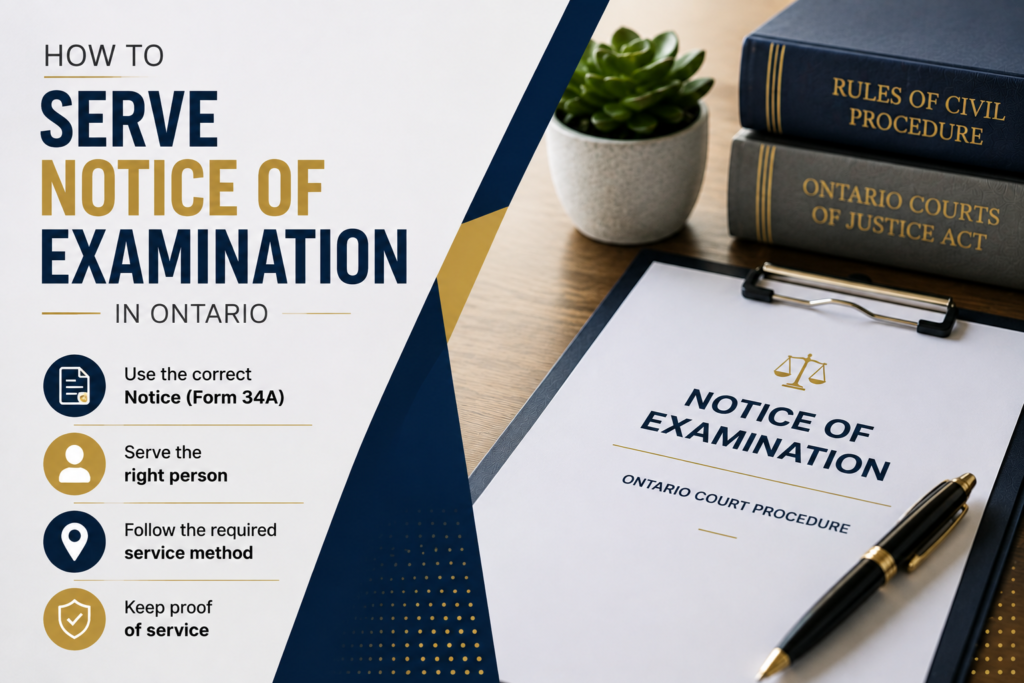
To serve notice of examination Ontario, you must first confirm the correct notice, the person being examined, and the applicable service method. In Ontario, Form 34A is the Notice of Examination used in several examination settings. The required method depends on who is being examined and the type of examination.
What you need before you start
Before you serve notice of examination Ontario, review the court file and the purpose of the examination.
Confirm the court file number, names of the parties, and the identity of the person being examined. You should also confirm the examination date, time, and location.
Ontario’s Rules of Civil Procedure identify Form 34A as the Notice of Examination. Rule 34.04 sets out different service requirements depending on who is being examined.
You can review the current Ontario Rules of Civil Procedure, Rule 60 before arranging enforcement-related service. For general oral examinations, Rule 34 also applies.
The Ontario Court Forms website currently lists Form 34A as the Notice of Examination. The listed version date is May 3, 2021.
You should also identify whether the person being examined is a party, a person examined on behalf of a party, or another person.
That distinction matters.
The service method can change based on that status.
The steps in order
1. Confirm the examination
Start by confirming why the examination is taking place.
An examination may relate to discovery, enforcement, or another court process.
If you are dealing with a judgment debtor and enforcement, confirm that the examination is properly arranged before requesting service.
Do not assume that every examination uses the same service instructions.
2. Check Form 34A
Review the Notice of Examination carefully.
Form 34A identifies the examination and provides information about the person being examined and the arrangements for attendance.
Check the spelling of all names.
Check the court file number.
Check the date, time, and location.
Also check any documents that must be produced.
The current Ontario Court Forms website identifies Form 34A as the Notice of Examination.
3. Identify the person being examined
Next, determine exactly who must receive the notice.
If the person is a party represented by a lawyer, Rule 34.04 provides for service on the lawyer of record.
If the party acts in person, the rule provides for service on the party personally or by an alternative to personal service.
Different rules apply when someone is examined on behalf of or in place of a party.
For that situation, Rule 34.04 provides for personal service on the person being examined.
4. Check the service address
Confirm the correct address before sending the documents for service.
An old address can create unnecessary problems.
If the person has moved, further investigation may be needed.
Make sure the address matches the current information in your instructions.
Where personal service is required, the process server needs accurate information to locate the recipient.
5. Prepare the service package
Assemble the complete service package.
Include the Notice of Examination and any documents that must accompany it.
Do not remove pages simply because they appear repetitive.
The process server should receive clear instructions about the recipient and the examination.
If additional documents must be served, identify them clearly.
This helps avoid confusion during the service attempt.
6. Arrange notice of examination service
Once the documents and instructions are confirmed, arrange notice of examination service.
A professional process server can attempt delivery at the address provided.
The process server should follow the service instructions that apply to the document.
If personal service is required, the server should make the required attempt to deliver the documents directly to the recipient.
Select Serve and File Process Server Inc. provides professional document delivery and service support in Ontario.
7. Document the attempt
Every service attempt should be recorded.
The record can include the date, time, address, recipient details, and what happened during the attempt.
If the recipient is not found, record the result accurately.
Do not describe an unsuccessful attempt as completed service.
Further attempts may be appropriate depending on the circumstances.
8. Complete the proof of service
After successful service, retain the appropriate proof.
Ontario’s civil procedure forms include Form 16B, Affidavit of Service. The Ontario Court Forms website currently lists this form among the Rules of Civil Procedure forms.
The exact proof required can depend on the proceeding and document.
How to prove it was done properly
Good records are central to serve notice of examination Ontario work.
Keep the served documents, service instructions, service report, and proof of service together.
Your records should show what was served, who received it, where service occurred, and when it occurred.
The proof should match the documents that were actually delivered.
Check names and dates carefully before filing or relying on the proof.
The court may need to determine whether service was completed correctly.
A clear service record makes that history easier to understand.
For an examination involving a judgment debtor, the service record can also become part of the broader enforcement file.
Do not assume that sending the document by ordinary mail is enough.
The applicable rule may require a different method.
For example, Rule 34.04 distinguishes between service on a represented party, a self-represented party, and a person examined on behalf of a party.
Mistakes that cause problems
Using the wrong form
- The Ontario Court Forms website currently identifies Form 34A as the Notice of Examination.
- Check the current version before preparing documents.
Serving the wrong person
- The correct recipient depends on the examination.
- A represented party and a self-represented party can have different service requirements.
Using the wrong service method
- Do not assume that every examination notice can be served in the same way.
- Rule 34.04 sets out different requirements for different circumstances.
Using an old address
- An outdated address can lead to failed attempts.
- Confirm the recipient’s current information before sending documents.
Leaving out part of the package
- The server should receive the complete documents that must be delivered.
- Missing pages can create uncertainty about what was actually served.
Forgetting the proof
- Service is not complete from an administrative standpoint simply because someone says the document was delivered.
- Keep the appropriate proof and service records.
Confusing attendance requirements
- The rules also address notice of the time and place of an examination. Rule 34.05 contains notice requirements for persons being examined and other parties.
When to use a professional
You can manage some administrative steps yourself.
However, professional support can help when an examination notice must be served correctly and documented.
Select Serve and File Process Server Inc. has served Ontario since 2005. We provide process serving, court filing, document retrieval, and related administrative support.
We are a process serving company, not a law firm. We do not provide legal advice or decide whether an examination should take place.
If you need advice about the purpose of an examination, the questions to ask, attendance requirements, or the legal effect of the examination, consult a licensed Ontario lawyer or paralegal.
The key to serve notice of examination Ontario work is accuracy. Confirm the correct notice, recipient, service method, address, and proof before treating service as complete.
Need documents served in Ontario? Request a quote.
This article provides general information about process serving and court procedure in Ontario. It is not legal advice and does not create a solicitor client relationship. Court rules and procedures change. Confirm current requirements with the relevant court or consult a licensed Ontario lawyer or paralegal before acting.
Deadlines and service requirements vary by document type, court and proceeding. Missing a deadline can result in your matter being delayed or dismissed. Verify all timelines against the applicable rules and the practice direction of the court or tribunal where your matter is filed.