
What Is a Writ of Delivery and When Is It Used?
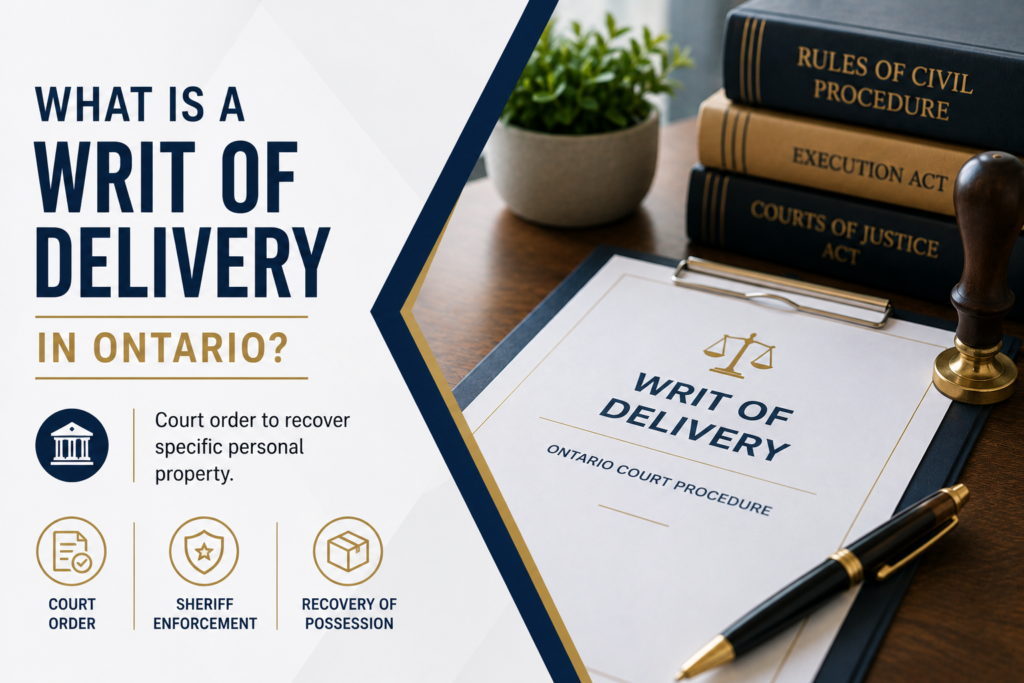
A writ of delivery Ontario is a court enforcement document used to help recover specific personal property when a court has ordered its delivery or recovery. It gives the sheriff authority to enforce the order according to the applicable court procedure. The process is different from ordinary debt collection.
Why it matters in Ontario
A court order does not always mean that property will be returned voluntarily.
If you have obtained an order for the recovery of specific goods, you may need an enforcement process to obtain possession.
This is where a writ of delivery Ontario can become relevant.
Rule 60 of Ontario’s Rules of Civil Procedure includes enforcement provisions for orders involving the recovery of personal property. Rule 60.04 specifically addresses enforcement of an order for recovery of personal property.
The Ontario Court Forms website also lists Form 60D, Writ of Delivery, under the Rules of Civil Procedure forms.
You can review the current Ontario Rules of Civil Procedure, Rule 60 before taking action.
You can also check the Ontario Court Forms website for the current form and related documents. Ontario Court Services advises users to verify current information before acting.
A writ of delivery is generally connected with specific goods.
This means the property being recovered must be identifiable.
It is not simply a general demand for money.
For example, a court order may require the return of particular personal property. If the order is not followed, an enforcement process may be available.
The exact procedure depends on the order and the court proceeding.
What it involves in practice
Understanding the writ of delivery explained
A writ of delivery explained in simple terms is an enforcement document connected with an order for the recovery of personal property.
The writ is not the original court order.
Instead, it is part of the enforcement process that follows the court’s order.
The current Ontario court forms identify Form 60D as a Writ of Delivery.
The process can involve the sheriff because the sheriff is responsible for enforcing certain writs issued by the court.
The exact steps depend on the order and applicable rules.
Reviewing the court order
Before dealing with a writ of delivery Ontario, start with the order.
Read the order carefully.
Confirm what property must be delivered or recovered.
Check the names of the parties and the court file number.
You should also confirm whether the order is final, entered, and enforceable.
Do not assume that an informal agreement or correspondence can replace the court order required for enforcement.
Identifying the property
The property should be clearly identifiable.
The more precise the description, the easier it may be to understand what the writ concerns.
Descriptions should match the relevant court documents.
Avoid relying on vague descriptions if the order contains more specific information.
The purpose of the process is recovery of possession, not a general search for property.
Preparing the writ
Once the applicable requirements have been confirmed, the required writ can be prepared.
Ontario Court Services currently lists Form 60D as the Writ of Delivery.
The form should be completed using information consistent with the court record.
Check names, addresses, court file information, and the description of the property.
Filing and enforcement
The writ must be handled according to the applicable court process.
Depending on the matter, the document may then be directed to the sheriff for enforcement.
The sheriff’s role is different from that of a process server.
A process server delivers documents.
The sheriff may have authority to enforce certain court writs.
Do not assume that serving a copy of the writ on someone completes the enforcement process.
Understanding sheriff involvement
A sheriff delivery writ can involve the sheriff taking steps to enforce the court’s order.
The exact enforcement procedure can depend on the type of property and the terms of the order.
The sheriff may have specific requirements for receiving and acting on enforcement documents.
Arranging document service
Although the sheriff may handle enforcement, other documents connected with the matter may still require service.
This can include court documents that must be delivered to another party.
Service requirements depend on the document and proceeding.
Where people commonly go wrong
Confusing a writ with a court order
The court order establishes what must happen.
The writ is an enforcement document connected with carrying out that order.
They are not interchangeable.
Describing the property incorrectly
A vague or inconsistent property description can create practical problems.
Check the description against the court order before preparing enforcement documents.
Assuming every property dispute uses a writ of delivery
A writ of delivery is not a general remedy for every property dispute.
The available enforcement process depends on the type of order and circumstances.
Legal advice may be needed before choosing an enforcement option.
Using an outdated form
Court forms can change.
Ontario Court Services warns users to check current versions before acting.
Always review the current forms before preparing documents.
Confusing service with enforcement
A process server delivers documents.
The sheriff’s enforcement role is separate.
Do not assume that having a document served means the property has been recovered.
Failing to keep records
Keep copies of the order, writ, filing records, correspondence, service reports, and other relevant documents.
A clear record helps you track what has happened.
When to use a professional
You may be able to handle some administrative steps yourself.
However, professional support can help when documents must be served, filed, retrieved, or tracked.
Select Serve and File Process Server Inc. has served Ontario since 2005. We provide process serving, court filing, document retrieval, and related administrative support.
We are a process serving company, not a law firm. We do not provide legal advice or determine whether a writ of delivery is appropriate.
If you need advice about whether a writ of delivery Ontario is the correct enforcement method, speak with a licensed Ontario lawyer or paralegal.
The key to a writ of delivery Ontario matter is accuracy. Confirm the court order, identify the property clearly, check the current form, follow the applicable filing process, and keep complete records.
Need documents served in Ontario? Request a quote.
This article provides general information about process serving and court procedure in Ontario. It is not legal advice and does not create a solicitor client relationship. Court rules and procedures change. Confirm current requirements with the relevant court or consult a licensed Ontario lawyer or paralegal before acting.
Deadlines and service requirements vary by document type, court and proceeding. Missing a deadline can result in your matter being delayed or dismissed. Verify all timelines against the applicable rules and the practice direction of the court or tribunal where your matter is filed.