
Court Filing Ontario: Continuing Record & Endorsements Explained (2026 Guide)
Court filing Ontario requirements can vary by the type of case and court. In Family Court matters, a Continuing Record keeps filed documents organized, while endorsements record directions or decisions made by a judge. Knowing how these records work helps you prepare documents for filing and keep the court file properly updated.
1. Identify the Correct Court Filing Ontario Requirements
Start by confirming what type of case you have and which court is handling it.
Do not assume every Ontario court uses a Continuing Record in the same way. The official Family Law Rules contain specific requirements for Continuing Records, while civil matters follow different procedures.
For Family Court matters, the Ontario government explains that most documents filed in a case must be included in the Continuing Record.
For civil matters, review the Ontario Rules of Civil Procedure (O. Reg. 194) before preparing your filing.
If you are unsure which procedure applies, ask the court or a licensed Ontario lawyer or paralegal.
2. Prepare the Continuing Record for Court Filing Ontario
Create or update the Continuing Record according to the requirements that apply to your case.
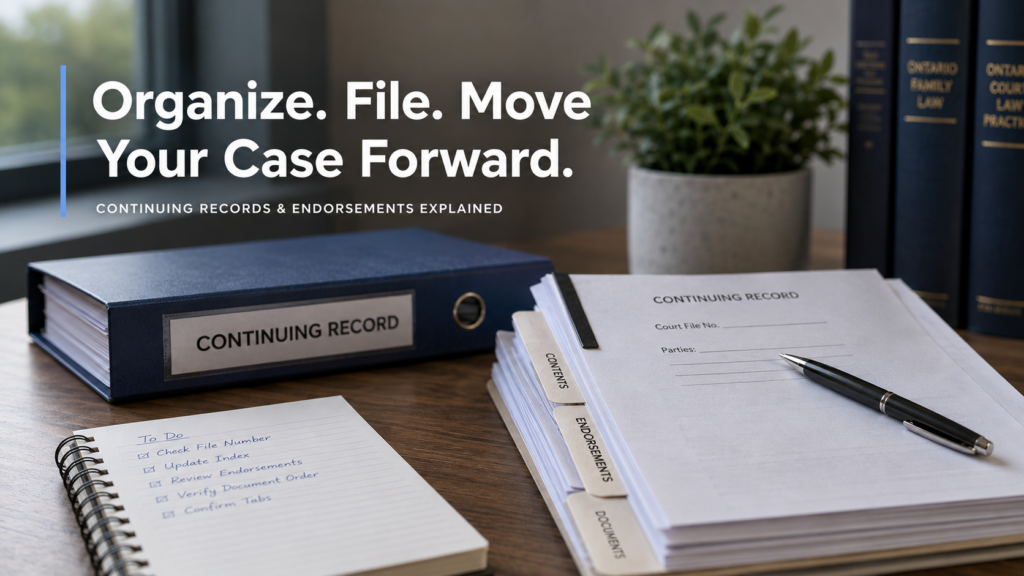
In Family Court, the Continuing Record generally includes a contents section, endorsements section, and documents section. The table of contents must be updated when documents are filed. The Family Law Rules also require documents in the record to follow specified organization and formatting requirements.
For court filing Ontario work, check:
- The correct court file number
- The correct parties
- The current table of contents
- The correct document order
- Required tabs or references
- The applicable paper or electronic format
Do not copy a filing structure from another case without checking the current requirements.
3. Add Endorsements and Orders Correctly
Understand what an endorsement means before adding it to the record.
An endorsement is written direction from a judge about what must happen in a case. In Family Court, endorsements are kept in the endorsement section of the Continuing Record. Court file copies of orders are also placed in that section under the applicable rules.
When handling court filing Ontario documents, check whether you have:
- A new endorsement
- A court order
- Written reasons
- An updated table of contents
- New documents that must be added
Do not remove documents from a Continuing Record unless the applicable rules or a court order permit it.
4. Check the File Before Court Filing Ontario Submission
Review the complete package before submitting it.
Check the file number, party names, document dates, document sequence, tabs, table of contents, endorsements, orders, and required signatures or commissioning.
[CONFIRM] From operating experience, one of the problems that most often causes extra work is an outdated table of contents or placing a new document in the wrong section. Confirm this observation against your current filing workflow.
Protect personal information during document handling as well. The Office of the Privacy Commissioner of Canada provides guidance on protecting personal information and explains privacy responsibilities for organizations.
5. Submit and Track the Court Filing Ontario Process
Submit the documents using the filing method accepted for your matter.
Depending on the court and document, this may involve electronic filing or filing through the court office. Keep confirmation of submission and watch for any request from the court for corrections or additional material.
Court filing Ontario work should always be checked against current court instructions because procedures can change.
Select Serve and File Process Server Inc. has served Ontario since 2005. The company assists with Continuing Record preparation, document retrieval, court filing, endorsement organization, and related filing services.
Need documents served in Ontario? Request a quote or call (647) 568-5700.
“This article provides general information about process serving and court procedure in Ontario. It is not legal advice and does not create a solicitor client relationship. Court rules and procedures change. Confirm current requirements with the relevant court or consult a licensed Ontario lawyer or paralegal before acting.”