
Who Can Legally Serve Documents in Ontario?
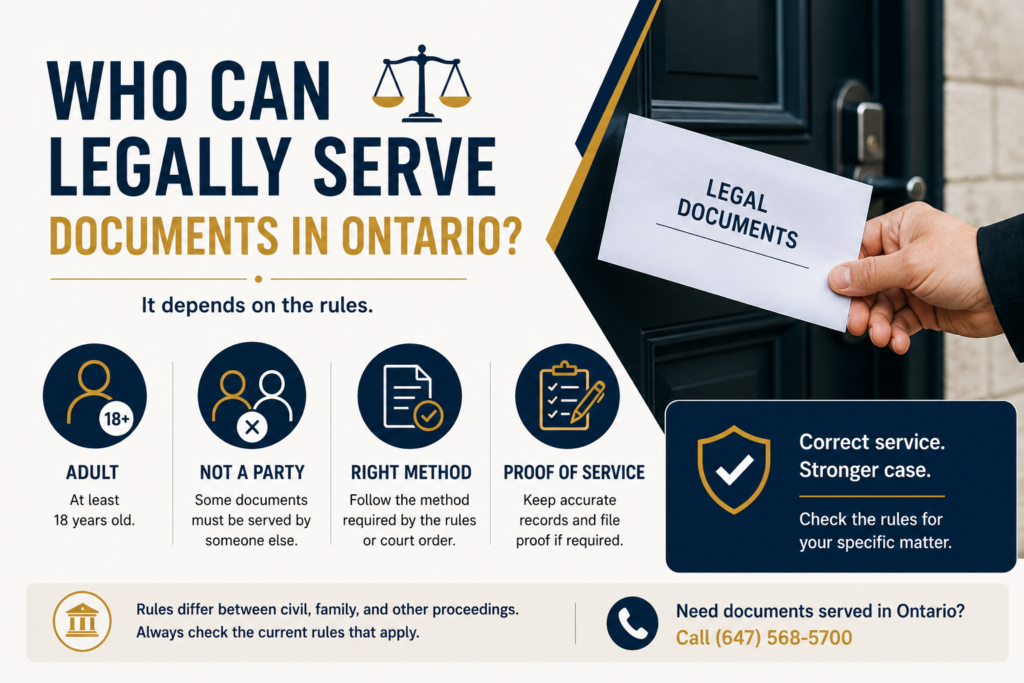
Who can serve legal documents Ontario? In many Ontario matters, the answer depends on the document and the rules that apply. Some documents may be served by an adult who meets the requirements. Other documents must be served by someone other than the party. The method of service also matters.
What the rules say
If you are asking who can serve legal documents Ontario, start with the rules for your type of case. There is no single rule that applies to every legal document.
For civil proceedings governed by the Ontario Rules of Civil Procedure, Rule 16 sets out different methods of service. It explains when personal service is required and how documents can be served in other circumstances.
The Ontario Rules of Civil Procedure (O. Reg. 194) are the main source for civil matters covered by those rules.
The rules focus on how the document must be served, rather than simply saying that anyone can deliver it. For personal service, the rules describe how the document is to be left with the individual or another appropriate recipient.
Family matters follow a separate framework. Under the Family Law Rules, a person serving documents must generally be at least 18 years of age. Certain documents requiring special service must be served by a person other than the party required to serve them.
The Family Law Rules (O. Reg. 114/99) provide the current framework for service in family proceedings.
So, who can serve court papers? It depends on the proceeding, the document, and the required method.
For some family documents, an adult friend, family member, or professional process server may be able to serve the documents. Ontario’s family court guide specifically states that certain documents cannot be personally served by the party and must instead be served by someone else who is at least 18.
The Superior Court of Justice also publishes practice directions that can affect court procedures. You can check the Superior Court of Justice practice directions for current court-specific and province-wide directions.
When it applies and when it does not
A common question is, can anyone serve documents? Not always.
- An independent adult may be suitable for some service assignments. However, simply being over 18 does not automatically make every person eligible to serve every document.
- In family proceedings, the rules expressly require a person serving documents to be at least 18. They also restrict the party from serving certain documents that require special service.
- This means an independent adult can sometimes serve documents where the applicable rules permit it. A person does not necessarily need to be a professional process server.
However, the person serving the documents may need to be not a party to the proceeding. This is particularly relevant where the rules require special service by someone other than the party.
A disqualified server is someone who cannot properly perform the service required for that particular document or proceeding. The reason may relate to the person’s role, age, relationship to the case, or another rule that applies.
Civil procedure works differently in some respects. The Rules of Civil Procedure identify different methods and recipients for service. For example, personal service of an individual involves leaving the document with that individual, while service on a corporation can involve an officer, director, agent, or appropriate person at its place of business.
This is why the question who can serve legal documents Ontario cannot be answered by age alone.
You should first identify the type of proceeding. Then check whether the document requires personal service, special service, regular service, or another permitted method.
How to comply correctly
The safest approach is to work through the service requirements before attempting delivery.
- First, identify the proceeding. Determine whether your matter is civil, family, or another type of proceeding.
- Second, identify the document. Different documents can have different service requirements.
- Third, check who may serve it. Look for any age restriction or requirement that the server be not a party.
- Fourth, confirm the method. Being an eligible server does not make every method of delivery valid.
- Fifth, keep accurate records. Record the date, time, location, recipient, documents delivered, and method used. These details can become important when proving service.
- Sixth, prepare proof of service correctly. Depending on the proceeding, you may need an affidavit or another form of proof.
These steps are a practical way to understand the serving papers rules Ontario litigants and legal professionals need to consider.
[CONFIRM] From practical operating experience, one of the most common problems is choosing the server before checking the service requirement. The person may be available and willing, but the document may require someone other than the party to perform the service.
Remember that a process server is not a lawyer. A professional can handle the service assignment and document what occurred, but cannot advise you on the legal strategy for your case.
What happens if you get it wrong
If the wrong person serves a document, or the wrong method is used, questions can arise about whether service was valid.
The consequences depend on the proceeding and the specific service requirement. The court may need to determine whether the service complied with the applicable rules or whether another step is required.
Do not assume that a failed service attempt automatically ends your case. Do not assume that an incorrect attempt is automatically accepted either.
If personal service is difficult or cannot be completed, there may be procedures for requesting another method. The available option depends on the circumstances and the rules that apply.
If you are still asking who can serve legal documents Ontario, the practical answer is this: check the rules for your specific proceeding and document before choosing the server. An adult may qualify in one situation but not another.
Need documents served in Ontario? Request a quote or call (647) 568-5700.
“This article provides general information about process serving and court procedure in Ontario. It is not legal advice and does not create a solicitor client relationship. Court rules and procedures change. Confirm current requirements with the relevant court or consult a licensed Ontario lawyer or paralegal before acting.”