
Process Serving for Collection Agencies
Process serving for collection agencies involves delivering legal documents to debtors and other recipients while creating a clear record of each service attempt. For agencies handling judgment enforcement, garnishment, or related court matters, reliable service helps keep files moving and provides documentation for the next procedural step.
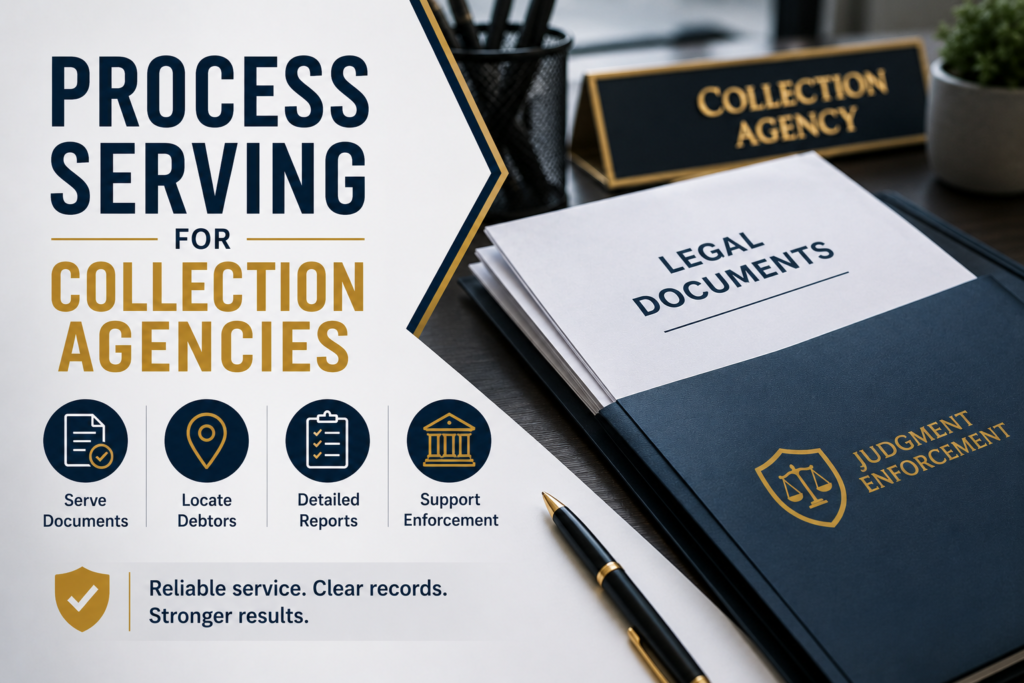
What this group typically needs
Collection agencies often manage multiple files at the same time. Their process serving needs can differ from those of an individual litigant because they may need consistent handling across many assignments.
Process serving for collection agencies can involve serving court documents connected with judgments, enforcement steps, garnishment proceedings, or other collection-related matters.
A collections process server may be asked to serve a debtor at a known address, workplace, or another location where service is permitted. The exact method depends on the document and the rules governing the proceeding.
The first priority is usually accurate information. The agency should provide the correct name, available address details, copies of the documents, and any instructions relevant to the assignment.
The service provider then needs to understand what has been requested. Clear instructions can reduce confusion and help prevent unnecessary delays.
Collection agencies may also need serving debtors documented consistently. A service report can record whether documents were successfully delivered or whether an attempt was unsuccessful.
The Ontario Rules of Civil Procedure provide rules for civil proceedings and enforcement. Rule 60 covers several judgment enforcement procedures. You can review the Ontario Rules of Civil Procedure, Rule 60 for the current requirements.
The Ontario Court Forms website provides current court forms and related materials. These resources can help agencies identify the documents associated with particular court processes.
A collection agency may also need skip tracing when a debtor cannot be located using the information already available. Locating the person and serving the documents are separate tasks, but they can work together in a collection workflow.
If a judgment has already been obtained, the agency may also be handling judgment enforcement. Service can form one part of that larger process.
For general information, see how to enforce a small claims court judgment in ontario.
How the process works for them
Process serving for collection agencies works best when the service provider receives complete information at the start.
The agency provides the documents and instructions. The provider reviews the assignment and determines how the requested service should be handled based on the information supplied.
The server then attempts service using the applicable method.
If the debtor is available and service is completed, the server records the relevant details. This can include the date, time, location, recipient, documents delivered, and method used.
If the debtor is not available, the attempt should be recorded. Additional attempts may be appropriate depending on the instructions, available information, and requirements of the matter.
This is where a clear volume workflow can help collection agencies. Multiple files are easier to manage when assignments, attempts, outcomes, and follow-up information are recorded consistently.
A useful reporting system should make it easy to see which files were completed, which remain active, and which require additional information.
The provider should also distinguish between a completed service and an unsuccessful attempt. An attendance at an address does not automatically mean that legal service was completed.
Depending on the matter, proof of service may also be required. The type of proof depends on the proceeding and applicable rules.
Collection agencies should therefore avoid treating service reports as a substitute for legal advice. The process server can report factual results, but the agency must determine what those results mean for its legal or collection process.
The Ministry of the Attorney General provides official information about Ontario’s courts and justice system through its Ministry of the Attorney General resources.
If a debtor has moved or cannot be located, additional steps may be needed before service can continue. Read what happens when a judgment debtor cannot be found for general information about locating a judgment debtor.
What to look for in a provider
When choosing a provider for process serving for collection agencies, look beyond whether the company can deliver documents.
First, consider whether the provider can handle multiple assignments in an organized way.
Second, ask how service attempts are recorded. Clear records should identify the outcome of each attempt and provide useful information for the agency’s file.
Third, check whether the provider can handle different types of assignments. Collection agencies may need process serving, locate searches, skip tracing, court filing, or document retrieval.
Fourth, consider communication. Your team should be able to understand the current status of an assignment without having to reconstruct the file.
Fifth, ask how unsuccessful service is reported. A useful report should explain what happened and identify information that may help with the next step.
[CONFIRM] From practical operating experience, one of the most common problems in agency work is incomplete assignment information. Missing addresses, unclear recipient names, or incomplete documents can slow the first attempt and create avoidable follow-up.
A provider should also understand that collection agency files may require repeatable processes. Consistency matters when several people within an agency are tracking active assignments.
Select Serve and File Process Server Inc has served Ontario since 2005. The company provides process serving, skip tracing, locate searches, court filing, and related services for collection agencies, law firms, financial institutions, corporations, and individuals.
A process serving company is not a law firm. It can perform the requested service and report factual results, but it cannot advise you on the legal strategy for a collection matter.
Common issues and how to avoid them
Process serving for collection agencies can become difficult when information is outdated.
A debtor may have moved since the original court documents were prepared. An old address can result in unsuccessful attempts and wasted time. If the available address is no longer useful, consider whether an appropriate locate search or skip trace is needed.
Another common issue is unclear instructions. If the agency needs a specific document served or has information about the recipient, that information should be provided clearly.
A further problem is poor follow-up tracking. With multiple files, it can be difficult to remember which assignments need another attempt. A consistent reporting process can help. Each file should show the current status, latest attempt, and any information received from the server.
Agencies should also distinguish between service and enforcement. Serving a document does not itself guarantee recovery of a judgment.
The provider should report what happened without making assumptions about the legal outcome.
Finally, make sure current rules and forms are checked for the specific proceeding. Requirements can change, and different documents may require different service methods. [VERIFY]
The best process serving for collection agencies workflow is clear, repeatable, and properly documented. Good information at the start helps the server work efficiently, while clear reporting helps the agency decide what to do next.
Need documents served in Ontario? Request a quote or call (647) 568-5700.
“This article provides general information about process serving and court procedure in Ontario. It is not legal advice and does not create a solicitor client relationship. Court rules and procedures change. Confirm current requirements with the relevant court or consult a licensed Ontario lawyer or paralegal before acting.”
“Deadlines and service requirements vary by document type, court and proceeding. Missing a deadline can result in your matter being delayed or dismissed. Verify all timelines against the applicable rules and the practice direction of the court or tribunal where your matter is filed.”