
Ontario Bankruptcy Searches: What They Reveal and Why They Matter
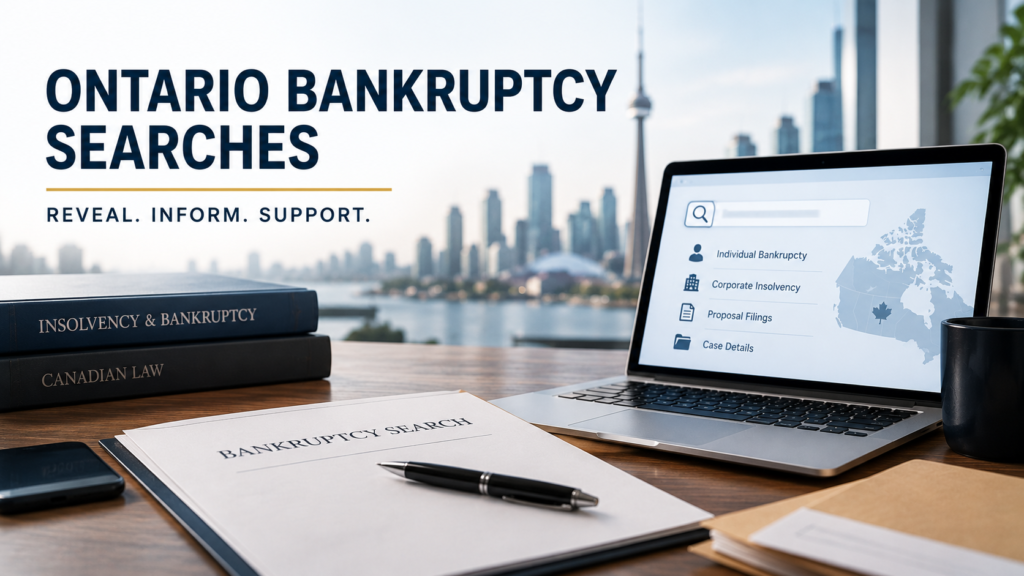
An Ontario bankruptcy search can help confirm whether a person or business has an insolvency filing that may affect litigation, enforcement, or due diligence. Because bankruptcy is governed federally, searches can cover filings across Canada. The results should be current and interpreted alongside the specific circumstances of the matter.
1. Identify Who You Need to Search
Start by gathering accurate information about the person or business.
For an individual, useful identifiers may include:
- Full legal name
- Known former names or aliases
- Date of birth, where lawfully available
- Last known address
For a corporation, collect:
- Exact legal name
- Corporate number
- Previous business names, where relevant
Accurate identification is essential for a bankruptcy search Ontario because similar names can produce misleading results.
2. Conduct the Bankruptcy Search Ontario
Bankruptcy and insolvency records are maintained under Canada’s federal insolvency system.
The federal Office of the Superintendent of Bankruptcy’s insolvency records and search services can be used to search insolvency information.
An Ontario bankruptcy search may identify proceedings such as:
- Bankruptcy
- Consumer proposals
- Division I proposals
- Notices of intention to file a proposal
- Other insolvency proceedings
The search is not limited to Ontario simply because the client or proceeding is in Ontario.
3. Review the Status of the Filing
Finding an insolvency record is only the beginning.
Review the available information to determine the status of the proceeding. Depending on the record, this may include:
- Filing information
- Insolvency type
- Trustee information
- Estate number
- Filing jurisdiction
- Current status
- Discharge information, where applicable
A bankruptcy search Ontario should be treated as a snapshot based on the information available when the search is conducted.
If the matter is active, confirm current information before taking further action.
4. Understand What a Bankruptcy Search Ontario Can Reveal
An Ontario bankruptcy search can help establish whether an individual or business appears in Canada’s insolvency records.
This can be useful for:
- Litigation due diligence
- Enforcement planning
- Creditor research
- Estate administration
- Corporate due diligence
- Financial risk assessment
However, the search does not provide a complete picture of someone’s financial position.
It generally should not be treated as a substitute for detailed financial, court, or trustee records.
5. Know What the Search Does Not Reveal
A bankruptcy search Ontario does not automatically provide every detail about an individual’s or company’s finances.
For example, a basic search should not be treated as a complete source for:
- Private banking information
- Detailed current financial activity
- Confidential account information
- Complete asset information
- Every creditor communication
Additional records may be required depending on the purpose of the investigation.
6. Use the Results Before Enforcement or Litigation
An Ontario bankruptcy search can be particularly useful before taking enforcement-related steps.
An insolvency proceeding may affect how a creditor can proceed against a debtor. Bankruptcy can also affect existing litigation and enforcement activity.
Do not assume that a search result automatically tells you what legal action is permitted.
If the search identifies an active insolvency proceeding, confirm the appropriate next step with the relevant trustee, court, or a licensed Ontario lawyer or paralegal.
7. Cross-Check the Bankruptcy Search Ontario Results
A bankruptcy search Ontario is often more useful when combined with other due diligence.
Depending on the matter, professionals may also conduct:
- Corporate searches
- Litigation searches
- Writ searches
- Locate searches
- Property-related searches
- Document retrieval
Cross-checking can help identify inconsistencies and provide a broader picture of the subject.
[CONFIRM] From practical legal support work, clients often benefit from checking insolvency status before proceeding with enforcement-related assignments. Confirm this observation against your team’s current operating experience.
8. Keep the Search Current
Do not rely indefinitely on an old bankruptcy search Ontario result.
An insolvency status can change. A proposal may be completed, a bankruptcy may reach another stage, or a new proceeding may appear.
If the result will be used for an important decision, consider obtaining a current search rather than relying on an older report.
Why Select Serve and File?
Select Serve and File Process Server Inc. provides bankruptcy and insolvency searches as part of broader legal support services, including process serving, court filing, skip tracing, locate searches, and document retrieval.
The company has served Ontario since 2005.
A professional bankruptcy search Ontario can help provide current insolvency information for litigation, enforcement, corporate due diligence, and other legitimate purposes. The search itself does not provide legal advice about what you should do with the result.
Need documents served in Ontario? Request a quote or call (647) 568-5700.
“This article provides general information about process serving and court procedure in Ontario. It is not legal advice and does not create a solicitor client relationship. Court rules and procedures change. Confirm current requirements with the relevant court or consult a licensed Ontario lawyer or paralegal before acting.”