
Due Diligence Searches to Run Before Filing a Lawsuit
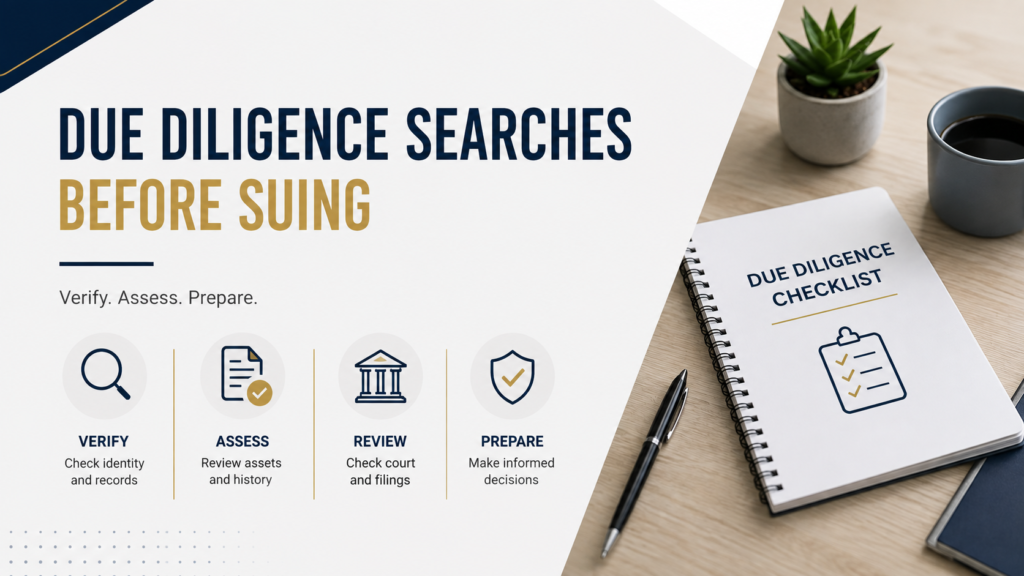
Due diligence searches before suing help you verify the defendant, identify useful records, and assess practical collection issues before filing. In Ontario, searches can include corporate records, court history, property records, insolvency information, and locate work. These checks can help you confirm that your information is accurate before taking further steps.
Why this matters
Running due diligence searches before suing can answer basic questions about the person or business you are considering naming.
You may already have a name, address, invoice, agreement, or other record.
That information may not tell you whether the defendant’s legal identity is correct.
It also may not show whether the defendant has changed a business name, moved, or appeared in other proceedings.
Good pre-litigation searches can help you build a clearer administrative picture.
They can also help identify records that may be relevant to your file.
The purpose is not to predict the outcome of a lawsuit.
It is to verify information and support proper preparation.
You should also remember that searches do not replace legal advice. If you need advice about whether to sue, what claim to bring, or what remedies are available, speak with a licensed Ontario lawyer or paralegal.
Privacy also matters.
The Office of the Privacy Commissioner of Canada explains that publicly available personal information is not automatically free from privacy obligations. The purpose and manner of collection can matter when handling personal information.
Review the Office of the Privacy Commissioner of Canada’s guidance on publicly available information before using public information as part of a broader investigation.
The list in full
1. Confirm the defendant’s legal identity
One of the most useful due diligence searches before suing is a basic identity check.
If the defendant is a business, confirm its legal name and business structure.
A trading name may not be the same as the corporation or registered business.
The Ontario Business Registry provides access to business information and search products. This can help you confirm the entity you are dealing with.
For an individual, use the strongest identifying information available.
Avoid relying on a name alone if other details are available.
2. Check corporate status
A corporate search can show whether a business exists as a registered entity.
You can review available information about the corporation, including its registered office and other record details.
This can be especially useful if your documents use a brand name or operating name.
A corporate record may also help distinguish between businesses with similar names.
The result should be compared with the information already in your file.
3. Search for civil litigation history
A litigation search can help determine whether a person or business appears in available Ontario court records.
This is one of the more useful searches before filing a claim when you need background information about a potential defendant.
A judgment history may also provide useful context where available.
Do not assume that a search result represents every proceeding involving the person.
Court access can be restricted in some circumstances.
A search result also does not provide every document from a court file.
4. Check property records
A property search can help identify registered interests connected with land.
This may be relevant when assessing the defendant’s known asset position.
A property title search can provide information about a registered owner and registered interests.
However, land records do not provide a complete picture of all assets.
Personal property, business assets, and other interests require different types of searches.
5. Consider insolvency records
Before filing, you may want to check whether the potential defendant appears in available insolvency records.
A bankruptcy or insolvency search can identify relevant records connected with a person or business.
This can matter because insolvency proceedings may affect collection activity and other steps.
The Office of the Superintendent of Bankruptcy provides information about bankruptcy and insolvency records in Canada.
If you discover an insolvency record, do not assume what it means for your proposed claim.
Legal advice may be needed to understand the effect on your matter.
6. Review PPSA registrations
A PPSA search can identify registered security interests connected with personal property.
This can help you understand whether certain assets may have another party’s registered security interest.
The result does not automatically establish ownership or priority.
It is one more source of information about the potential defendant’s asset position.
This can be particularly useful when due diligence searches before suing form part of broader collection planning.
7. Confirm the defendant’s address
Accurate address information can become critical after filing.
It can affect correspondence, document delivery, and service arrangements.
A business registry record may provide a registered office.
Other searches may provide additional address information.
For an individual, a locate search may be appropriate if the address you have is uncertain or outdated.
If you cannot confirm the defendant’s location, consider resolving that issue before relying on the address in your file.
8. Consider collectability
A lawsuit may establish a judgment, but collection is a separate issue.
This is why due diligence searches before suing can include information about the defendant’s assets, business status, court history, and known location.
The purpose is not to guarantee recovery.
It is to give you a clearer administrative picture before proceeding.
Your lawyer or paralegal can advise you about legal strategy and the remedies available in your circumstances.
How to apply this to your matter
Not every matter requires every search.
The right combination depends on what you already know and what you need to confirm.
For example, a corporate defendant may require a business search and corporate review.
An individual defendant may require stronger identity and locate information.
A collection matter may also justify court, property, PPSA, or insolvency searches.
Think of due diligence searches before suing as a verification process.
Start with the information already in your file.
Then identify the gaps.
Ask what information could create a problem later.
You may need to confirm the defendant’s legal name.
You may need a better address.
You may need to understand whether the defendant operates through a corporation.
You may also need to determine whether public records show previous proceedings or registered interests.
[CONFIRM] From real operating experience, one issue that often causes unnecessary follow-up is starting a search with an incomplete defendant name. Confirm the legal identity before ordering related searches or arranging service.
Keep your search records
For each search, record what you searched and when.
Keep the exact name used.
Save relevant search results.
Record any corporation number, court file information, address, or other identifier found.
This creates a clearer administrative trail.
It also makes later document retrieval or process serving easier.
Do not treat a search as legal advice
Search results provide information.
They do not tell you whether you have a valid claim.
They do not determine liability.
They do not guarantee that a judgment can be collected.
They also do not replace advice about limitation periods, jurisdiction, pleading requirements, or available remedies.
If you need legal advice, consult a licensed Ontario lawyer or paralegal.
When professional support can help
You can perform some basic searches yourself.
Professional support can be useful when due diligence searches before suing form part of a larger litigation, collection, locate, document retrieval, or process serving assignment.
Select Serve and File Process Server Inc. has served Ontario since 2005. We provide process serving, court filing, document retrieval, and related search support.
A coordinated search can help you organize information from different sources and identify gaps before moving forward.
The goal is simple.
- Confirm the right defendant.
- Confirm the available information.
- Keep a clear record of what you found.
- Then discuss the legal next step with your lawyer or paralegal.
The value of due diligence searches before suing is not in collecting every possible record. It is in finding the information that matters to your particular file.
Need documents served in Ontario? Request a quote.
This article provides general information about process serving and court procedure in Ontario. It is not legal advice and does not create a solicitor client relationship. Court rules and procedures change. Confirm current requirements with the relevant court or consult a licensed Ontario lawyer or paralegal before acting.