
What Is an Examination in Aid of Execution?
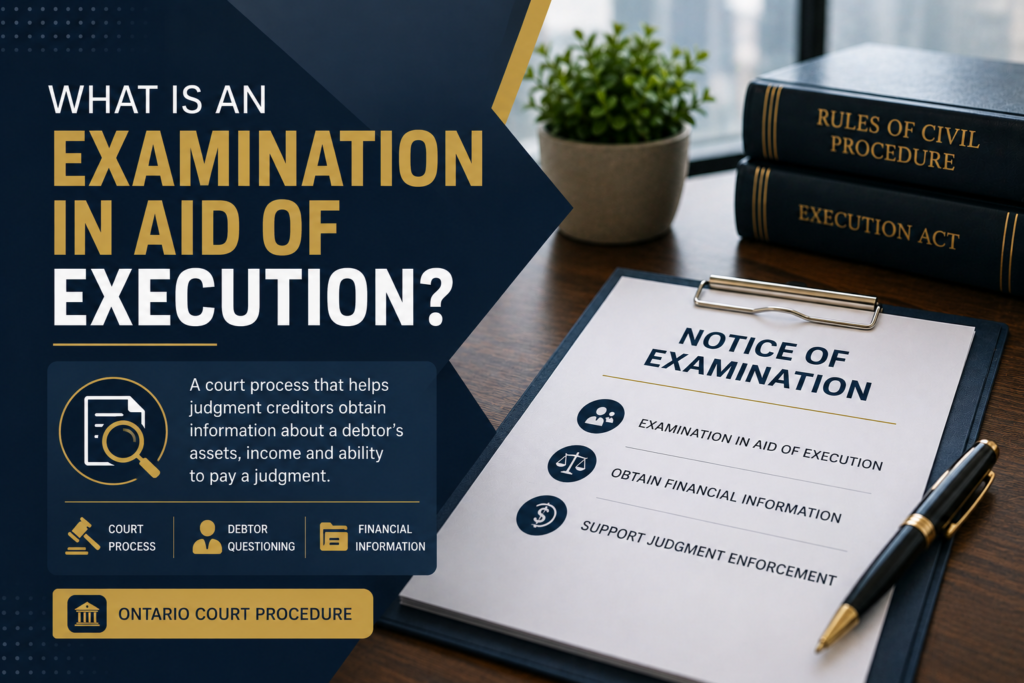
An examination in aid of execution Ontario is a court process used by a judgment creditor to obtain information about a judgment debtor’s assets, income, and ability to satisfy a judgment. The debtor may be required to answer questions under oath and provide relevant financial information. The process is governed by Ontario’s court rules.
Why it matters in Ontario
Winning a judgment does not always mean you know how the judgment debtor can pay it.
You may have a court order, but limited information about the debtor’s income, assets, employment, or other financial interests. An examination in aid of execution Ontario can help a judgment creditor obtain information needed for enforcement.
Rule 60.18 of Ontario’s Rules of Civil Procedure deals specifically with examinations in aid of execution. You can review the current Ontario Rules of Civil Procedure, Rule 60 before taking action.
The process is different from a regular examination for discovery.
Discovery generally takes place before a case is decided. An examination in aid of execution takes place as part of enforcement after a judgment or order.
In simple terms, the purpose is to ask questions that may help identify assets or other information relevant to enforcing the judgment.
The person being examined may be required to provide information under oath.
This makes the process more formal than an ordinary conversation with the debtor.
The Ontario court system also provides forms used for examinations. The current Ontario Court Forms website lists Form 34A, Notice of Examination, which includes an examination in aid of execution as one of its uses.
An examination in aid of execution Ontario may therefore be useful when you have a judgment but need more information before deciding how to proceed.
What it involves in practice
Understanding the judgment debtor examination
A judgment debtor examination is a formal process connected with enforcement.
The judgment creditor can seek information from the judgment debtor that may help identify assets or sources of payment.
The questions should relate to the enforcement of the judgment.
The process is not intended to provide unlimited access to unrelated personal information.
The applicable rules determine what information may be requested and what the debtor may be required to provide.
Preparing before the examination
Before arranging an examination in aid of execution Ontario, review the judgment and court file.
Confirm the names of the parties and the court file number.
Then identify what information you already have.
For example, you may already know the debtor’s employer or financial institution. You may also have information about property, business interests, or other assets.
Knowing what is missing can help keep the examination focused.
You should also review the current notice and procedural requirements.
Form 34A is the Notice of Examination used for several types of examinations, including an examination in aid of execution. The form allows the notice to specify whether the examination will take place in person, by telephone conference, or by video conference.
Serving the notice
The notice must be served according to the applicable procedure.
Ontario’s Rules of Civil Procedure contain specific requirements for serving a notice of examination. The rules distinguish between different types of persons being examined and how the notice must be served.
Where a person is being examined in aid of execution on behalf of or in place of a party, the applicable service rule can require personal service.
Do not assume that ordinary mail is sufficient.
The exact service requirement should be checked for the circumstances of your matter.
This is where professional document service can be useful.
Preparing questions and documents
An examination can involve questioning a debtor about information relevant to enforcement.
Possible areas may include employment, income, bank accounts, property, business interests, and other financial information.
The exact questions depend on the judgment and the information already available.
The debtor may also be required to produce specified documents.
Form 34A provides space to identify documents and things that must be produced at the examination.
The purpose is to obtain useful information for enforcement, not to ask unrelated questions.
Understanding financial disclosure
Financial disclosure means providing information about financial circumstances.
During an examination, the debtor may be required to provide information relevant to enforcement.
The information can help a creditor understand what assets or income may be available.
The debtor may also raise objections or disputes about particular questions.
If that happens, legal advice may be required.
Select Serve and File Process Server Inc. does not determine what questions should be asked or what information a debtor must disclose.
Where people commonly go wrong
Using the wrong notice
An examination notice must match the type of examination being conducted.
Form 34A covers several examination types, including examination in aid of execution.
Check the current form before preparing documents.
Serving the notice incorrectly
Service requirements can depend on who is being examined.
Do not assume the same service method applies to every examination.
Keep proof showing what was served, who received it, where it was served, and when.
Failing to identify the missing information
An examination is more useful when you know what information you need.
Review existing records before preparing for the hearing.
This can prevent repeated questions and help focus the process.
Treating the examination like ordinary questioning
An examination is a formal court process.
The debtor may be required to answer under oath and produce specified documents.
It should not be treated like an informal interview.
Assuming the examination guarantees payment
An examination in aid of execution Ontario does not automatically result in payment.
It is an information gathering process connected with enforcement.
The information obtained may help identify an appropriate enforcement step.
Losing track of the service record
Keep a complete file.
Your records should include the notice, service instructions, proof of service, court information, and related correspondence.
[CONFIRM] From real operating experience, one common problem is sending an examination notice for service without checking the recipient’s current address. Verify the service information before the documents are dispatched.
When to use a professional
You may be able to manage some administrative steps yourself.
However, professional support can help when an examination notice must be served correctly and documented.
Select Serve and File Process Server Inc. has served Ontario since 2005. We provide process serving, court filing, document retrieval, and related administrative support.
We are a process serving company, not a law firm. We do not provide legal advice or decide whether an examination is appropriate for your enforcement matter.
If you need advice about whether to conduct an examination, what questions to ask, or what information you can require, consult a licensed Ontario lawyer or paralegal.
The key to an examination in aid of execution Ontario is preparation. Review the judgment, identify the information you need, use the correct notice, confirm service requirements, and keep complete records.
Need documents served in Ontario? Request a quote.
This article provides general information about process serving and court procedure in Ontario. It is not legal advice and does not create a solicitor client relationship. Court rules and procedures change. Confirm current requirements with the relevant court or consult a licensed Ontario lawyer or paralegal before acting.
Deadlines and service requirements vary by document type, court and proceeding. Missing a deadline can result in your matter being delayed or dismissed. Verify all timelines against the applicable rules and the practice direction of the court or tribunal where your matter is filed.