
How Judgment Enforcement Works in Ontario
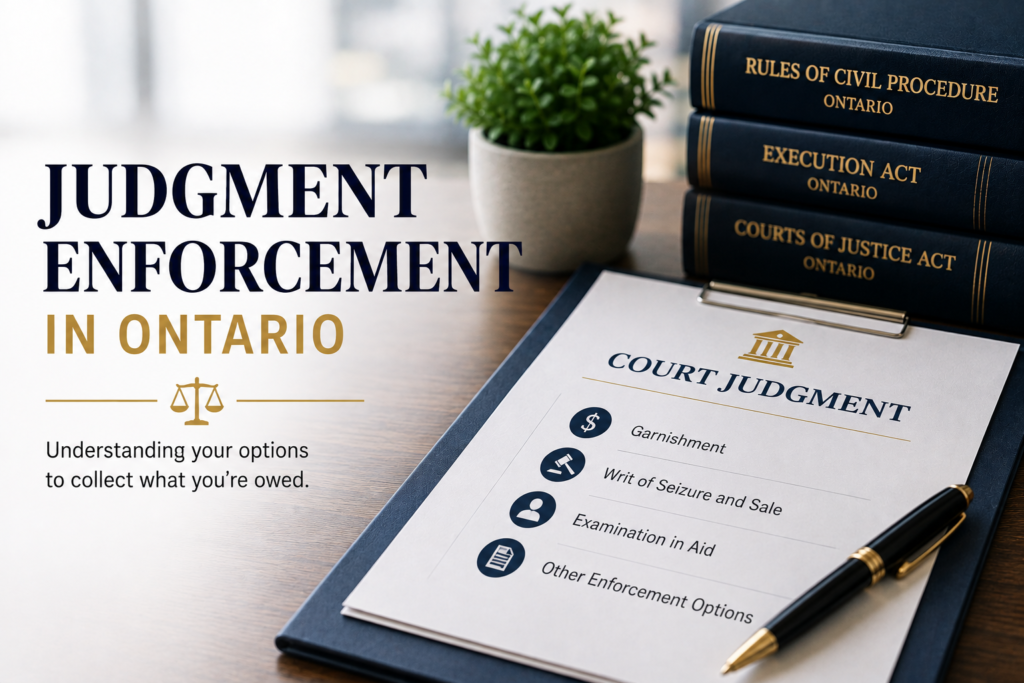
Judgment enforcement Ontario is the process of taking steps to recover money after a court judgment or order. Depending on the matter, enforcement can involve garnishment, a writ of seizure and sale, an examination in aid, or other lawful remedies. The correct option depends on the judgment, debtor, assets, and applicable court procedure.
Why it matters in Ontario
Winning a judgment does not always mean payment happens automatically.
If you are a judgment creditor, you may need to take further steps to recover what the court awarded.
This is where judgment enforcement Ontario becomes relevant.
The enforcement process is designed to help a judgment creditor recover from a judgment debtor. The available options depend on the type of judgment and the circumstances.
For civil proceedings, Rule 60 of Ontario’s Rules of Civil Procedure contains provisions dealing with enforcement, including garnishment and writs of execution. You can review the current Ontario Rules of Civil Procedure, Rule 60 before taking action.
The Ontario Court Forms website also provides current forms used in court proceedings. Review the Ontario Court Forms website when identifying the documents applicable to your matter.
A judgment creditor may need to consider several questions.
Does the debtor have employment income?
Does another person or organization owe money to the debtor?
Does the debtor own property?
Can the debtor be located?
Is additional information needed before choosing an enforcement step?
These questions can help determine which enforcement options Ontario provides for the particular matter.
Enforcement is not one single procedure.
A garnishment may be relevant where another party owes money to the judgment debtor. A writ of seizure and sale may be relevant where property could be subject to enforcement.
An examination in aid can be another tool for obtaining information about the debtor’s assets and financial circumstances, where permitted.
What it involves in practice
Understanding how to enforce a judgment
If you are researching how to enforce a judgment, start by reviewing the judgment itself.
Check the court file number, names of the parties, amount or relief awarded, and any relevant terms.
Then consider what information you have about the judgment debtor.
A creditor with no information about the debtor’s income, employer, bank, or property may need additional investigation before enforcement can be effective.
Reviewing the available information
The more accurate your information is, the easier it can be to determine which enforcement process may be relevant.
You may need to confirm the debtor’s legal name and current address.
You may also need to identify an employer, financial institution, property, or other potential source of recovery.
A professional locate search can sometimes help where the available information is incomplete.
Considering garnishment
Garnishment involves a third party that owes money to the judgment debtor.
That third party is called the garnishee.
For example, an employer may be a garnishee where wages are owed to the debtor.
Civil Rule 60 contains provisions governing garnishment, including requirements concerning the Notice of Garnishment and service on the judgment debtor and garnishee.
The current Ontario Court Forms website identifies the applicable garnishment forms for different proceedings.
Garnishment can therefore be one part of judgment enforcement Ontario, but it is not suitable for every matter.
Considering a writ of seizure and sale
A writ of seizure and sale is another enforcement mechanism.
It can involve the sheriff and may allow property to be seized and sold under the applicable enforcement process.
The process can differ depending on the type of property involved.
Land can involve additional registration and enforcement considerations.
Do not assume that a judgment automatically means property can be seized.
The applicable rules, exemptions, competing interests, and enforcement procedures must be considered.Considering an examination in aid
An examination in aid can help a judgment creditor obtain information about the debtor’s financial circumstances.
In simple terms, it is a court process that can require a debtor to provide information relevant to enforcement.
The specific procedure and documents depend on the applicable rules.
Considering service requirements
Many enforcement matters involve documents that must be delivered to another person or organization.
Correct service matters because proof may later be required.
You should know which document must be served, who must receive it, and which service method applies.
If you are handling a garnishment, for example, do not assume that serving the employer alone completes the process.
Depending on the proceeding, the judgment debtor may also need to receive documents.
Where people commonly go wrong
Assuming a judgment means automatic payment
A judgment confirms the court’s decision.
It does not necessarily mean the debtor will pay voluntarily.
Further enforcement may be required.
Choosing an enforcement method without enough information
A creditor may start with a remedy that does not match the information available.
For example, you may not know where the debtor works or whether the debtor has identifiable assets.
Additional investigation may be needed first.
Using outdated court forms
Court forms and procedures can change.
Always check the current Ontario Court Forms website before preparing enforcement documents.
Serving the wrong party
Different enforcement documents can have different service requirements.
Make sure you identify every required recipient before arranging service.
Using an incorrect address
An old debtor or garnishee address can cause service problems.
Check the information before sending documents for delivery.
Failing to keep proof
Keep records of what was served, where it was served, when it was served, and how service occurred.
This can be important if service is later questioned.
Treating enforcement as a single event
Judgment enforcement Ontario can involve several stages.
You may need to locate the debtor, identify assets, prepare documents, arrange service, file records, and monitor the response.
When to use a professional
You may be able to handle some administrative enforcement steps yourself.
However, professional support can help when documents must be served, filed, retrieved, or coordinated.
Select Serve and File Process Server Inc. has served Ontario since 2005. We provide process serving, court filing, document retrieval, and related enforcement support.
We are a process serving company, not a law firm. We do not provide legal advice or determine which enforcement remedy you should use.
If you need advice about whether garnishment, a writ of seizure and sale, an examination in aid, or another remedy is appropriate, consult a licensed Ontario lawyer or paralegal.
The key to judgment enforcement Ontario is preparation. Review the judgment, identify the debtor, gather accurate information, choose the appropriate procedure with professional legal guidance, and keep clear records throughout the process.
Need documents served in Ontario? Request a quote.
This article provides general information about process serving and court procedure in Ontario. It is not legal advice and does not create a solicitor client relationship. Court rules and procedures change. Confirm current requirements with the relevant court or consult a licensed Ontario lawyer or paralegal before acting.
Deadlines and service requirements vary by document type, court and proceeding. Missing a deadline can result in your matter being delayed or dismissed. Verify all timelines against the applicable rules and the practice direction of the court or tribunal where your matter is filed.