
How to Serve Legal Documents in Toronto: 2026 Guide
To serve legal documents in Toronto correctly, you must follow the service requirements that apply to your specific document and proceeding. The right method, recipient, timing, and proof of service all matter. Incorrect service can create delays or disputes, so careful preparation is essential.
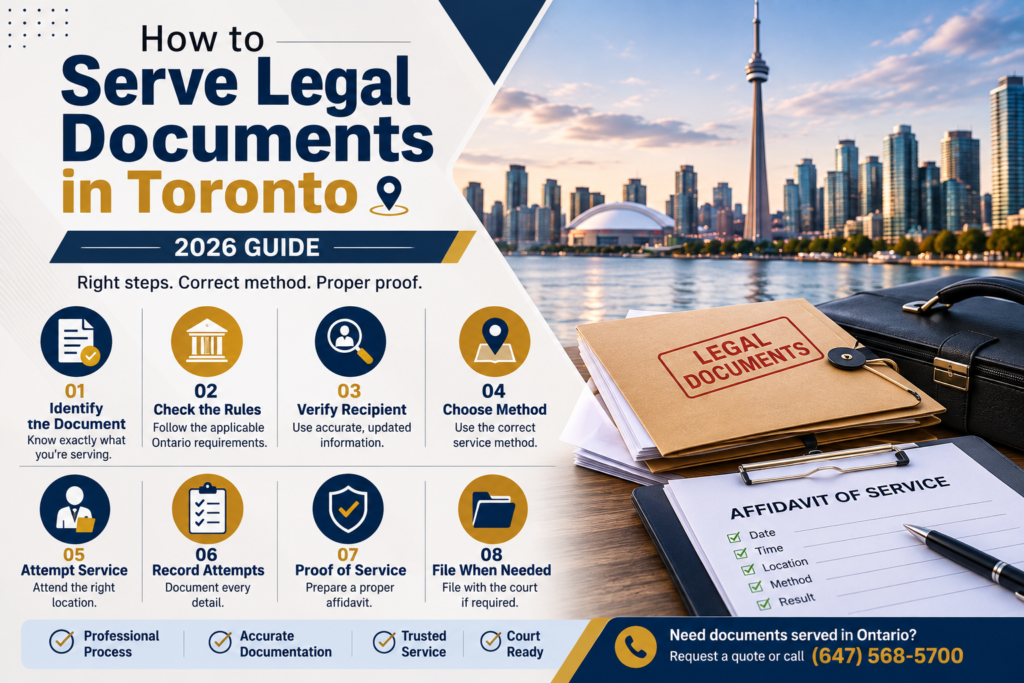
1. Identify the Documents You Need to Serve
Before you serve legal documents in Toronto, identify exactly what you are delivering.
Common documents include:
- Statements of claim
- Notices of application
- Notices of motion
- Summonses
- Court orders
- Affidavits
- Small Claims documents
- Family law documents
- Landlord and tenant documents
Different documents can have different service requirements.
Do not assume that a method that works for one document will automatically work for another.
2. Confirm the Applicable Service Rules
The next step is determining which rules apply to your proceeding.
For civil matters, the Ontario Rules of Civil Procedure (O. Reg. 194) contain requirements concerning service.
Other proceedings can have their own rules and procedures.
If you are unsure how a document must be served, confirm the requirement with the relevant court or a licensed Ontario lawyer or paralegal.
A process server can carry out an assigned service method, but does not provide legal advice about which method you should choose.
3. Confirm the Recipient’s Information
Accurate recipient information makes it easier to serve legal documents in Toronto efficiently.
Provide:
- Full legal name
- Current or last known address
- Workplace information, if available
- Phone number, where appropriate
- Physical description or photograph, if available
- Court file information
- Service deadline
If the address is outdated or uncertain, consider a professional locate search or skip tracing assignment.
4. Select the Appropriate Service Method
The applicable rules determine how the documents can be served.
Depending on the circumstances, service may involve:
- Personal service
- Another permitted method of service
- Substituted or alternative service where authorized
Do not assume that leaving documents with a neighbour, receptionist, family member, or another person automatically completes valid service.
Electronic service also should not be assumed to be valid simply because an email address is available.
Confirm the requirements for your specific matter before attempting service.
5. Arrange Professional Service
A professional process server can help coordinate the assignment and document the result.
When you serve legal documents in Toronto through a professional provider, the workflow may include:
- Reviewing the documents
- Confirming recipient information
- Planning the service attempt
- Attending the appropriate location
- Recording the result
- Preparing appropriate proof of service
If the recipient is difficult to locate, skip tracing or additional locate work may be considered.
6. Document Every Attempt
Not every service attempt is successful.
If the recipient is unavailable, accurate records can still be valuable.
Document:
- Date and time
- Location
- Access conditions
- What occurred
- Information learned
- Result of the attempt
Detailed records create a clearer account of the steps taken.
[CONFIRM] From practical process serving experience, incomplete attempt notes can make it harder to demonstrate what happened during unsuccessful service. Confirm this observation against your team’s current operating experience.
7. Complete the Appropriate Proof of Service
After successful service, the applicable proof of service should be prepared.
Depending on the proceeding, this may involve an affidavit or another prescribed document.
The record may identify:
- Who was served
- When service occurred
- Where it occurred
- How service was completed
- Relevant identification details
The exact requirements depend on the proceeding and document.
Do not assume that one affidavit format applies to every Ontario matter.
8. File the Proof When Required
After you serve legal documents in Toronto, determine whether the proof of service must be filed with the court or tribunal.
Depending on the proceeding, filing may be handled:
- Online
- In person
- Through an authorized filing process
The applicable court or tribunal determines the filing requirements.
If you are unsure whether filing is required or when it must occur, confirm with the relevant court or a licensed Ontario lawyer or paralegal.
Common Problems When Serving Legal Documents
Several issues can make service more difficult:
- Incorrect recipient information
- Outdated addresses
- Restricted building access
- Recipient avoidance
- Missing documents
- Unclear deadlines
- Incorrect proof of service
- Assuming electronic service is automatically permitted
Planning ahead can reduce many of these problems.
Why Use a Professional Process Server?
A professional process server can assist with:
- Personal service
- Locate searches
- Skip tracing
- Attempt documentation
- Affidavit and proof-of-service support
- Court filing
- Rush and same-day assignments
- Document retrieval
Select Serve and File Process Server Inc. provides these services across Ontario.
The company has served Ontario since 2005.
Professional service does not remove the need to confirm legal requirements. Instead, it provides practical support for carrying out and documenting the assigned service.
Need Help to Serve Legal Documents in Toronto?
If you need to serve legal documents in Toronto, provide the complete documents, recipient information, location, and deadline. This allows the process server to assess the assignment and coordinate the appropriate service work.
Need documents served? Request a quote or call (647) 568-5700.
“This article provides general information about process serving and court procedure in Ontario. It is not legal advice and does not create a solicitor client relationship. Court rules and procedures change. Confirm current requirements with the relevant court or consult a licensed Ontario lawyer or paralegal before acting.”