
What Is a PPSA Search and When Do You Need One?
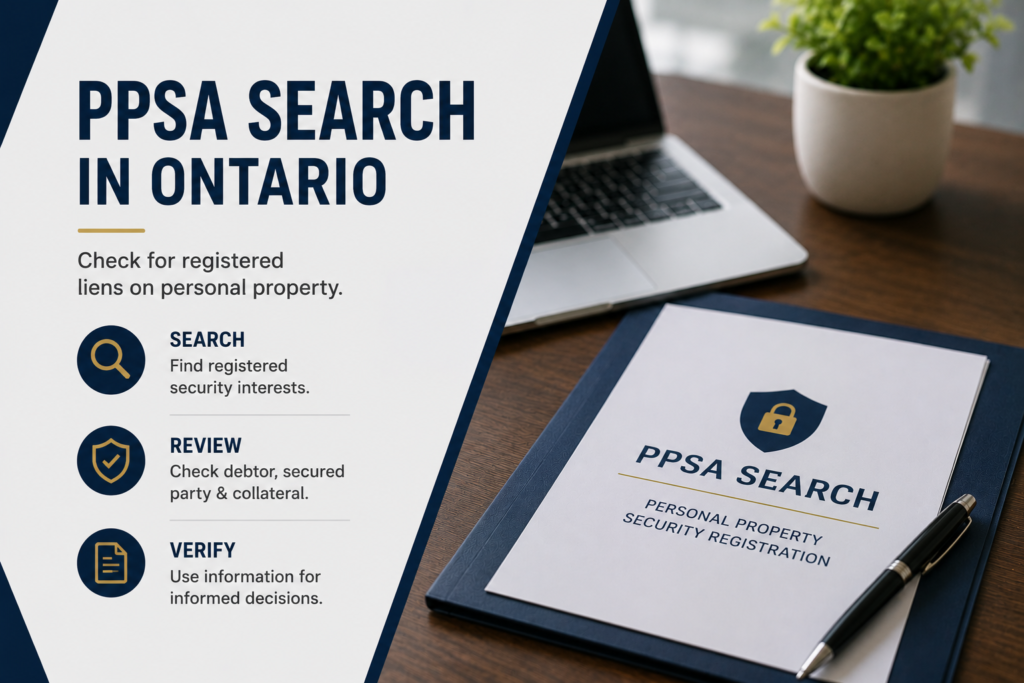
A PPSA search ontario helps you check whether personal property has a registered security interest or lien. It can help creditors, collection agencies, and litigation clerks understand whether a debtor’s assets may be subject to another party’s claim. In Ontario, these records are maintained through the Personal Property Security Registration system.
Why it matters in Ontario
A PPSA search ontario can help answer an important question: has someone registered a security interest against the personal property you are investigating?
The Personal Property Security Act, commonly called the PPSA, governs security interests in personal property in Ontario. The provincial government provides an online system for registering security interests and searching for liens.
A personal property security search can be useful during collection, lending, litigation, and due diligence work.
For example, you may want to investigate whether a debtor’s equipment, vehicle, inventory, or other personal property has an existing registration.
A search can also help you identify a secured party.
A secured party is generally the person or organization holding a security interest in the collateral.
Collateral means the property connected with the security interest.
The result can provide information about registrations that may affect the property or debtor.
This does not automatically tell you who has priority.
It also does not determine what legal action you should take.
If you need advice about priority, enforcement, or the legal effect of a registration, consult a licensed Ontario lawyer or paralegal.
A PPSA search ontario is also different from a property title search.
A property title search deals with registered interests in land.
A PPSA search deals primarily with personal property and related registrations.
The Ontario government specifically states that the PPSR system is used to register and search security interests or liens on personal property. It does not provide information about real property such as land or real estate.
That distinction matters.
You may need more than one type of search when investigating a person or business.
What it involves in practice
Understanding a PPSA search ontario
A PPSA search ontario normally starts with identifying the correct debtor or property.
You may search against an individual debtor.
You may also search against a business entity.
The information needed can depend on the type of search and the registration involved.
Accuracy matters.
A registration may be connected to a person’s legal name or a corporation’s registered information.
Using an incorrect name can produce incomplete results.
Review the registration details
A PPSA registration search can return registration information connected with the debtor.
Review the debtor information carefully.
Then review the secured party.
Next, examine the collateral description.
A registration can cover different classes of personal property.
The description may therefore be broader than one specific item.
Do not assume that every registration affects every asset owned by the debtor.
The PPSA provides rules concerning attachment, perfection, registration, and collateral. The legal effect depends on the circumstances and the applicable provisions.
Check the registration number
A registration number can help identify a specific PPSA registration.
Keep the registration information with your search records.
If the search is part of a larger investigation, record the debtor name and other identifying information used.
This makes later review easier.
It can also help you distinguish between multiple registrations connected with the same debtor.
Understand the collateral
Collateral is one of the most important parts of a PPSA registration.
The registration may identify a category of property rather than one individual asset.
For example, a registration may refer to equipment, inventory, accounts, or other collateral classifications.
You should read the description carefully.
Do not assume that a registration means the secured party owns the property.
A security interest is different from ownership.
The PPSA provides a framework for security interests in personal property.
Compare the search with other information
A lien search Ontario request may be only one part of a larger investigation.
You may also need to confirm the debtor’s business identity.
You may need to investigate court records.
You may need to check property ownership separately.
Each search answers a different question.
For example, a corporate search can help identify a company’s legal identity. A PPSA search can help identify registrations against personal property.
Know what the search does not prove
A PPSA search ontario does not automatically establish the value of the collateral.
It does not confirm that the debtor still owns the property.
It does not determine whether a registration is valid in every circumstance.
It also does not tell you whether a creditor can seize or sell an asset.
Those questions can involve legal analysis.
If the result affects an active enforcement matter, obtain appropriate legal advice before acting.
Where people commonly go wrong
Searching the wrong debtor name
A common mistake is using an incomplete or incorrect debtor name.
This can produce an incomplete search.
For an individual, use the strongest identifying information available.
For a corporation, confirm the legal entity before relying on the result.
Treating every registration as the same
Registrations can differ.
They can identify different collateral classifications and different secured parties.
Do not assume that two registrations have the same scope or legal effect.
Read the actual registration information.
Confusing a PPSA registration with ownership
A registration does not simply mean that the secured party owns the asset.
The PPSA deals with security interests.
Ownership and security interests are separate concepts.
If you need to understand the legal relationship between the debtor, secured party, and collateral, seek legal advice.
Ignoring registration details
A search result should be reviewed as a whole.
Check the debtor.
Check the secured party.
Check the collateral.
Check the registration number.
Check the relevant dates shown in the record.
This can reduce confusion when multiple registrations appear.
Using an outdated search
Search information can change.
Registrations can be amended, renewed, discharged, or otherwise updated.
If the search is being used for an active matter, confirm that the information is current.
[VERIFY] Confirm the current PPSR search process and registration status before relying on a result for an enforcement or litigation decision.
Overlooking privacy considerations
Search results may contain personal information.
You should handle information responsibly and use it only for an appropriate purpose.
The Office of the Privacy Commissioner of Canada provides guidance about personal information that is publicly available and the circumstances in which organizations may collect, use, or disclose it.
Review the Office of the Privacy Commissioner of Canada’s guidance on publicly available information before using search information in a broader investigation.
[CONFIRM] From real operating experience, one issue that often causes unnecessary follow-up is searching a debtor without confirming the legal name first. Confirm the debtor identity before treating the search as complete.
When to use a professional
You can perform some basic PPSA searches yourself.
Professional support can be useful when a PPSA search ontario forms part of a larger collection, locate, litigation, document retrieval, or process serving assignment.
Select Serve and File Process Server Inc. has served Ontario since 2005. We provide process serving, court filing, document retrieval, and related administrative support.
The purpose of a PPSA search ontario is to help you identify registered security interests and liens connected with personal property. Use accurate debtor information, review the registration carefully, and confirm current records before relying on them.
Need documents served in Ontario? Request a quote or call (647) 568-5700.
This article provides general information about process serving and court procedure in Ontario. It is not legal advice and does not create a solicitor client relationship. Court rules and procedures change. Confirm current requirements with the relevant court or consult a licensed Ontario lawyer or paralegal before acting.