
The Legal Limits of Skip Tracing in Canada
Is skip tracing legal in Canada? Yes, skip tracing can be lawful when personal information is collected, used, and disclosed for an appropriate purpose and in line with applicable privacy rules. In Ontario, businesses must consider privacy obligations, including PIPEDA where it applies, and should not treat public information as unrestricted.
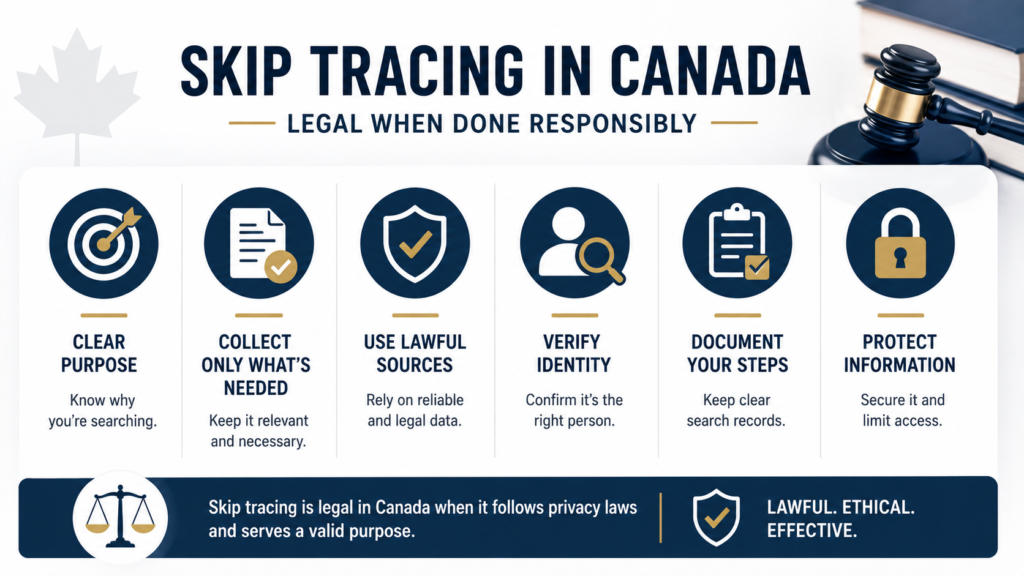
What the rules say
Is skip tracing legal in Canada depends on what information is collected, why it is collected, how it is obtained, and how it will be used.
Skip tracing means locating or verifying information about a person. It may involve reviewing public records, business information, address history, and other available sources.
The process itself is not automatically unlawful.
The limits come from privacy law and the way information is handled.
What is PIPEDA?
PIPEDA is Canada’s federal private-sector privacy law. It sets rules for how covered organizations collect, use, and disclose personal information during commercial activities.
PIPEDA includes principles covering accountability, identifying purposes, consent, limiting collection, accuracy, safeguards, and limiting use and disclosure.
That means skip tracing privacy law is not simply about whether information can be found.
You also need to consider whether the collection is appropriate for the purpose.
The Office of the Privacy Commissioner of Canada says organizations should identify and document why personal information is being collected. The purpose should be limited to what a reasonable person would consider appropriate.
Does every search require consent?
No.
- Consent is an important part of PIPEDA, but the legislation contains specific exceptions.
- For example, PIPEDA can permit collection without knowledge or consent in certain circumstances involving an investigation of a breach of an agreement or a contravention of Canadian or provincial law. The conditions of the exception matter.
- This does not mean that a business can collect any information simply because it believes an investigation exists.
- The purpose, necessity, method, and circumstances still matter.
- If you are unsure whether an exception applies, obtain legal advice before relying on it.
When it applies and when it does not
Is skip tracing legal in Canada for collection work?
- Is skip tracing legal in Canada for collection work can depend on the facts and the organization involved.
- A creditor or collection agency may need to locate a debtor.
- A process server may need to verify an address before attempting service.
- A litigation team may need information connected with a court matter.
- These purposes can be different from using personal information for unrelated marketing or profiling.
- The purpose should be clear before the search begins.Public information is not a free pass
- A common misunderstanding is that information found online has no privacy limits.
- That is not always correct.
- The Office of the Privacy Commissioner explains that organizations should consider the purpose for collecting and using publicly available information. Public availability does not automatically remove all privacy obligations.
- The same principle applies to business information.
- The Ontario Business Registry provides access to publicly available business information and search products. Some information filed in the registry is placed on the public record.
- However, using business information for one purpose does not automatically authorize every other use.
What about personal information?
- Personal information can include information about an identifiable individual.
- That can include names, addresses, identification information, financial information, and other information connected to a person.
- A PIPEDA skip tracing assignment should therefore be limited to information that is relevant to the stated purpose.
- Avoid collecting unrelated information simply because it is available.
How to comply correctly
1. Identify the purpose
Before starting a legal skip trace Canada assignment, write down why the information is needed.
For example, the purpose may be to locate a debtor for lawful communication or service.
A narrow purpose makes it easier to decide what information is relevant.
2. Collect only what you need
Do not collect every piece of information you can find.
PIPEDA’s fair information principles include limiting collection to what is necessary for the identified purpose.
If you only need to verify an address, unrelated personal details may not be necessary.
3. Use appropriate sources
Use reliable and lawful sources.
Public business records can be useful.
Court and registry records may also provide relevant information.
Do not assume that a website, database, or social media profile gives unrestricted permission to collect or reuse everything displayed there.
4. Check the identity
A matching name does not necessarily identify the correct person.
Use relevant identifiers to distinguish between people with similar names.
Compare information before treating a result as verified.
This reduces both privacy risks and operational errors.
5. Document your purpose
Keep a record of why the search was conducted.
Record the relevant information sources.
Document the result and any important limitations.
Good documentation can help demonstrate that the search had a defined purpose.
6. Protect the information
Finding personal information creates another responsibility.
Information should be protected from unauthorized access.
PIPEDA includes safeguards as one of its fair information principles. It also requires organizations to consider appropriate retention and disposal practices.
Do not keep personal information indefinitely without a reason.
7. Know when to stop
A search should not become broader simply because more information is available.
If the original purpose has been satisfied, further collection may not be necessary.
A focused search is usually easier to explain and manage than an open-ended investigation.
[VERIFY] Privacy requirements can differ depending on the organization, province, industry, and type of information involved. Confirm which privacy law applies to your specific matter before relying on a particular rule or exception.
What happens if you get it wrong
Is skip tracing legal in Canada is not only a question about starting the search.
It is also about what happens afterward.
Improper collection, use, or disclosure of personal information can create privacy concerns.
An organization may also face complaints or regulatory scrutiny.
The Office of the Privacy Commissioner has emphasized that investigative collection without consent must still be reasonable and limited. In one investigation involving a private investigation firm, the Commissioner considered whether less privacy-invasive methods had been exhausted and whether the collection was limited to the investigation’s purpose.
This shows why a lawful purpose alone should not be treated as a complete answer.
The method used can also matter.
Common mistakes
Searching without a defined purpose.
Do not begin with a vague goal such as finding everything available.
Collecting too much information.
Focus on information relevant to the assignment.
Assuming public means unrestricted.
Public records can still require careful handling.
Using the information for a new purpose.
A new purpose may require additional privacy analysis.
Failing to protect search results.
Treat personal information as information that needs appropriate safeguards.
Assuming one privacy rule covers every situation.
Different laws can apply depending on the organization and activity.
[CONFIRM] From real operating experience, one issue that often causes unnecessary follow-up is starting a locate search without clearly defining what information is actually needed. A narrow request makes the search easier to document and reduces unrelated information collection.
When professional support makes sense
Is skip tracing legal in Canada is a question that should be separated from another question, whether you should conduct the search yourself.
- Basic public-record research may be straightforward.
- More involved locate work can require careful identity matching, address verification, business research, and record handling.
- Professional support can help when the search forms part of a larger process serving, litigation, collection, or enforcement assignment.
Select Serve and File Process Server Inc. has served Ontario since 2005. The company provides process serving, court filing, document retrieval, and related locate support.
A professional provider can help keep the search focused on the information required for the assignment.
If you are asking is skip tracing legal in Canada, the short answer is that skip tracing can be lawful, but the purpose, information, method, and applicable privacy rules all matter.
Need documents served in Ontario? Request a quote or call (647) 568-5700.
This article provides general information about process serving and court procedure in Ontario. It is not legal advice and does not create a solicitor client relationship. Court rules and procedures change. Confirm current requirements with the relevant court or consult a licensed Ontario lawyer or paralegal before acting.