
Skip Tracing for Debt Collection in Ontario
Skip tracing for debt collection helps creditors, collection agencies, and litigation teams locate a debtor or verify current contact information. In Ontario, the process can involve reviewing available records, comparing identifiers, checking addresses, and confirming information before further collection or enforcement steps. The goal is reliable information, not simply another possible address.
What this group typically needs
Skip tracing for debt collection usually starts with a problem.
- You have a debtor’s name, but the address is old.
- You may have tried to contact the person without success.
- The debtor may have moved, changed contact details, or stopped responding.
- A judgment debtor may also have changed business or employment information.
- In these situations, locate a debtor Ontario searches can help identify useful current information.
- The starting information matters.
- A full legal name is useful, but additional identifiers can make the search more accurate.
- These may include a previous address, telephone number, employer, business connection, or other relevant records.
- The purpose should also be clear.
- A collection agency may need current contact information.
- A creditor may need information before arranging service.
- A litigation clerk may need to confirm details before an enforcement step.
- Collections skip tracing should support that specific purpose.
Privacy also matters.
The Office of the Privacy Commissioner of Canada explains that personal information should be collected and used for appropriate purposes.
Its guidance on publicly available information is useful when considering how public records can be used.
Review the Office of the Privacy Commissioner of Canada’s guidance on publicly available information before using public information as part of a broader investigation.
How the process works for them
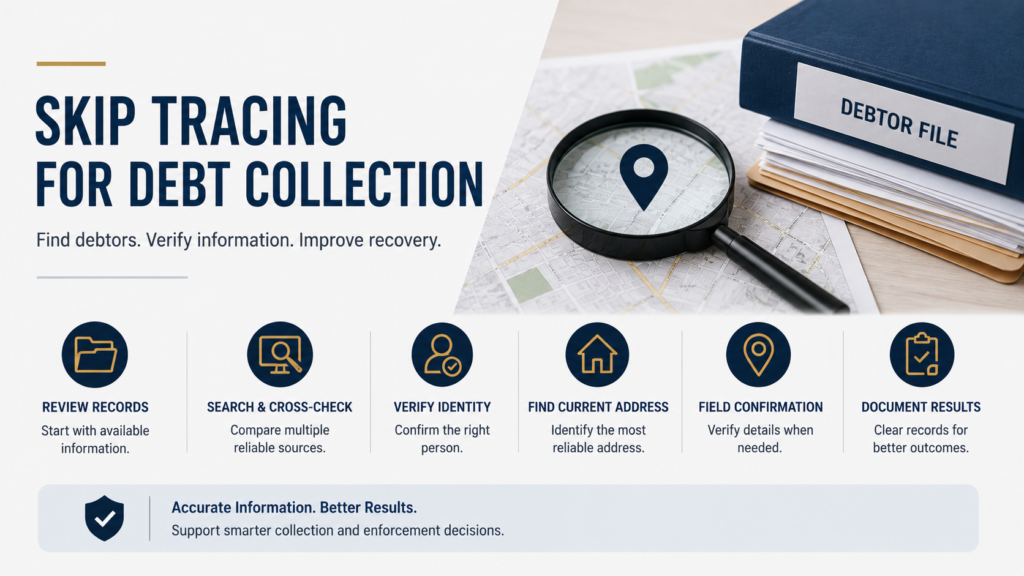
1. Review the information already available
Good skip tracing for debt collection starts with the file you already have.
Review the debtor’s full name.
Check previous addresses.
Look at telephone numbers and other contact information.
Review business details if the debtor is connected with a company.
Do not assume every piece of old information is still current.
The existing file can provide useful identifiers for the next search.
2. Compare available records
The next step is to compare information from relevant sources.
A database cross-reference may connect an older address with newer information.
Business records may provide another useful identifier.
Public records may also help confirm a person’s connection with a location.
The goal is to compare information rather than rely on one result.
A matching name alone is not enough.
This is a key part of effective skip tracing for debt collection.
3. Confirm the debtor’s identity
Before you find a debtor address, confirm that the information belongs to the correct person.
Similar names can create false matches.
Additional identifiers can help separate the right debtor from another person.
Where available, compare addresses, business connections, previous information, or other relevant identifiers.
Do not treat an unconfirmed match as a final result.
Identity verification is especially important before arranging another service attempt.
4. Check current address information
Address information is often the main goal of a locate assignment.
You may have an old address.
You may also have several possible addresses.
Compare the available information.
Consider the date and source of each result.
Do not automatically choose the newest address.
The newest record may still belong to someone else.
A reliable find a debtor address process focuses on connection and verification.
5. Consider business information
If the debtor operates a business, business records may provide useful information.
The Ontario Business Registry provides access to Ontario business information and search products.
Business information can help confirm a corporation’s identity and registered information.
It may also help distinguish between a person’s operating name and legal business entity.
Do not assume that a registered business address is the person’s residential address.
Each record answers a different question.
6. Use further verification when needed
Some files need more than database research.
A field confirmation may provide additional information about a location.
An occupancy check can help determine whether there are signs connecting the debtor with an address.
However, an observation does not automatically prove legal residence.
The purpose is to gather useful information and record it accurately.
[VERIFY] Confirm the current legal and procedural requirements for any locating or verification method before using it in a specific court or enforcement matter.
7. Record the result
A good skip tracing for debt collection assignment should produce a clear administrative record.
Record the debtor name used.
Keep relevant search results.
Note the search date.
Record addresses and other identifiers found.
Document any conflicting information.
If field confirmation was completed, record the relevant observations.
This makes it easier to understand how the result was reached.
What to look for in a provider
Choosing a provider for skip tracing for debt collection is not only about getting an address.
Look for a process that emphasizes verification.
Clear search methodology
- The provider should be able to explain what information they need before starting.
- Better starting information can improve the quality of the search.
Identity matching
- The provider should distinguish between possible matches and verified information.
- A name alone should not be treated as enough.
Clear reporting
- You should receive a straightforward result.
- The report should explain what was found without unnecessary personal information.
Related support
- Some collection matters require more than locating work.
- You may also need document retrieval, court filing, or process serving.
- Select Serve and File Process Server Inc. can support these related administrative tasks.
- The company has served Ontario since 2005.
- This can be useful when the locate assignment is part of a larger collection or enforcement workflow.
Privacy awareness
- A responsible provider should handle personal information carefully.
- The purpose of the search should be clear.
- Information should not be collected simply because it is available.
- Review applicable privacy requirements before using search information.
Common issues and how to avoid them
Starting with incomplete information
If the debtor’s name is incomplete, the search may produce unrelated results.
Provide the strongest identifiers available.
Treating an old address as current
A previous address is a starting point.
It does not automatically establish the debtor’s current location.
Assuming the first match is correct
The first possible match may not be the correct person.
Compare multiple identifiers before relying on it.
Ignoring conflicting results
Different sources may show different addresses.
Do not ignore the conflict.
Review the information and determine whether further verification is needed.
Repeating service attempts without new information
If an earlier attempt failed, repeating the same attempt may not solve the problem.
Use the failed attempt as new information.
Consider whether another search should happen first.
[CONFIRM] From real operating experience, one issue that often causes unnecessary follow-up is treating a possible address match as confirmed. Compare multiple identifiers before arranging another service attempt.
Expecting skip tracing to guarantee collection
Skip tracing for debt collection can help locate a person.
- It does not guarantee payment.
- It does not establish ownership of assets.
- It also does not determine which enforcement method is legally available.
- If legal advice is needed about enforcement, speak with a licensed Ontario lawyer or paralegal.
When professional support makes sense
You may be able to perform basic searches yourself.
Professional support can be useful when skip tracing for debt collection is part of a larger collection, litigation, enforcement, or process serving assignment.
- A coordinated approach can help reduce information gaps.
- It can also make the next administrative step easier to organize.
- If you need to locate a debtor Ontario, verify an address, or prepare for document service, start with accurate information and use appropriate search methods.
- The goal is simple.
- Find reliable information.
- Document how it was verified.
- Then use that information for the appropriate next step.
If you need legal advice about collection or enforcement, consult a licensed Ontario lawyer or paralegal.
Need documents served in Ontario? Request a quote or call (647) 568-5700.
This article provides general information about process serving and court procedure in Ontario. It is not legal advice and does not create a solicitor client relationship. Court rules and procedures change. Confirm current requirements with the relevant court or consult a licensed Ontario lawyer or paralegal before acting.