
How Skip Tracing Works: The Process Explained
How skip tracing works is best understood as a structured process for locating a person or verifying current contact information. In Ontario, skip tracing can combine available records, database cross-reference, public records, address checks, and field confirmation. The goal is to develop reliable information for a specific collection, litigation, or process serving matter.
Why it matters in Ontario
Understanding how skip tracing works can help you decide what information you need before taking the next step.
- You may have an old address.
- You may have a disconnected phone number.
- You may have a previous employer or business connection.
- You may also have documents that identify the person but do not show where they are now.
- This is where a structured skip tracing process can help.
- The purpose is not simply to find as much information as possible.
- The purpose is to identify useful information that can help locate the correct person.
- This can matter when documents need to be served.
- It can also matter in collection and litigation work.
- A current address can help you decide where a service attempt may be appropriate.
- However, a skip trace does not determine whether service is legally valid.
- The applicable court rules and circumstances still matter.
- If you need legal advice about service requirements, speak with a licensed Ontario lawyer or paralegal.
- Privacy is also part of responsible skip tracing.
The Office of the Privacy Commissioner of Canada explains that organizations should consider the purpose for collecting personal information and limit collection to what is appropriate for that purpose.
Review the Office of the Privacy Commissioner of Canada’s guidance on publicly available information before using public information as part of a broader investigation.
What it involves in practice
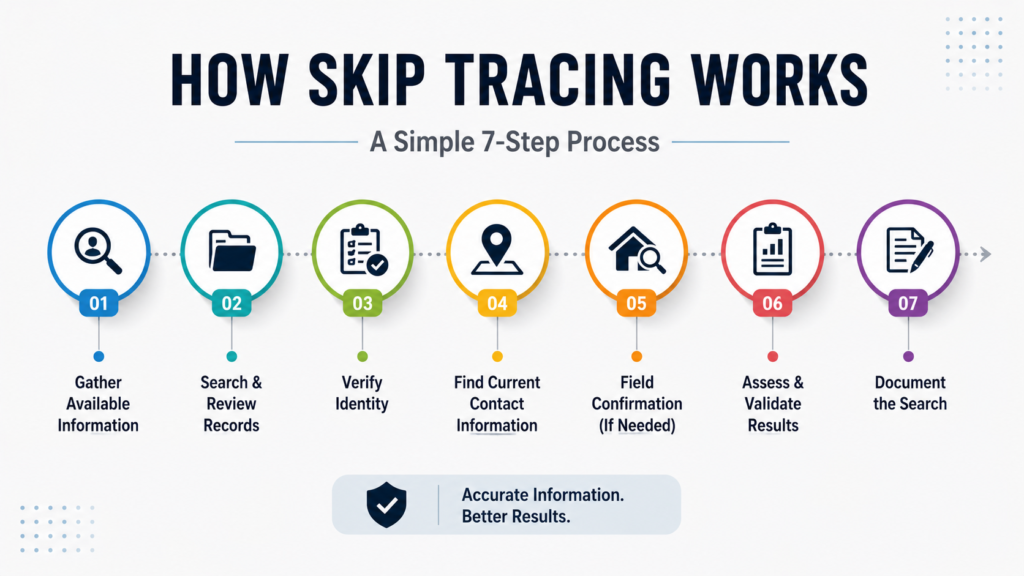
1. Start with the information you already have
The first part of understanding how skip tracing works is reviewing the starting information.
You may have the person’s full name, previous address, telephone number, email address, employer, business connection, or other identifying information.
Start with the strongest information available.
Do not assume that an old address is current.
Do not assume that a name alone identifies the correct person.
The more reliable identifiers you have, the easier it can be to distinguish the correct person from someone with a similar name.
2. Check and compare available records
The next stage involves reviewing relevant information sources.
These may include public records, business records, address information, and other lawful sources.
A database cross-reference can help compare information from different sources.
For example, an older address may appear alongside a newer address.
A business connection may help confirm identity.
A previous telephone number may connect the person with another record.
The goal is to compare information rather than rely on one result.
3. Verify the person’s identity
Identity verification is a key part of how skip tracing works.
A matching name does not necessarily mean you have found the correct person.
Review other available identifiers.
These may include previous addresses, business connections, employer information, or other relevant records.
You should look for information that supports the connection between the person and the result.
Avoid treating an unconfirmed match as a final result.
4. Identify possible current contact information
Once records have been compared, look for the strongest current contact information.
This may include an address or other information that can support further locating work.
A result should be assessed against the information already in your file.
If the information conflicts, investigate the conflict.
Do not simply choose the newest result without checking whether it belongs to the correct person.
5. Conduct further verification when needed
Some matters require more than database research.
A field confirmation may help determine whether information found through other sources is still connected with a particular location.
A field check should be treated as an information gathering step.
Observing activity at a location does not automatically prove that a person lives there.
The purpose is to confirm relevant information as carefully as possible.
[VERIFY] Confirm the current legal and procedural requirements for any locating or verification method before using it in a specific court matter.
6. Assess the results
A good skip tracing process does not end with the first possible match.
Review the results.
Ask whether the information is consistent.
Look for conflicting addresses.
Check whether the person’s name is being confused with another individual.
Consider whether more information is needed before arranging service.
The objective is a reliable working result, not simply a possible result.
7. Document the search
Keep a clear record of the information used.
Record the person’s name.
Record the date of the search.
Keep relevant search results.
Note the sources reviewed.
If a field confirmation was completed, record the relevant observations.
This can help another person understand how the result was reached.
It also provides a useful administrative record for later service or litigation work.
Where people commonly go wrong
Relying on one database
One source rarely answers every locating question.
Information can be outdated or incomplete.
Cross-checking can help identify conflicts.
Searching by name alone
Common names can produce multiple possible matches.
Use additional identifiers whenever available.
Treating an old address as current
A previous address can be useful.
It should not automatically be treated as the person’s current location.
If the address is old, consider whether further verification is needed.
Assuming the first match is correct
The first result may look convincing.
It may still belong to someone else.
Review the full set of available information before treating it as verified.
Collecting information without a clear purpose
Skip tracing should have a defined purpose.
The Office of the Privacy Commissioner of Canada explains that privacy principles include limiting collection to information that is necessary for the identified purpose.
Use information responsibly.
Do not collect unrelated personal details simply because they are available.
Failing to record the search
If you do not document the search, it can be difficult to explain how a result was reached.
Keep relevant records.
Record the search date.
Note the information used.
This makes later review easier.
[CONFIRM] From real operating experience, one issue that often causes unnecessary follow-up is treating a possible address match as a confirmed result. Compare multiple identifiers before arranging another service attempt.
When to use a professional
You can perform some basic locating work yourself.
Professional support can be useful when how skip tracing works becomes part of a larger collection, litigation, locate, document retrieval, or process serving assignment.
Select Serve and File Process Server Inc. has served Ontario since 2005. We provide process serving, court filing, document retrieval, and related search support.
Professional assistance can be especially useful when an earlier address is outdated or a previous service attempt failed.
A structured search can help you identify information gaps before another attempt is arranged.
If you are trying to understand how skip tracing works, start with the information already available, verify the person’s identity, compare relevant records, and document the results.
Need documents served in Ontario? Request a quote.
This article provides general information about process serving and court procedure in Ontario. It is not legal advice and does not create a solicitor client relationship. Court rules and procedures change. Confirm current requirements with the relevant court or consult a licensed Ontario lawyer or paralegal before acting.