
Skip Tracing vs Private Investigation: What’s the Difference?
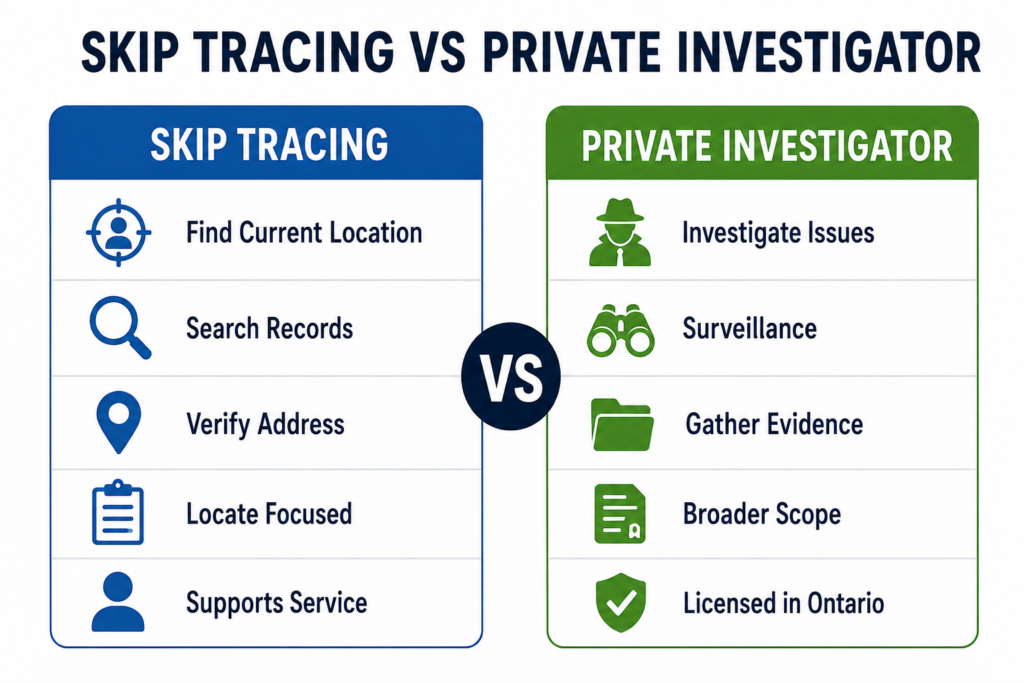
Skip tracing vs private investigator work can overlap, but they usually serve different purposes. Skip tracing focuses on locating a person or verifying contact information. A private investigator may conduct a broader investigation, which can include surveillance and other investigative work. In Ontario, the right choice depends on your goal, the information needed, and the scope of work.
The short answer
The main difference skip tracer investigator work is the scope of the assignment.
- Skip tracing is usually focused on a specific locate question.
- You may need to find a current address.
- You may need to confirm whether an old address is still connected to someone.
- You may need information before arranging document service.
A private investigator can handle broader investigative assignments. Ontario requires people working as private investigators to hold a valid licence. Businesses that sell private investigator services also require an agency licence.
This means skip tracing vs private investigator is not simply a choice between two names for the same service.
- The work can be different.
- The legal requirements can also differ.
Privacy is another factor. The Office of the Privacy Commissioner of Canada says organizations should identify why personal information is collected and limit collection to what is needed for that purpose.
Review the Office of the Privacy Commissioner of Canada’s guidance on fair information principles before using personal information as part of a locating or investigative assignment.
The first option explained
What skip tracing usually does
Skip tracing is generally a locate-focused service.
The goal is to identify useful information about a person.
You may start with:
- A full name
- A previous address
- A telephone number
- An email address
- An employer
- A business connection
- Other relevant identifiers
The search may involve comparing available records and checking whether different pieces of information connect to the same person.
The focus remains on the locate question.
For example, a creditor may have an old address for a judgment debtor. A skip trace can help identify possible current information before another service attempt.
This is why skip tracing vs private investigator matters in collection and litigation work.
A locate assignment may not require surveillance or a broad investigation.
When skip tracing may be appropriate
Skip tracing can make sense when you mainly need to:
- Locate a person
- Confirm an address
- Verify identifying information
- Check whether an old address remains useful
- Support a process serving assignment
- Fill an information gap in a collection file
If your need is locate service vs PI, first define the question you need answered.
A locate-only assignment can be more focused than a full investigation.
The second option explained
What a private investigator does
A private investigator can work on a wider range of investigative assignments.
Ontario describes a private investigator as someone whose work primarily consists of conducting investigations to provide information. A valid licence is required to work as a private investigator in Ontario.
Depending on the assignment and applicable requirements, investigative work may involve activities such as surveillance.
Surveillance means observing activity and documenting relevant observations.
That is different from simply searching records for a current address.
A private investigator may therefore be appropriate when your question goes beyond locating someone.
For example, you may need information about activity, conduct, or circumstances surrounding a person.
The exact scope should be agreed before the work begins.
Licensing matters
If you are considering a private investigator, check licensing.
Ontario maintains a public system for checking individual and agency licence status.
The province also requires private investigators to complete basic training and pass the required test before applying for a licence.
[VERIFY] Confirm the current licence status and applicable requirements before engaging an investigator for a specific assignment.
Skip tracing vs private investigator: a simple comparison
| Area | Skip tracing | Private investigation |
|---|---|---|
| Main purpose | Locate or verify information | Investigate a broader question |
| Typical scope | Locate only | Can include broader investigative work |
| Address search | Common | May be included |
| Record comparison | Common | May be included |
| Surveillance | Not normally the focus | May be part of the assignment |
| Licensing | Depends on the service and provider | Ontario private investigator licensing applies |
| Best starting point | You need a person located | You need an investigative question answered |
The table shows why skip tracing vs private investigator should be based on the result you need.
If the question is simply, “Where is this person now?” a locate-focused service may be suitable.
If the question is broader, you may need an investigator with the appropriate licence and experience.
Which one you need
Ask what you actually need answered
Before choosing between skip tracing vs private investigator, write down the exact question.
- Do you need an address?
- Do you need to verify a person’s identity?
- Do you need information about a business connection?
- Do you need observations about activity?
- The answer can help define the correct scope of work.
Choose skip tracing for a locate-focused need
If you mainly need to locate someone, skip tracing may be the more direct option.
This can be useful for creditors, collection agencies, litigation clerks, and process serving matters.
You can provide the information already in your file and explain what needs to be confirmed.
The provider can then focus on the locate question.
Choose a private investigator for broader investigation
If your assignment requires surveillance or a broader investigation, a licensed private investigator may be more appropriate.
The scope should be clear before work starts.
You should also confirm the investigator’s licence status where applicable.
Consider the full workflow
Sometimes locating someone is only the first step.
You may then need documents served.
Select Serve and File Process Server Inc. has served Ontario since 2005. The company supports process serving, court filing, document retrieval, and related locating work.
A coordinated workflow can help when a locate assignment leads directly into document service.
[CONFIRM] From real operating experience, one common source of unnecessary follow-up is requesting a broad investigation when the actual need is only a current address. Defining the locate question first can make the assignment clearer.
Know when the two can overlap
Skip tracing vs private investigator is not always an either-or decision.
- A broader investigation may begin with locating work.
- A locate assignment may also reveal information that suggests further investigation is needed.
- The key is to avoid assuming that one service automatically includes the other.
- Ask what the provider will actually do.
- Ask what information will be reported.
- Ask whether additional investigative work is within the agreed scope.
When to use professional support
If you are unsure do I need a PI or skip tracer, start with the outcome you need.
For a locate-only assignment, consider a service focused on finding or verifying information.
For surveillance or broader investigative work, consider a properly licensed private investigator.
If the matter involves court documents, service requirements can also apply. A locating result does not automatically establish that service is legally valid.
If you need legal advice about service, privacy, or investigative evidence, consult a licensed Ontario lawyer or paralegal.
If you need a locate or process serving assignment, provide the strongest information available and clearly explain the intended purpose.
Need documents served in Ontario? Request a quote or call (647) 568-5700.
This article provides general information about process serving and court procedure in Ontario. It is not legal advice and does not create a solicitor client relationship. Court rules and procedures change. Confirm current requirements with the relevant court or consult a licensed Ontario lawyer or paralegal before acting.