
Legal Courier vs Process Server: What’s the Difference in Ontario?
When legal documents need to be delivered quickly and accurately, choosing between a legal courier vs process server matters. Although both services involve transporting documents, they perform different functions and should not automatically be treated as interchangeable.
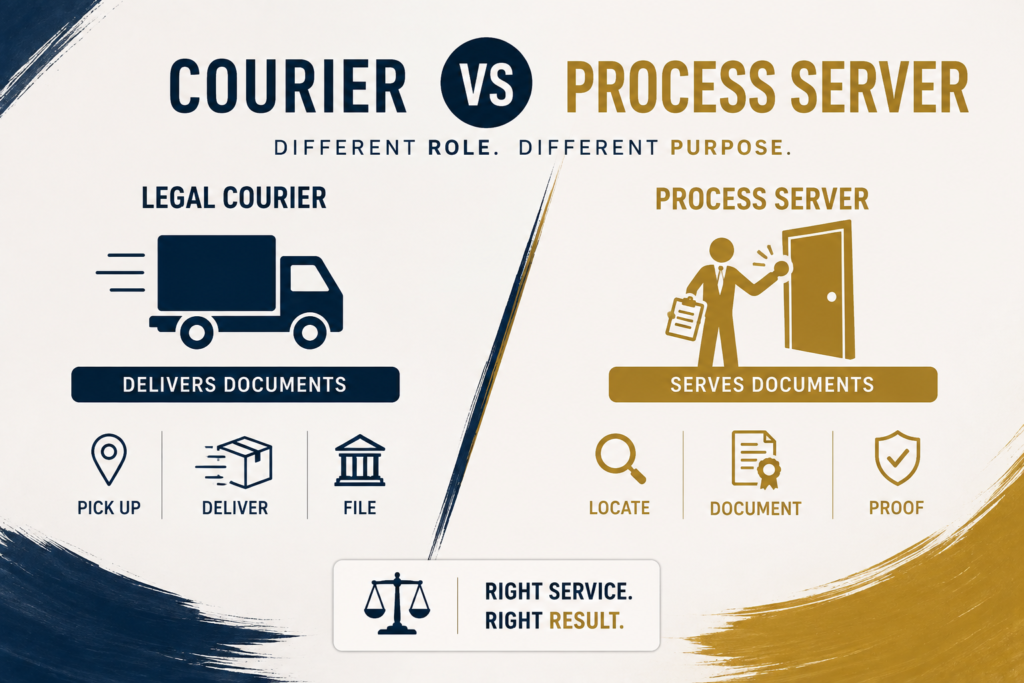
A legal courier generally transports documents or assists with deliveries and filings. A process server carries out service of legal documents according to the requirements that apply to the particular proceeding and provides documentation of what occurred.
This guide explains the difference between a legal courier vs process server, when each service may be appropriate, and what to consider before choosing a provider in Toronto, Brampton, Mississauga, Vaughan, or elsewhere in the GTA.
What Does a Legal Courier Do?
A legal courier primarily transports documents from one location to another.
Depending on the provider, legal courier services may include:
- Delivering documents between law offices
- Picking up and dropping off legal paperwork
- Delivering documents to clients
- Attending a courthouse or registry for filing
- Returning filed or stamped documents
- Handling same-day or scheduled deliveries
A courier’s role is generally focused on transport and delivery logistics.
A courier delivery or signature does not automatically mean that legal service has been completed. Whether a document has been validly served depends on the rules applicable to the specific proceeding and document.
What Does a Process Server Do?
A process server is engaged to carry out service of legal documents using the method required or authorized for the particular matter.
Depending on the proceeding, documents may include:
- Statements of claim
- Notices of application
- Motion materials
- Summonses
- Court orders
- Family law documents
- Small Claims documents
- Landlord and tenant documents
- Corporate litigation documents
A process server may also document attempts, prepare or support the applicable proof of service, and provide related services such as locate searches or skip tracing.
Legal Courier vs Process Server: Key Differences
| Feature | Legal Courier | Process Server |
|---|---|---|
| Primary role | Transport documents | Carry out legal service |
| Main focus | Delivery logistics | Service requirements and documentation |
| Personal service | Not generally the purpose | May be required depending on the document |
| Attempt documentation | Usually limited | Detailed service-attempt records |
| Proof of service | Not generally provided as the legal proof of service | Affidavit or other applicable proof-of-service support |
| Skip tracing | May not be available | Often available through specialized providers |
| Court filing | May be offered | May be offered |
| Rush service | Often available | Often available |
The key difference in legal courier vs process server is not simply how quickly a document moves from one place to another. It is the purpose of the assignment and the service requirements that apply to the legal proceeding.
When Should You Hire a Process Server?
A process server may be appropriate when you need to formally serve documents on another party.
Examples include:
- Starting a civil proceeding
- Serving motion materials
- Serving family law documents
- Serving Small Claims documents
- Serving court orders
- Serving landlord and tenant documents
- Serving corporate litigation documents
- Meeting a court-imposed service deadline
A process server can also help when the recipient is difficult to locate or attempts to avoid service.
If you are unsure whether a particular document requires personal service or another method, confirm the requirement with the relevant court or a licensed Ontario lawyer or paralegal.
When Is a Legal Courier the Better Choice?
A legal courier may be appropriate when the primary requirement is moving documents rather than formally serving them.
Examples include:
- Delivering paperwork between law offices
- Returning signed documents
- Picking up court-stamped copies
- Delivering supporting materials
- Transporting documents to or from a courthouse
- Handling routine or same-day legal deliveries
For these assignments, the courier’s speed, reliability, and document-handling procedures may be the most important considerations.
What If You Need Both Services?
Many legal matters require both document transportation and formal service.
For example, a law firm may need to:
- Prepare legal documents.
- Have documents delivered to a process server.
- Arrange formal service on the recipient.
- Receive proof of service.
- File the required documents with the court.
- Retrieve filed or stamped copies.
Using a provider that offers both courier and process serving services can simplify coordination.
Common Risks of Confusing a Courier With a Process Server
One of the biggest mistakes is assuming that handing a document to someone automatically constitutes valid service.
Potential problems can include:
- Service being challenged
- Missing or incomplete proof of service
- Additional service attempts
- Court delays
- Missed deadlines
- Additional legal costs
The exact consequences depend on the proceeding and the service requirements that apply.
A courier may successfully transport a document while still not completing the legal service required by the court.
What to Ask Before Hiring a Provider
When comparing a legal courier vs process server, ask the provider:
1. What exactly is included?
Confirm whether the assignment involves transportation, formal service, filing, or several services.
2. How is service documented?
Ask what proof or reporting you will receive after the assignment.
3. Can you handle difficult recipients?
If the recipient has moved or may avoid service, ask whether locate searches or skip tracing are available.
4. Do you offer rush service?
If there is a strict deadline, confirm whether same-day or urgent assignments are available.
5. Are court filing services available?
If documents also need to be filed, combining the services may save time.
6. Are charges clearly explained?
Ask about additional attempts, rush charges, skip tracing, filing fees, travel, and other potential costs before starting the assignment.
Why Choose Select Serve and File Process Server Inc.?
Select Serve and File Process Server Inc. provides both process serving and related legal support services across Ontario.
Services include:
- Process serving
- Legal courier services
- Rush and same-day assignments
- Skip tracing
- Locate searches
- Affidavit and proof-of-service support
- Court filing
- Document retrieval
The company has served in the region since 2005.
Whether you need a document transported or formally served, the appropriate service depends on the purpose of the assignment and the requirements of the applicable proceeding.
Legal Courier vs Process Server: Which One Do You Need?
The difference between a legal courier vs process server comes down to the purpose of the delivery.
Choose a legal courier when you primarily need documents transported, picked up, delivered, or filed.
Choose a process server when you need legal documents formally served and the service documented according to the applicable rules.
If you are uncertain which service you need, explain the document, recipient, location, and deadline to the provider. They can assess the practical requirements of the assignment, while legal questions about the required method of service should be confirmed with the appropriate court or legal professional.
Need Legal Documents Delivered or Served?
If you need a legal courier or process server in Ontario, Select Serve and File Process Server Inc. can assist with document delivery, formal service, court filing, skip tracing, and related support.
Need documents delivered or served? Request a quote or call (647) 568-5700.
“This article provides general information about legal document delivery and process serving in Ontario. It is not legal advice and does not create a solicitor client relationship. Court rules and procedures change. Confirm current requirements with the relevant court or consult a licensed Ontario lawyer or paralegal before acting.”