
How to Find the Registered Owner of an Ontario Business
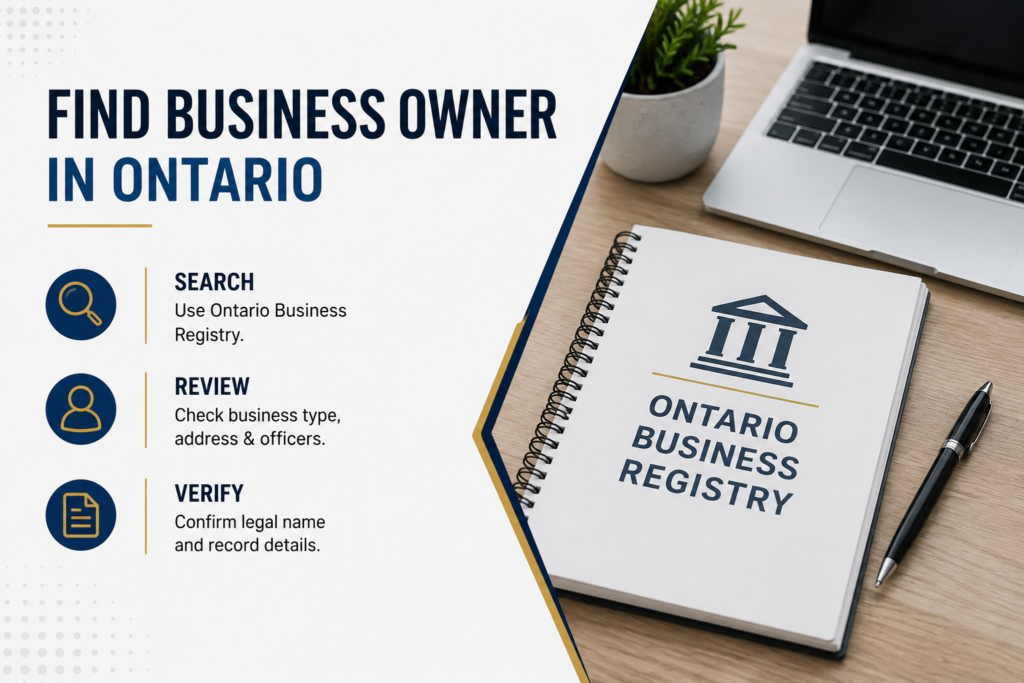
To find business owner in Ontario, start with the Ontario Business Registry and confirm the business’s legal identity. The registry can provide public business information and search products. Your search should distinguish between a corporation, sole proprietorship, partnership, and business name registration before you rely on the result.
What you need before you start
To find business owner in Ontario, first gather the strongest information you already have.
You may have the business name, a website, an invoice, a contract, or an address. A legal business name is more useful than a trading name or brand.
- You should also decide what you are trying to confirm.
- You may want to identify a corporation.
- You may want to confirm a registered office.
- You may need to identify officers or directors.
- You may simply need to verify whether a person operates a business under a registered name.
These are different questions.
The Government of Ontario states that the Ontario Business Registry allows searches for basic information about businesses and not-for-profit organizations. More detailed search products are also available through the registry.
The steps in order
1. Identify the legal business name
Start with the name you believe the business uses.
Do not assume that the name on a sign or website is the legal name.
A business may operate under a registered business name that differs from the owner’s personal name.
A corporation also has its own legal identity.
A business name search Ontario can help you determine whether the name appears in the provincial registry.
Write down the exact spelling.
Also record any corporation number or other identifying information you already have.
2. Search the Ontario Business Registry
Use the Ontario Business Registry to search for the business.
The registry is Ontario’s official system for businesses and other registered entities. It allows users to search for basic business information and order available search products.
A basic search can help you confirm that the business exists in the registry.
It may also help you distinguish between similar business names.
3. Check the business structure
Look at the type of entity shown in the record.
This matters because ownership information can differ by structure.
A corporation is separate from the individuals who own its shares.
A sole proprietorship is different. The business is operated by an individual.
A partnership has its own structure and registration information.
Ontario recognizes different business structures, each with different legal and tax considerations.
Do not treat every registered business name as evidence that the person listed is a corporate shareholder.
4. Review the available business information
Review the information returned by the registry.
Depending on the entity and search product, information may include the registered office or other address information.
The Ontario government states that much information filed in the OBR, including registered office or other address information, is placed on the public record and available for searches.
A registered owner search should therefore focus on the exact information the record supports.
Do not assume that every person connected with a business owns it.
5. Check for officers and directors
For a corporation, review the information available about its officers and directors.
These roles do not necessarily mean the person owns the corporation.
An officer may manage the corporation.
A director has a governance role.
Share ownership is a separate issue.
This distinction matters if you are trying to find business owner in Ontario for collection, litigation, or service purposes.
A corporate record can help identify the legal entity and people connected with it. It may not answer every question about beneficial ownership.
6. Review the corporate profile
If you need more detailed information, consider an appropriate corporate profile or other available registry search product.
The Ontario Business Registry identifies profile reports and document copies among its available search products.
A corporate profile can provide more information than a basic name search.
The exact information available depends on the entity and record requested.
[VERIFY] Confirm the current contents and availability of the specific Ontario Business Registry search product before relying on it for an active matter.
7. Compare the information with your records
Do not stop after finding a matching name.
Compare the registry information with the information you already have.
Check the business name.
Check the corporation number, where available.
Check the registered office.
Check known addresses.
Check the names of relevant individuals.
This comparison can reduce the risk of confusing two businesses with similar names.
8. Record what you found
Keep a clear record of the search.
Record the date of the search.
Save the relevant search result or document.
Record the exact legal name.
Note the corporation number or other identifier.
This creates a useful audit trail if another person needs to review the work later.
How to prove it was done properly
To find business owner in Ontario reliably, you should be able to show how you reached your result.
- Keep the original business name you searched.
- Keep the registry information you relied on.
- Record any differences between the trading name and legal name.
- If you obtained a corporate profile, keep that record with your file.
- You should also distinguish between information the registry confirms and information you inferred from other sources.
For example, finding a person listed as a director does not automatically prove that person owns all or part of the corporation.
The Ontario Business Registry also notes that public information can include registered office and other address information, while some administrative contact information is not shown on the public record.
That distinction can matter during a locate or service assignment.
Mistakes that cause problems
Searching only the trading name
A website may use a brand name that differs from the legal entity.
Search the strongest legal name available.
Assuming a director is the owner
Directors and owners are not automatically the same people.
Do not make that assumption from a corporate search alone.
Confusing a master business licence with corporate ownership
A registered business name can identify the person or entity operating under that name.
It does not create a corporation.
The record should be read according to the business structure shown.
Ignoring changes in the record
Business information can change.
A previous search may not reflect the current registry record.
Use current information if the search supports an active collection, litigation, or service matter.
Treating public information as unrestricted
Business records can contain information connected to identifiable people.
The Office of the Privacy Commissioner of Canada explains that publicly available personal information can still be subject to privacy rules. Collection and use should relate to an appropriate purpose.
You should handle registry information carefully and only use it for a legitimate purpose.
Relying on one source
A registry search is useful, but it may not answer every question.
A court search, property search, or locate search may be needed separately.
Each source answers a different question.
[CONFIRM] From real operating experience, one issue that often causes unnecessary follow-up is treating a trading name as the legal entity. Confirm the exact registered name and business structure before arranging service or further searches.
When to use a professional
You can perform a basic find business owner in Ontario search yourself.
Professional support can help when the search forms part of a larger collection, locate, litigation, document retrieval, or process serving assignment.
Select Serve and File Process Server Inc. has served Ontario since 2005. We provide process serving, court filing, document retrieval, and related administrative support.
If you need to find business owner in Ontario for an active matter, accurate entity identification can make later steps easier. A professional can help organize the search information and coordinate related administrative services.
Need documents served in Ontario? Request a quote.
This article provides general information about process serving and court procedure in Ontario. It is not legal advice and does not create a solicitor client relationship. Court rules and procedures change. Confirm current requirements with the relevant court or consult a licensed Ontario lawyer or paralegal before acting.