
How to Verify Someone’s Address Before Serving
To verify address before serving documents, start by checking the address against reliable records, recent information, and, where needed, field confirmation. You should confirm that the address is linked to the correct person before arranging service. A careful address check can reduce wasted attempts and help you document the steps taken.
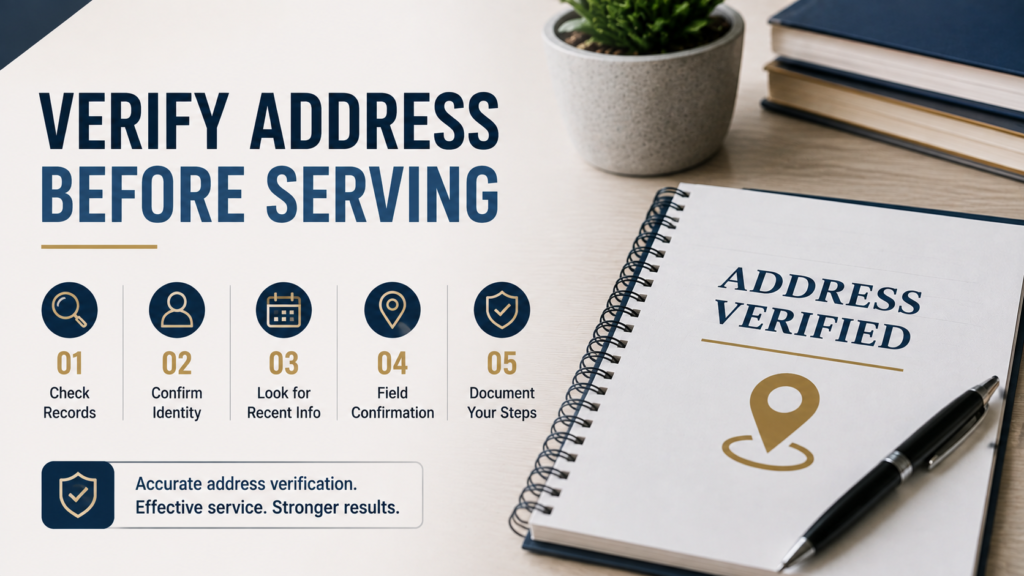
What you need before you start
Before you verify address before serving documents, gather all the information already available to you.
You may have a last known address, phone number, email address, employer information, business records, or previous service information.
Start with the person’s full legal name.
Add any other identifiers that can help distinguish that person from someone with a similar name.
You should also know why you are checking the address.
For example, you may need to confirm an address for service because an earlier attempt failed.
You may also be trying to determine whether the last known address is still current.
Keep the purpose narrow.
Address information can be personal information. The Office of the Privacy Commissioner of Canada’s guidance on publicly available information explains that publicly available information is not automatically unrestricted for every purpose. The purpose of collecting and using the information can matter.
The Ontario Business Registry can also provide public business information where the person is connected with a registered business. The Ontario Business Registry states that certain filed business information, including registered office and other address information, is available for searches.
The steps in order
1. Review the last known address
Start with the address already in your file.
Check where it came from.
Record when it was provided.
An old address is useful evidence, but it should not automatically be treated as a current address.
Ask yourself, is this address current?
If you have newer information, compare it with the last known address.
2. Compare available records
Look for other records that may confirm the person’s connection with the address.
Depending on the matter, these may include business records, court records, public directories, or information supplied by the client.
Do not treat every matching name as proof of occupancy.
A name and address combination should be assessed with the other information available.
This is where address verification legal considerations can matter.
The goal is not to collect everything available about a person.
The goal is to collect enough reliable information for the specific service purpose.
3. Confirm the person’s identity
Check whether the address belongs to the correct individual.
Similar names can create problems.
A person may also have moved while another person with the same name remains at the old address.
Use available identifiers where appropriate.
These might include a middle name, previous address, business connection, or other reliable information.
Accurate identity matching is a key part of trying to verify address before serving documents.
4. Check for recent information
Look for signs that the address may have changed.
A newer address from a reliable source may be more useful than an older record.
Review the date associated with the information where one is available.
Do not assume that a recently found address is automatically correct.
Compare it against other information before arranging service.
If the information conflicts, flag the conflict instead of ignoring it.
5. Consider a field confirmation
If records do not provide enough confidence, a field confirmation may be appropriate.
A field confirmation means checking the location to determine whether there are signs connecting the person with the address.
An occupancy check can provide useful operational information.
However, an observation at a property does not automatically prove that a person lives there.
The purpose is to gather relevant information without making assumptions.
[VERIFY] Confirm the current legal and procedural requirements for any address verification method before using it for a specific court matter.
6. Decide whether further locating is needed
If the address cannot be confirmed, consider whether a broader locate search is necessary.
You may have an old address but no reliable current information.
You may also have conflicting records.
In those situations, repeatedly attempting service at the same address may not solve the problem.
A professional locate search can help identify additional information before another service attempt.
7. Document the verification
Record what you checked.
Note the source of each address.
Record the date of the information where available.
Keep relevant search results and notes.
If a field confirmation was completed, record what was observed.
Avoid adding assumptions that were not supported by the search.
A clear record helps show how you reached the decision to proceed.
How to prove it was done properly
To verify address before serving documents, you should be able to explain why you believed the address was suitable.
Keep the original address provided by the client.
Record any additional address information found during your checks.
Note conflicting information.
Keep supporting records where appropriate.
This creates a useful administrative trail.
If service later becomes disputed, the search history can help explain what information was available before the attempt.
It does not determine whether service was legally valid.
That question depends on the applicable court rules and circumstances.
[CONFIRM] From real operating experience, one issue that often causes unnecessary follow-up is treating a previous successful service address as permanently current. Confirm the address again when there are signs the person may have moved.
Mistakes that cause problems
Using only the last known address
A last known address is a starting point.
It is not automatically proof that the person still lives there.
Searching by name alone
A matching name can belong to several people.
Use additional identifying information where available.
Ignoring conflicting information
If two sources show different addresses, investigate the difference.
Do not simply choose the address that is easiest to use.
Repeating a failed attempt
A failed attempt may provide useful information.
For example, a resident may indicate that the person moved.
Record that information and assess whether another search is needed.
Repeated attempts without updated information can lead to a wasted attempt.
Collecting too much personal information
Only collect information relevant to the purpose.
The Office of the Privacy Commissioner of Canada explains that PIPEDA includes principles covering appropriate purposes and limiting the collection, use, and retention of personal information.
Use information carefully.
Do not treat public availability as permission to use information for every purpose.
Assuming occupancy proves residence
Seeing a person’s vehicle at an address does not automatically establish legal residence.
Likewise, speaking with another person at the property does not necessarily prove the target’s current address.
Record observations accurately.
Avoid conclusions that the evidence does not support.
When to use a professional
You can perform basic checks yourself.
Professional support can be useful when you need to confirm address for service as part of a larger process serving, locate, collection, or litigation assignment.
Select Serve and File Process Server Inc. has served Ontario since 2005. We provide process serving, court filing, document retrieval, and related administrative support.
Professional assistance can be especially useful when an earlier attempt failed or available records conflict.
The goal is to reduce uncertainty before another service attempt.
If you need to verify address before serving documents, start with the information already available, compare reliable records, document your checks, and arrange further locating work when necessary.
Need documents served in Ontario? Request a quote or call (647) 568-5700.
This article provides general information about process serving and court procedure in Ontario. It is not legal advice and does not create a solicitor client relationship. Court rules and procedures change. Confirm current requirements with the relevant court or consult a licensed Ontario lawyer or paralegal before acting.