
Ontario Skip Tracing Tools: What Professionals Use in 2026
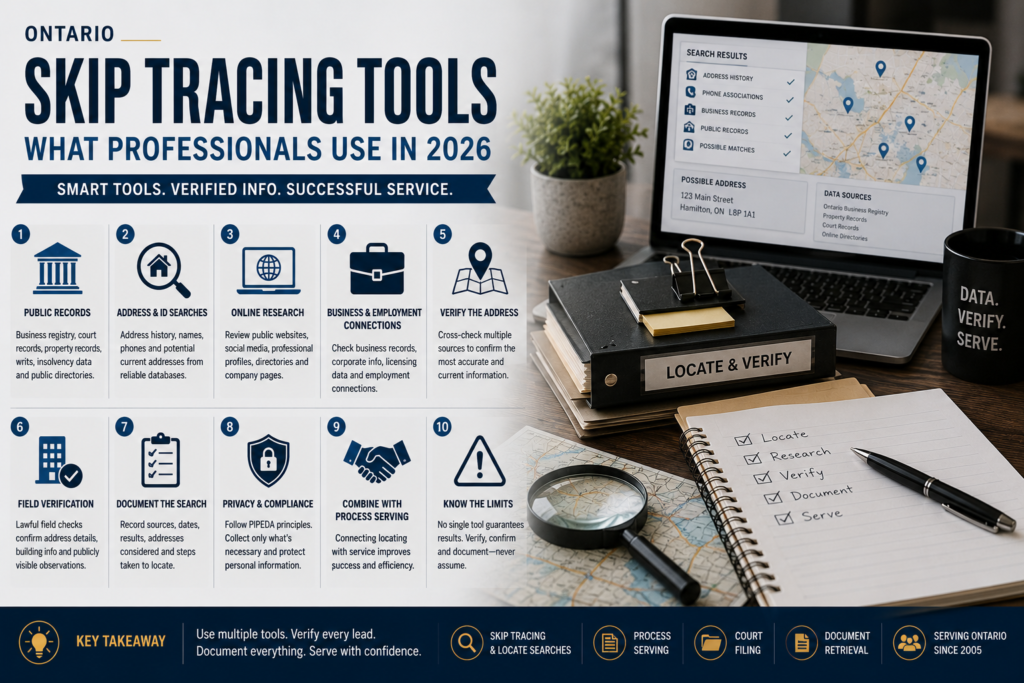
Professional skip tracing tools Ontario teams use are not limited to one database or website. Effective locating work combines public records, business information, open-source research, address checks, and field verification. The goal is to identify reliable information lawfully, document the search, and support the next step in a legal or business matter.
1. Start With Public Records
Public records can provide useful leads when someone has moved or cannot be located.
Depending on the matter and access available, professionals may review:
- Business registration information
- Property-related records
- Court records
- Insolvency information
- Writ and litigation searches
- Public directories
The Ontario Business Registry can provide publicly available business information and business search products.
These sources are useful for confirming connections between a person, business, or organization. They should not be treated as proof that a particular address is currently occupied.
2. Use Address and Identity Searches
One of the most useful skip tracing tools Ontario professionals rely on is address-history research.
Commercial databases may help identify:
- Previous addresses
- Possible current addresses
- Associated names
- Telephone information
- Potential address connections
Information from these sources should be cross-checked before being relied upon. A database result is a lead, not automatically a confirmed location.
3. Research Public Online Information
Open-source research can add another layer to a skip trace.
Professionals may review publicly accessible:
- Business websites
- Professional profiles
- Public social media posts
- Online directories
- Company pages
- Public listings
For example, a public professional profile may indicate a current employer or business connection.
However, public availability does not mean information can be collected or used without limits. The Office of the Privacy Commissioner of Canada guidance on PIPEDA’s fair information principles explains principles such as limiting collection, appropriate use, accuracy, and safeguards.
4. Check Business and Employment Connections
Business information can sometimes provide a useful lead when residential information is outdated.
Professionals may compare:
- Business names
- Corporate records
- Professional profiles
- Company websites
- Public directories
- Publicly available licensing information
The Ontario Business Registry is one source for publicly available business information.
Employment information should be handled carefully. A workplace lead should be verified before a service attempt is planned.
5. Verify the Address Before Service
Finding an address is only part of successful skip tracing.
Before using information to arrange service, professionals may compare multiple indicators, such as:
- Address history
- Public records
- Building information
- Public business connections
- Available field observations
This helps reduce unsuccessful attempts caused by outdated or incomplete information.
[CONFIRM] In practical process serving work, treating the first database result as confirmed can create unnecessary failed attempts. Confirm this observation against your team’s current operating experience.
6. Use Field Verification When Appropriate
Digital skip tracing tools Ontario professionals use can identify leads, but fieldwork can sometimes help confirm what online sources cannot.
Depending on the circumstances, lawful field research may involve:
- Confirming whether an address exists
- Checking building or unit information
- Observing publicly visible property details
- Speaking with appropriate contacts without misrepresentation
The purpose is to verify information, not to intrude into private spaces or obtain confidential information.
7. Document the Search Process
A professional skip trace should be documented.
Record:
- Sources checked
- Search dates
- Information discovered
- Addresses considered
- Verification steps
- Unsuccessful searches
- Relevant observations
Detailed records can be useful when a client later needs to explain what reasonable efforts were made to locate someone.
In some family law circumstances, Ontario’s Family Law Rules specifically refer to evidence about steps taken to locate a person when seeking substituted service.
8. Protect Personal Information
Skip tracing involves personal information, so privacy should be part of the process.
The OPC explains that organizations subject to PIPEDA must limit the collection, use, disclosure, and retention of personal information to appropriate purposes.
Professionals should not rely on hacked information, restricted databases accessed improperly, private account credentials, or other unlawfully obtained information.
Use information only for legitimate purposes and protect it appropriately.
9. Combine Skip Tracing With Process Serving
The strongest workflow often connects locating work with the actual service assignment.
Select Serve and File Process Server Inc. provides skip tracing, locate searches, process serving, court filing, document retrieval, and related services. The company has served Ontario since 2005.
This allows locating information to be assessed alongside the practical requirements of the service assignment.
If a recipient cannot be found, the next step may involve additional locating work or another procedural option. Do not assume that skip tracing alone authorizes an alternative method of service.
10. Know the Limits of Skip Tracing Tools Ontario
No database guarantees a current address.
A good skip tracing tools Ontario workflow uses multiple sources and treats results as information to verify.
Avoid relying on:
- A single database hit
- Unverified social media claims
- Old address records
- Anonymous tips
- Information obtained through unauthorized access
The objective is accurate, lawful, and documented locating work.
Need documents served in Ontario? Request a quote or call (647) 568-5700.
“This article provides general information about process serving and court procedure in Ontario. It is not legal advice and does not create a solicitor client relationship. Court rules and procedures change. Confirm current requirements with the relevant court or consult a licensed Ontario lawyer or paralegal before acting.”