
Top 10 Mistakes People Make When Serving Documents Ontario
Serving documents Ontario requires more than simply handing paperwork to another person. The correct service method, recipient, timing, and proof of service can all matter. Small mistakes can lead to failed service attempts, filing problems, or delays. This guide covers ten common mistakes and practical ways to avoid them.
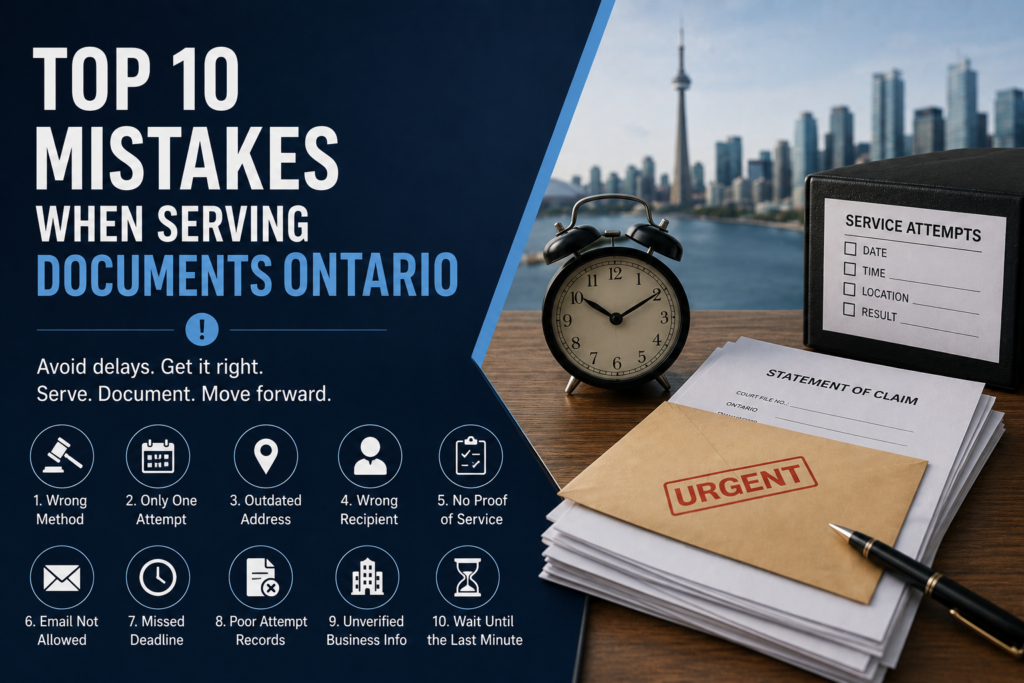
1. Use the Wrong Service Method
One of the most common mistakes when serving documents Ontario is assuming every document can be delivered the same way.
Depending on the proceeding, service may involve personal service, another permitted method, or a method authorized by the court.
For civil matters, review the Ontario Rules of Civil Procedure (O. Reg. 194) for the applicable requirements.
If you are unsure which method applies, confirm it with the relevant court or a licensed Ontario lawyer or paralegal.
2. Make Only One Service Attempt
A single unsuccessful attempt may not provide enough information to move forward.
A professional serving documents Ontario assignment may require attempts at different times or locations, depending on the circumstances.
Record each attempt carefully, including:
- Date and time
- Location
- Access conditions
- What occurred
- Information learned during the attempt
Do not assume that a specific number of attempts is always required.
3. Serve at an Outdated Address
An old address can waste valuable time.
Before serving documents Ontario, review the information available about the recipient.
Depending on the assignment, a professional may use:
- Locate searches
- Skip tracing
- Public records
- Workplace information
- Lawful occupancy checks
An address should be assessed carefully before relying on it for another service attempt.
4. Fail to Confirm the Recipient’s Identity
Finding the right address does not automatically mean you have found the right person.
Identity confirmation can be especially important when several people have similar names.
A professional process server should document how the recipient was identified when relevant to the service assignment.
When serving documents Ontario, never assume that a person at an address is automatically the intended recipient.
5. Complete the Service but Neglect the Proof
Successful delivery is only part of the process.
Depending on the proceeding, you may need an affidavit or other proof showing:
- Who was served
- Where service occurred
- When it occurred
- How service was completed
- Other relevant service details
A mistake in the proof can create problems even when the physical delivery was completed correctly.
6. Assume Email Service Is Always Permitted
Email can be useful, but you should not assume that sending documents electronically automatically completes valid service.
The applicable rules may require another method or specific authorization.
Before serving documents Ontario electronically, confirm whether the method is permitted for your particular proceeding.
A process server can carry out an authorized service method, but should not be treated as a substitute for legal advice.
7. Ignore the Service Deadline
Timing matters.
Before serving documents Ontario, identify the actual deadline and any related hearing or filing date.
Provide the process server with:
- Court or tribunal information
- Relevant deadline
- Hearing date
- Previous service information
- Filing requirements, if known
Do not invent or assume a service deadline. Confirm it from the applicable court materials or with a licensed legal professional.
8. Keep Poor Records of Failed Attempts
Failed attempts can still be important.
If the recipient is unavailable, the server should record what actually happened.
Useful records may include:
- Exact date and time
- Location visited
- Access information
- Observations
- Conversations relevant to the attempt
- Whether the location appeared occupied
[CONFIRM] From practical process serving experience, incomplete attempt notes are one of the easiest ways to weaken the record of a difficult service assignment. Confirm this observation against your team’s current operating experience.
Detailed records can also help a legal professional assess what options may be available if ordinary service cannot be completed.
9. Rely on Unverified Business Information
When serving documents Ontario on a corporation or other business, confirm the legal identity before attending.
The Ontario Business Registry can be useful for checking available business information.
Depending on the assignment, also review:
- Legal business name
- Business address
- Corporate information
- Known operating locations
- Relevant individual names
Do not assume that a trade name and legal entity are the same thing.
10. Wait Until the Last Minute
Urgent service can be difficult when instructions arrive just before a deadline.
If you know that documents must be served, start early whenever possible.
Early instructions give the process server more time to:
- Review the documents
- Confirm the address
- Plan attempts
- Conduct a locate search if needed
- Handle unsuccessful attempts
- Prepare proof of service
When serving documents Ontario, planning ahead is usually easier than trying to solve an address or access problem at the last moment.
How to Avoid These Serving Documents Ontario Mistakes
Before assigning service, prepare a complete package.
Provide:
- The documents to be served
- Recipient’s full name
- Current or last known address
- Workplace information, if available
- Court file information
- Known deadline
- Previous attempt details
- Any relevant service instructions
A professional process server can then assess the assignment and document the work completed.
Why Choose Select Serve and File?
Select Serve and File Process Server Inc. provides serving documents Ontario services alongside skip tracing, locate searches, court filing, document retrieval, and urgent service.
The company has served Ontario since 2005.
Professional service can help create a clear record of attempts and completed service. The appropriate method still depends on the document, proceeding, applicable rules, and any court order.
Need documents served? Request a quote or call (647) 568-5700.
“This article provides general information about process serving and court procedure in Ontario. It is not legal advice and does not create a solicitor client relationship. Court rules and procedures change. Confirm current requirements with the relevant court or consult a licensed Ontario lawyer or paralegal before acting.”