
What Is an Application Record and What Goes In It?
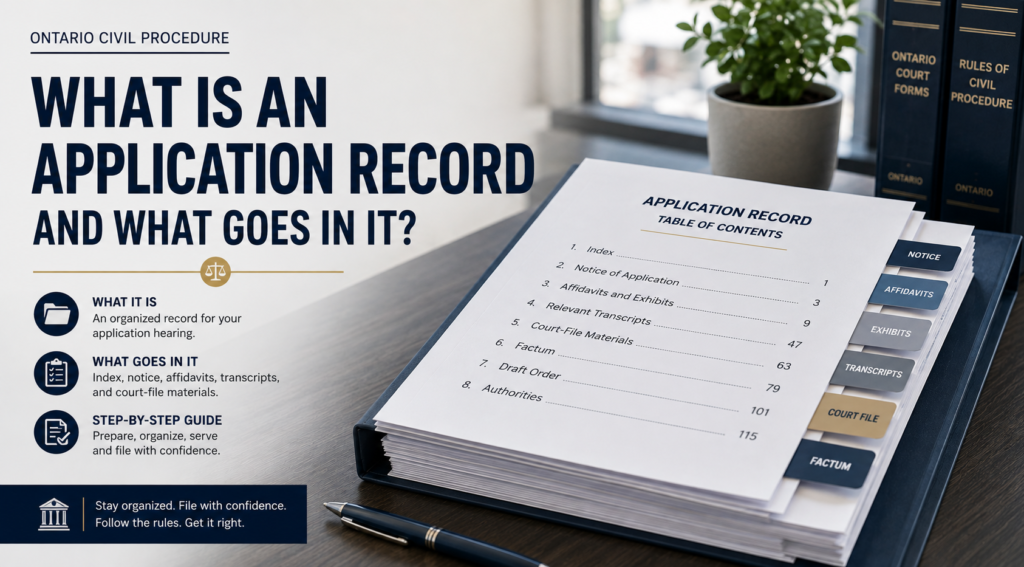
An application record Ontario is an organized set of documents used for an application hearing in the Ontario Superior Court of Justice. It brings key materials together for the judge. For civil applications under Rule 38, the record generally includes an index, notice of application, affidavits, relevant transcripts, and necessary court-file materials.
Why it matters in Ontario
An application record Ontario helps the court review the materials needed for an application in one organized package.
An application is a court proceeding started by a notice of application. Under Rule 38, the rule applies to proceedings started by a notice of application, subject to stated exceptions.
The record is not simply a collection of every document connected with the case. It has a defined purpose. You should include the materials required for the application and organize them in the required order.
If you are researching what is an application record, start with the current Rules of Civil Procedure. Rule 38.09 sets out requirements for application records and factums in applicable civil applications.
The official Ontario Court Forms website provides current forms under the Rules of Civil Procedure. It also identifies the Notice of Application form and other related forms.
You should also review the Superior Court of Justice practice directions before preparing your materials. Practice directions can provide additional instructions for court proceedings.
The exact application record Ontario requirements can depend on the proceeding and current court directions.
What it involves in practice
1. Start with the notice of application
The notice of application identifies the proceeding and tells the respondents what application is being brought.
The Ontario Court Forms website currently lists Form 14E as the Notice of Application under the Rules of Civil Procedure.
Make sure the information in the notice is consistent with the rest of your materials.
Check the court file number, party names, place of commencement, and hearing information.
2. Build the index
The application record starts with a table of contents, sometimes called an index.
Under Rule 38.09, the table of contents describes each document, including each exhibit, by its nature and date. Exhibits should also be identified by their exhibit number or letter.
This makes the record easier to review.
Your index should match the documents actually included in the final record.
3. Add the affidavits and other material
Supporting affidavits are a central part of many applications.
Rule 38.09 refers to copies of affidavits and other material served by any party for use on the application.
If an affidavit contains exhibits, check that the referenced exhibits are included and correctly identified.
Do not assume that every document you have belongs in the record. The materials should relate to what the court needs for the application.
4. Include relevant transcripts
An application record can also include a list of relevant transcripts of evidence.
The rule calls for relevant transcripts to be listed in chronological order. The transcripts themselves do not necessarily have to be reproduced in the record.
If transcripts are relevant to your matter, check the current requirements before preparing the final record.
5. Add necessary court-file materials
The record can include other material already contained in the court file if it is necessary for the hearing.
This prevents the application from being separated from important earlier court materials.
However, this does not mean you should add every document from the court file.
Use the applicable rule and court directions to determine what belongs in the record.
6. Prepare the factum
A factum is a written document that presents a party’s argument and the facts and law relied upon.
For applications governed by Rule 38, the applicant generally serves and files an application record together with a factum.
The factum and application record should work together.
The record contains the evidence and court materials. The factum explains the argument based on those materials.
7. Number the pages
The documents in an application record Ontario must be organized with consecutively numbered pages under Rule 38.09.
Check the final document after assembly.
Page numbers should match the index. Exhibit references should point to the correct pages.
This is one reason preparing an application record should include a final page-by-page review.
8. Serve and file the record
Serving the application record and filing it with the court are separate steps.
Rule 38.09 requires the applicant, in applicable cases, to serve the application record and factum on respondents who have served a notice of appearance. The applicant must also file the record and factum with proof of service.
The rule also sets timing requirements before the hearing.
[VERIFY] The current deadline and filing procedure should be confirmed for your specific application, including any applicable practice direction or court order.
Where people commonly go wrong
The index does not match the record
One of the simplest problems is an index that was prepared before the final document changes.
If documents are added or removed, update the index and page numbers.
An exhibit is missing
An affidavit may refer to an exhibit that was not included in the final package.
Check every exhibit reference before filing.
Documents are in the wrong order
Rule 38.09 sets out the required order for an applicant’s application record.
Do not rely on an old application record as your only template.
The wrong version of a form is used
Court forms can be updated.
The Ontario Court Forms website warns users to check effective dates and avoid forms that have not yet come into force.
The record contains too much material
More documents do not automatically make a better record.
The record should contain the material required for the application and necessary for the hearing.
Filing and service are treated as one step
Submitting documents to the court does not automatically serve the other parties.
Keep separate records for service and court filing.
[CONFIRM] From real operating experience, one common problem is that the application record is changed at the last minute, but the index and page numbering are not updated. A final page-by-page comparison can catch this before filing.
When to use a professional
You may be able to prepare an application record Ontario yourself if you understand the applicable procedure and have complete materials.
Professional administrative support can be useful when you have a large record, multiple exhibits, filing requirements, or service that must be coordinated with filing.
Select Serve and File Process Server Inc. has served Ontario since 2005. We provide process serving, court filing, and document retrieval support.
We are a process serving company, not a law firm. We do not provide legal advice or decide which evidence, arguments, or documents you should use.
If you are unsure whether an application record is required, what should be included, or how the rules apply to your case, consult a licensed Ontario lawyer or paralegal.
The key to an application record Ontario is organization and accuracy. Start with the correct notice, build the index, add the required materials, number the pages, serve the record, and file it with the required proof.
Need documents served in Ontario? Request a quote.
This article provides general information about process serving and court procedure in Ontario. It is not legal advice and does not create a solicitor client relationship. Court rules and procedures change. Confirm current requirements with the relevant court or consult a licensed Ontario lawyer or paralegal before acting.