
How to Prepare and File a Motion Record in Ontario
How to file a motion record Ontario starts with identifying the correct motion procedure, preparing the required documents, organizing them in the required order, serving the materials, and filing proof of service with the court. The exact requirements can vary by proceeding, so always check the current court rules and directions before filing.
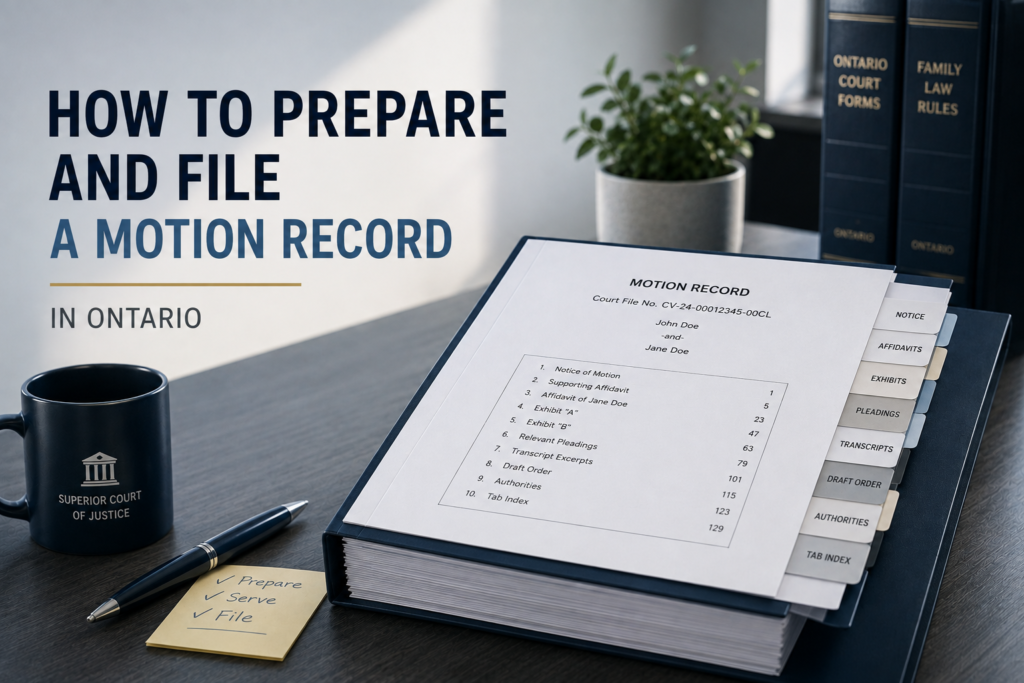
What you need before you start
Before learning how to file a motion record Ontario, make sure you understand what type of motion you are bringing.
A motion is a request asking the court to make an order. The documents supporting that request are called motion materials.
For a civil motion made on notice, Ontario’s Rules of Civil Procedure generally require a motion record unless the court orders otherwise. The record must be served on the other parties and filed with proof of service.
Your starting checklist should include:
- Notice of motion.
- Supporting affidavit or other evidence.
- Relevant pleadings.
- Relevant transcripts, where applicable.
- Other court-file material needed for the motion.
- Proof of service.
- Factum, where required.
- Draft order, where required.
The exact documents depend on your motion.
The official Ontario Court Forms website provides current court forms. Check the applicable form before preparing your package.
You should also review the Superior Court of Justice practice directions that apply to your proceeding.
Filing requirements can vary depending on the court, type of motion, hearing method, and current practice directions. Confirm the applicable requirements before filing.
The steps in order
1. Identify the motion requirements
Start by identifying the exact motion you are bringing.
Check whether your motion requires a motion record, factum, supporting affidavit, draft order, or other material.
Do not assume every motion uses the same package. Some motions can have different filing requirements.
This is the first step in how to file a motion record Ontario because the contents depend on the proceeding.
2. Prepare the notice of motion
Prepare the notice of motion using the applicable court form.
The notice tells the other parties and the court what order you are asking for.
Ontario’s current Rules of Civil Procedure identify Form 37A as the notice of motion form for civil proceedings.
Make sure the court file number, party names, hearing information, and requested relief are consistent throughout your documents.
3. Prepare the supporting affidavit
Prepare any affidavit required to support your motion.
An affidavit is a written statement sworn or affirmed by the person making it. It can provide evidence that the court considers when deciding the motion.
Attach the required exhibits and identify them clearly.
Do not add documents simply because they seem useful. The material included should comply with the applicable rules and directions.
4. Collect the required court materials
The Rules of Civil Procedure specify what a motion record should contain in applicable civil motions.
The contents include a table of contents, notice of motion, affidavits and other material served for use on the motion, a list of relevant transcripts, and other necessary court-file material.
This is the practical meaning of what goes in a motion record.
Review the court file before assembling the record. You may need earlier pleadings or other documents that are already part of the proceeding.
5. Organize the record
Arrange the documents in the required order.
The pages should be consecutively numbered. The table of contents should accurately identify the documents and exhibits included.
The goal is to make the record easy to review.
Depending on the applicable requirements, records may also need specific covers, binding, or other formatting.
6. Prepare the factum
A factum is a written summary of the facts and legal arguments relied upon by a party.
Not every motion has identical factum requirements.
Where a factum is required, prepare it according to the applicable rules and court directions.
Keep the factum consistent with the evidence and relief requested in your motion materials.
7. Serve the motion materials
Before filing the motion record, determine who must receive the documents and how service must be completed.
For a motion on notice, the moving party generally serves the motion record on the other parties and files it with proof of service.
Service and filing are separate steps.
If you need help with the service portion, arrange professional document delivery before the applicable filing requirement.
8. File the motion record
Once the materials have been served, file the motion record using the filing method that applies to your proceeding.
The court may accept eligible documents through an online filing service or another permitted method.
If you need administrative filing support, you can use file documents with the court.
Keep confirmation of your filing.
9. Check the completed filing
Review what was filed before the hearing.
Confirm that the court received the correct documents and that proof of service was included where required.
Keep copies of the submitted materials and any confirmation from the court.
How to prove it was done properly
Good records matter after how to file a motion record Ontario has been completed.
Keep a complete copy of the final motion record. Also keep your notice of motion, affidavits, exhibits, factum, proof of service, filing confirmation, and any court correspondence.
Your final package should be consistent.
Check:
- Party names.
- Court file number.
- Document dates.
- Page numbers.
- Exhibit references.
- Table of contents.
- Service information.
- Filing confirmation.
A factum should also match the evidence contained in the motion materials.
Mistakes that cause problems
Missing documents
A motion record can be incomplete if required material is left out.
Review the applicable rules and compare your record against the requirements before filing.
Incorrect document order
The record must follow the applicable order.
Ontario’s Rules of Civil Procedure specify an order for documents in a civil motion record.
Incomplete table of contents
The table of contents should accurately describe the documents and exhibits.
A mismatch makes the record harder to use.
Unclear exhibit references
Make sure exhibits referenced in an affidavit are included and identified consistently.
Filing without proof of service
Where proof of service is required, do not treat service as complete without keeping the appropriate proof.
Missing relevant court material
A motion record may need material already contained in the court file if it is necessary for the hearing.
Always perform a final page-by-page review before submission.
When to use a professional
You may be able to prepare a motion record yourself if you understand the applicable requirements.
Professional administrative support can help when you have multiple documents, several exhibits, urgent filing requirements, or filing and service that must be coordinated.
Select Serve and File Process Server Inc. has served Ontario since 2005. We provide process serving, court filing, and document retrieval support.
We are a process serving company, not a law firm. We do not provide legal advice or decide what legal arguments or evidence you should use.
If you are unsure what belongs in your motion record or what relief you should request, consult a licensed Ontario lawyer or paralegal.
The key to how to file a motion record Ontario is careful preparation. Identify the applicable procedure, prepare the correct documents, organize the record, serve the required parties, and keep proof of filing.
Need documents served in Ontario? Request a quote.
This article provides general information about process serving and court procedure in Ontario. It is not legal advice and does not create a solicitor client relationship. Court rules and procedures change. Confirm current requirements with the relevant court or consult a licensed Ontario lawyer or paralegal before acting.
Frequently Asked Questions
What is the deadline for filing a motion record in Ontario?
The deadline depends on the type of motion and applicable court rules or directions. For ordinary civil motions on notice, the Rules of Civil Procedure contain specific filing requirements. Other procedures can differ. Confirm the current deadline for your motion before serving or filing the materials.
What happens if the recipient refuses the documents?
A refusal by the recipient is a service issue, not a reason to ignore the filing requirements. The applicable service rules determine what happens next. Keep appropriate proof of service and confirm the correct procedure for your motion. If uncertain, consult a licensed Ontario lawyer or paralegal.
Do I need an affidavit of service afterwards?
Proof of service is generally required when the applicable motion procedure requires the motion record to be filed with proof of service. The exact document and method can vary. Keep the completed proof with your filing records and confirm the current requirements for your specific motion.