
Family Court Filing in Ontario: Document Checklist
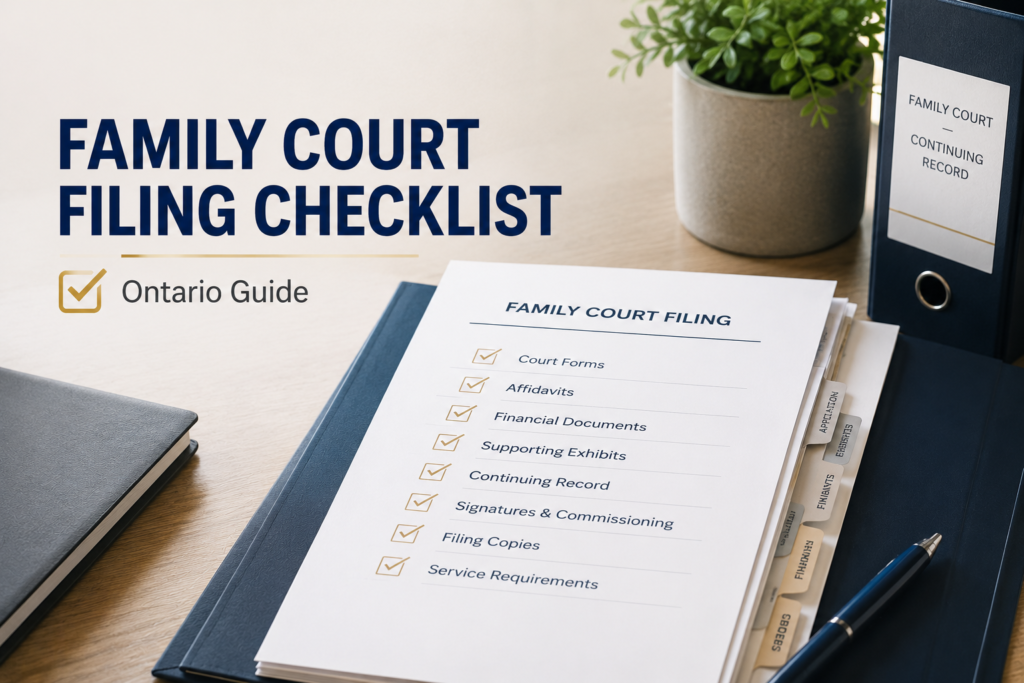
A family court filing checklist in Ontario can help you organize the documents needed for an Ontario family court proceeding. Your filing package may include court forms, affidavits, financial documents, and materials for the Continuing Record. The exact documents depend on your case, so always check the current court requirements.
Why this matters
A good family court filing checklist in Ontario helps you catch missing documents before submission. Family court filings can involve several forms and supporting records.
The Family Law Rules set requirements for documents filed in family proceedings. The rules can also differ depending on the type of step you are taking.
The official Ontario Court Forms website provides current forms for Ontario family proceedings. Check the applicable form before preparing your filing package.
You should also review the current practice directions of the Superior Court of Justice. The Superior Court of Justice practice directions provide procedural information that can apply to family court matters.
The exact family court filing checklist Ontario you need depends on your proceeding.
A checklist is useful because it separates the documents you need from documents you may not need.
Here is the list in full:
1. Check the correct family court forms
- Start by identifying the forms that apply to your proceeding.
- Family court forms Ontario resources include forms for different family court processes. Do not download a form from an old website without checking its current status.
- For example, Form 8 is used for an application in certain family law proceedings. However, you should confirm whether it applies to your particular matter.
2. Confirm the court and court file number
- Make sure your documents identify the correct court and proceeding.
- If you already have a court file, use the correct court file number throughout your documents.
- A mismatch between the file number, party names, or court information can create administrative problems.
- This is a basic but important part of any family court filing checklist Ontario.
3. Prepare the main application or response
- Your main court document explains what proceeding you are starting or responding to.
- The document depends on your situation. Different family proceedings use different forms and processes.
- Do not assume that the document used in one family matter applies to another.
- If you are unsure what to file family court, check the official Ontario Court Forms website or consult a licensed Ontario lawyer or paralegal.
4. Prepare affidavits and supporting documents
- Affidavits are written statements made under oath or affirmation.
- If your proceeding requires an affidavit, make sure it is completed and sworn or affirmed as required.
- Supporting documents may also be attached as exhibits. An exhibit is a document referred to and attached to an affidavit.
- Check each affidavit before filing. Make sure referenced exhibits are included and clearly identified.
5. Complete financial documents where required
- Financial information is important in many family law matters.
- You may need a financial statement and supporting financial information, depending on the issues in your case.
- The exact financial documents required can depend on the proceeding and relief being requested.
- Do not submit financial information simply because you have it. Check what the applicable rules and forms require.
6. Review the Continuing Record
- A continuing record is the organized court record used in family proceedings.
- It brings required materials together as the case progresses.
- The Family Law Rules contain requirements about what belongs in the record and how it should be organized.
- Your family court filing checklist Ontario should therefore include a check of the existing Continuing Record if you are filing in an ongoing matter.
- If you are unsure how a Continuing Record works, review the applicable court rules or seek legal guidance.
7. Check signatures and commissioning
- Review every document that requires a signature.
- Some documents may also need to be sworn or affirmed before an authorized person.
- Do not assume that typing your name into a document satisfies every signing requirement.
- Signing, commissioning, and electronic filing requirements can vary by document and current court procedure. Confirm the applicable requirements before filing.
8. Check supporting exhibits and attachments
- Go through every document and check its references to attachments.
- If an affidavit refers to an exhibit, make sure the exhibit is actually included.
- Check that pages are readable and that attachments are in the correct order.
- A missing exhibit can make an otherwise complete filing package incomplete.
9. Check filing and service separately
- Filing your documents with the court is not the same as serving them on another party.
- You may have separate requirements for delivering documents and proving that service occurred.
- This distinction is one of the most important parts of a family court filing checklist Ontario.
10. Check the current filing method
- Some Ontario family court documents can be submitted electronically.
- The applicable process depends on the court and type of document.
- If you are using an online system, check the current instructions before uploading your documents.
How to apply this to your matter
A family court filing checklist Ontario should be treated as a preparation tool, not a substitute for the Family Law Rules.
Start with your proceeding.
Ask:
- What type of family matter is this?
- Is this a new case or an existing case?
- What document am I filing?
- Are financial documents required?
- Does the filing need an affidavit?
- Are exhibits attached?
- Does the Continuing Record need to be updated?
- Does the document also need to be served?
- What filing method applies?
- What confirmation should I keep?
This approach can help you identify gaps before submission.
You should also check the current forms and practice directions immediately before filing. Online articles can become outdated.
Check the final package
Before submitting, compare the documents against your checklist.
Look for:
- Correct party names.
- Correct court.
- Correct court file number.
- Current forms.
- Required signatures.
- Properly completed affidavits.
- Required exhibits.
- Financial documents, where applicable.
- Continuing Record requirements.
- Service requirements.
- Filing confirmation requirements.
When to use a professional
You may be able to prepare and file your own documents if you understand the applicable requirements.
Professional administrative support can help when you have several documents, an existing court file, filing and service requirements, or multiple filing steps.
Select Serve and File Process Server Inc. has served Ontario since 2005. We provide process serving, court filing, and document retrieval support.
We are a process serving company, not a law firm. We do not provide legal advice or determine which documents you should prepare.
If you are unsure which form applies, what information must be included, or what legal step you should take, speak with a licensed Ontario lawyer or paralegal.
The key to a family court filing checklist Ontario is checking the complete process, not just the main form. Review the current forms, supporting documents, Continuing Record, filing method, and service requirements before submission.
Need documents served in Ontario? Request a quote.
This article provides general information about process serving and court procedure in Ontario. It is not legal advice and does not create a solicitor client relationship. Court rules and procedures change. Confirm current requirements with the relevant court or consult a licensed Ontario lawyer or paralegal before acting.