
What to Expect When Filing at an Ontario Courthouse
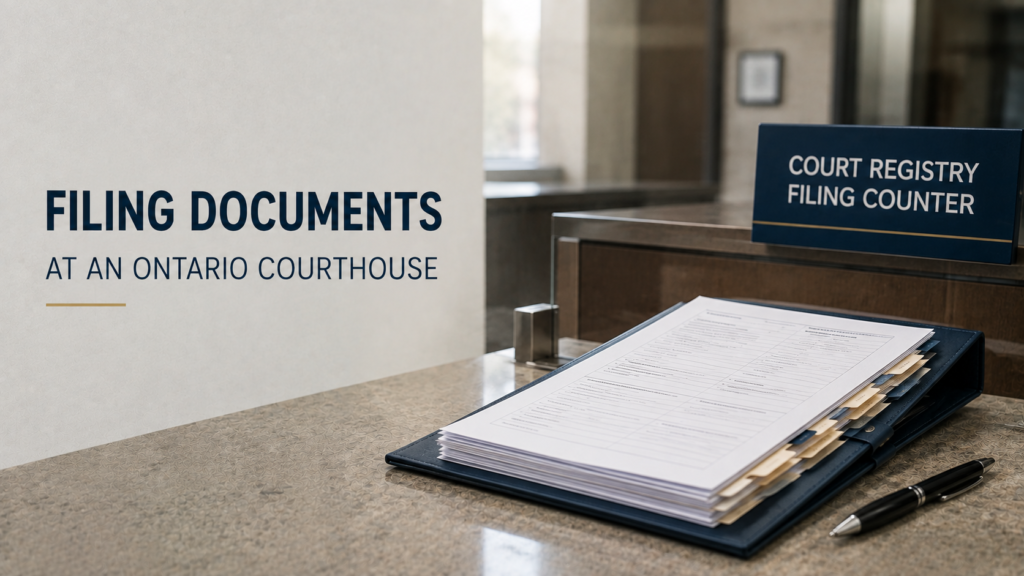
Filing documents at the courthouse Ontario involves bringing your completed documents to the appropriate court office for submission. You should arrive with the correct forms, supporting materials, and court file information. Court staff can process the filing, but they cannot provide legal advice about what you should file.
What you need before you start
Before filing documents at the courthouse Ontario, prepare your complete filing package.
Start by confirming the correct court and proceeding. Ontario has different courts and procedures, so the filing process depends on your matter.
The Ontario Court Forms website provides official forms for different Ontario court proceedings. Check the current version of the form before preparing your documents.
You should also have your court file number if you are filing documents for an existing case.
Your package may include:
- Completed court forms.
- Supporting documents.
- Affidavits and exhibits, where required.
- Existing orders or endorsements, where applicable.
- Copies required by the applicable procedure.
- Documents that have been signed or commissioned where required.
The exact requirements depend on your court and proceeding.
The Ontario government also provides online filing options for many matters. However, in-person filing remains available in circumstances where documents cannot or should not be submitted through an online process. (Ontario court services)
If you are unsure which filing method applies, check the current court instructions before attending.
Check court hours
Check the court office’s current court hours before travelling.
Court counters may have specific service hours that differ from the building’s general opening hours.
Court counter hours can change by location and service. Confirm the current hours with the relevant courthouse before attending.
The steps in order
1. Confirm the courthouse
Start by confirming where your matter should be filed.
Use the information on your court documents and current court instructions. If you already have a court file, use the court file number to help confirm the correct registry.
Do not assume that any courthouse can accept every type of filing.
2. Prepare your documents
Review every document before you leave.
Check names, dates, signatures, court information, and attachments. Make sure you have the required copies and supporting materials for the filing.
The Ontario Court Forms website is a useful starting point for checking current forms.
3. Check the applicable procedure
Review the current rules and practice direction for your proceeding.
A practice direction is an instruction issued by a court about how certain procedures should be handled.
The Superior Court of Justice publishes provincial and regional practice directions. These can contain requirements that apply to particular proceedings and filings. (Superior Court of Justice practice directions)
4. Bring your filing package
Take your completed documents to the appropriate court office.
Keep your originals and working copies organized.
If another person is attending on your behalf, make sure they have everything required to complete the filing.
5. Submit your documents
At the registry counter, provide the documents to court staff.
The court registry counter process can vary depending on the type of filing and the court office.
Court staff may review the documents for administrative requirements. They do not act as your lawyer or tell you what legal documents you should prepare.
6. Answer administrative questions
Court staff may ask for information needed to process the filing.
This can include your court file number, document type, party information, or other administrative details.
Answer accurately and provide the documents requested.
If there is a legal question about what you should file, ask a licensed Ontario lawyer or paralegal rather than relying on registry staff for legal advice.
7. Confirm the filing
Ask what confirmation you will receive after the documents are accepted.
Depending on the document and procedure, the court may return a stamped copy or provide another form of confirmation.
The terms issued and entered can have specific meanings in court procedure. Do not assume that every document is issued or entered simply because it was accepted at the counter.
8. Keep your records
Keep the filed or stamped documents with your court records.
Also retain any receipt, confirmation, or other information provided by the court.
This creates a record of what you submitted and helps you track the next step.
How to prove it was done properly
Good filing records are important.
If you are asking what happens when you file at court, the answer does not end when you hand over the documents.
You should leave with a clear understanding of whether the documents were accepted, what confirmation you received, and whether anything else is required.
Keep:
- A copy of every document submitted.
- The stamped or accepted copy, where provided.
- Filing confirmation.
- Receipts or reference information.
- Any correspondence from the court.
- Notes about follow-up requirements.
If the court tells you that something needs correction, record exactly what was requested.
Do not make legal changes based only on a general comment at the counter. If the issue affects your legal position, seek advice from a licensed Ontario lawyer or paralegal.
Mistakes that cause problems
Bringing an incomplete package
- One missing attachment can prevent you from completing the filing.
- Review the entire package before leaving for the courthouse.
Using an outdated form
- Forms can change.
- Check the current Ontario Court Forms website before attending.
Going to the wrong court office
- The fact that a courthouse is nearby does not mean it can process your filing.
- Confirm the correct court and registry first.
Arriving without the court file number
- For an existing proceeding, the file number is often essential for identifying the correct record.
- Keep it with your filing package.
Ignoring practice directions
- Court procedures can include requirements beyond the basic form itself.
- Review the applicable provincial and regional directions before filing.
Assuming filing means service
- Filing and service are different steps.
- Submitting a document to the court does not automatically mean the other party has received it.
When to use a professional
You may be able to handle filing documents at the courthouse Ontario yourself if your documents are complete and you understand the applicable filing process.
Professional administrative support can be useful when you have several documents, multiple filings, document retrieval needs, or filing and service that must be coordinated.
Select Serve and File Process Server Inc. has served Ontario since 2005. We provide process serving, court filing, and document retrieval support.
We are a process serving company, not a law firm. We do not provide legal advice or decide which documents you should file.
The key to filing documents at the courthouse Ontario is preparation. Confirm the correct court, check current requirements, bring a complete package, and keep proof of what you filed.
Need documents served in Ontario? Request a quote.
This article provides general information about process serving and court procedure in Ontario. It is not legal advice and does not create a solicitor client relationship. Court rules and procedures change. Confirm current requirements with the relevant court or consult a licensed Ontario lawyer or paralegal before acting.