
How to File a Defence in Ontario Small Claims Court
How to file a defence small claims Ontario starts with reviewing the claim, preparing the correct defence form, serving it on the plaintiff, and filing it with the court. In Ontario Small Claims Court, a defendant who wants to dispute a claim should respond within the applicable time. The exact requirements should always be checked against current court rules.
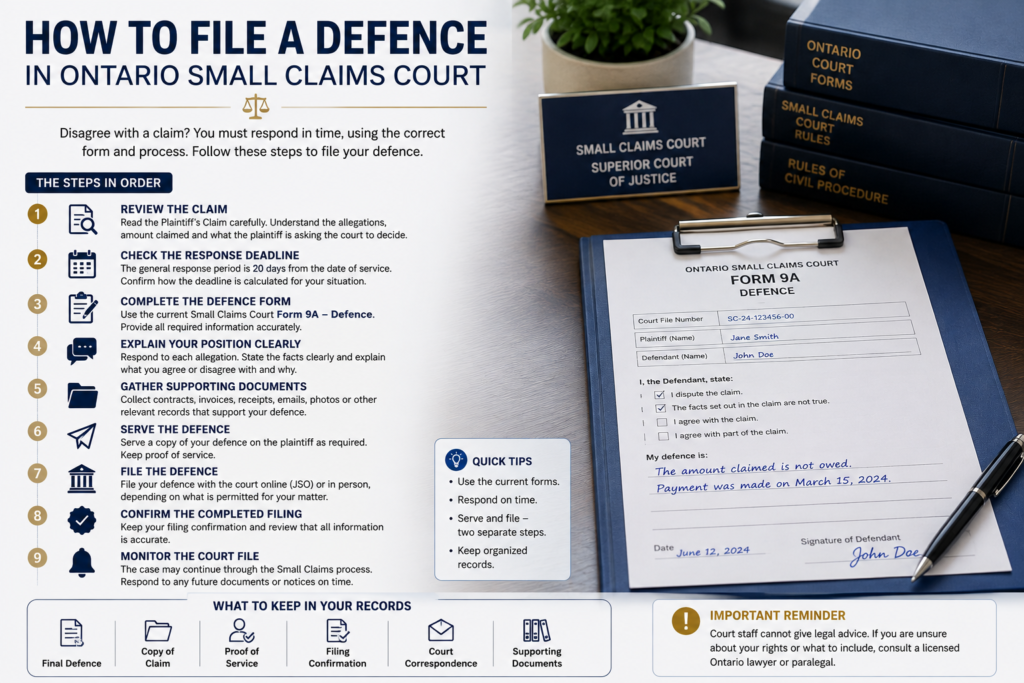
What you need before you start
Before learning how to file a defence small claims Ontario, read the claim carefully.
The claim tells you what the plaintiff is asking the court to decide. It also identifies the parties, court file, and allegations made against you.
If you disagree with the claim, you generally respond by filing a defence.
The official Ontario Court Forms website provides current Small Claims Court forms. Check the current form before preparing your response.
You should have:
- A copy of the Plaintiff’s Claim.
- The court file number.
- Correct names of all parties.
- The applicable defence form.
- Information needed to explain your position.
- Supporting documents, where appropriate.
- Information about where and how the defence must be served and filed.
The Small Claims Court Rules identify the procedure for defending a claim.
For many ordinary claims, the applicable defence is Form 9A, Defence. However, always confirm that the current form and procedure apply to your matter.
If you are researching filing a defence Ontario, start with the official Ontario court resources rather than an old form saved on your computer.
The steps in order
1. Review the claim
Start by reading the Plaintiff’s Claim from beginning to end.
Identify the allegations, amount claimed, and relief requested.
Make a list of the points you agree with and the points you dispute. Keep your response focused on the issues raised in the claim.
This is the first step in how to file a defence small claims Ontario because you need to understand what you are responding to.
2. Check the response deadline
Check the date you were served and the deadline that applies to your defence.
The Small Claims Court Rules provide a general response period for a defendant who has been served with a claim.
The commonly stated period is twenty days, but the calculation can depend on how and where the documents were served.
[VERIFY] Confirm the current deadline and how it is calculated for your specific service situation before relying on the twenty-day period.
Do not wait until the final day if you can avoid it.
3. Complete the defence form
Use the current small claims defence form provided by Ontario courts.
For many claims, this is Form 9A.
Provide the required information accurately. This normally includes information identifying the parties, court file, and your position regarding the claim.
Avoid leaving required sections blank.
If you are unsure how to state your legal position, consult a licensed Ontario lawyer or paralegal. Select Serve and File Process Server Inc. is a process serving company, not a law firm.
4. Explain your position clearly
Your defence should respond to the claim.
Use plain facts and keep your statements organized.
If you dispute something in the claim, explain why. If you rely on documents, identify them clearly.
Do not use the defence form as a place for unnecessary background information.
The purpose is to respond to the claim and identify the issues that you say the court needs to consider.
5. Gather supporting documents
Review the documents connected with your response.
Depending on your matter, these could include:
- Contracts.
- Invoices.
- Receipts.
- Emails.
- Photographs.
- Written agreements.
- Other relevant records.
Do not assume every document should be filed immediately.
If you are unsure what evidence you should rely on, seek legal advice.
6. Serve the defence
After preparing the defence, determine how it must be served on the plaintiff.
Responding to a claim normally involves both serving the plaintiff and filing the defence with the court.
Service and filing are separate steps.
Make sure you keep proof of service.
7. File the defence
Once the defence has been served, file it using the method permitted for your Small Claims Court matter.
Ontario provides online court services for eligible court documents. Depending on your matter, another permitted filing method may apply.
The Justice Services Online filing information provides current information about online court document filing.
Keep your filing confirmation.
If you attend a courthouse in person, keep a copy of the documents submitted and any confirmation provided by the court.
8. Confirm the completed filing
After submission, review your records.
Keep:
- Final defence.
- Copy of the claim.
- Proof of service.
- Filing confirmation.
- Court correspondence.
- Relevant supporting documents.
Your records should clearly show what was served and filed.
9. Monitor the court file
Filing a defence does not mean the case is finished.
The matter can continue through the Small Claims Court process.
You may receive further documents, notices, or hearing information.
Read anything you receive from the court carefully and respond according to the applicable requirements.
How to prove it was done properly
Good records are essential when considering how to file a defence small claims Ontario.
You should be able to show what defence was prepared, when it was served, how it was served, and when it was filed.
Keep the final version rather than relying on an earlier draft.
Check that the court file number and party names are consistent across the claim, defence, proof of service, and filing confirmation.
If something does not match, investigate it before relying on the document.
The difference between a completed form and a completed court response can be significant. Filing and service should both be documented.
Mistakes that cause problems
Missing the response deadline
One of the biggest problems is waiting too long to respond.
Check the applicable deadline immediately after receiving the claim.
Using an outdated form
Court forms can change.
Always check the current Ontario Court Forms website before completing your defence.
Using the wrong court file number
A simple number error can create administrative confusion.
Copy the file number directly from the court documents and check it again.
Leaving sections incomplete
Review the entire form before submitting it.
Do not assume an empty field is acceptable.
Failing to serve the plaintiff
Filing your defence with the court does not automatically mean the plaintiff has received it.
Service is a separate step.
Filing without proof of service
Keep evidence showing that the defence was served.
This can be important if service is later questioned.
Assuming a defence ends the claim
A defence responds to the claim. It does not automatically dismiss the proceeding.
The case can continue through the Small Claims Court process.
[CONFIRM] From real operating experience, one common problem is receiving a defence package where the court file number or party name differs slightly from the original claim. Check these details before serving and filing.
When to use a professional
You may be able to complete how to file a defence small claims Ontario yourself if you understand the applicable requirements and have straightforward documents.
Professional administrative support can help when you have limited time, need documents filed, require document service, or need filing and service coordinated.
Select Serve and File Process Server Inc. has served Ontario since 2005. We provide process serving, court filing, and document retrieval support.
We are not a law firm. We cannot advise you about whether you have a defence, what arguments to make, or what evidence you should rely upon.
If you need legal guidance about your response, speak with a licensed Ontario lawyer or paralegal.
The key to how to file a defence small claims Ontario is to act promptly, use the current form, serve the plaintiff correctly, file the defence through the permitted process, and keep clear records.
Need documents served in Ontario? Request a quote.
This article provides general information about process serving and court procedure in Ontario. It is not legal advice and does not create a solicitor client relationship. Court rules and procedures change. Confirm current requirements with the relevant court or consult a licensed Ontario lawyer or paralegal before acting.