
How to Document Due Diligence for a Substituted Service Motion
Due diligence in affidavit substituted service means clearly recording the reasonable steps taken to serve a person before asking the court for an alternative method. In Ontario, your record should explain what you tried, when you tried it, what happened, and what evidence supports those attempts.
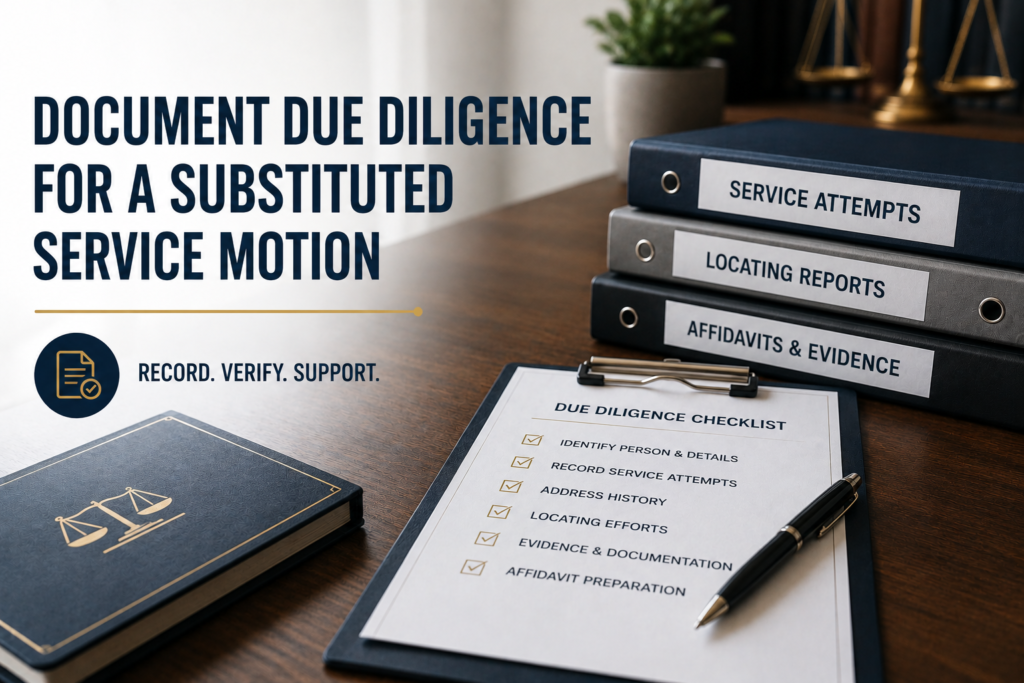
What you need before you start
Before documenting due diligence in affidavit substituted service, gather every relevant service record.
Start with the document you were required to serve. Confirm the person’s full name, last known address, telephone number, email address, and other useful information already in your file.
You should also collect earlier correspondence, returned mail, and records of previous service attempts. Keep information received during those attempts.
The goal is to create one clear file.
An affidavit is a written statement confirmed by oath or affirmation. It can be used as evidence in court.
The Ontario Rules of Civil Procedure, Rule 16 address service of documents, including substituted service.
[VERIFY] Confirm the current affidavit requirements and applicable forms for your specific proceeding before filing.
The steps in order
1. Collect every known detail
Gather the information you already have about the person.
Include known addresses, telephone numbers, email addresses, employment information, and previous contact details where relevant.
Use information that has a lawful purpose connected to the matter. Avoid collecting unrelated personal information.
2. Record each service attempt
Start documenting service attempts as they happen.
Record the date, time, location, method used, and result of each attempt. If someone was contacted at the address, record what was learned.
Your attempts affidavit Ontario record should make each attempt easy to understand.
An attempt log is stronger when it provides a clear timeline instead of simply stating that service was unsuccessful.
3. Explain the address history
Do not simply state that an address was unsuccessful.
Explain why the address was used and what happened during the attempt.
If it was the person’s last known address, say so. If later information suggested the address was no longer current, record that information.
This creates a clear history of your efforts.
4. Document further locating work
If a skip trace report was obtained, keep it with the file.
Record the date of the search and the result. If the search produced possible addresses, explain which ones were followed up.
Do not describe an unverified address as confirmed.
The quality of the evidence matters more than simply having a large file.
5. Verify useful information
Follow up on information that could reasonably lead to successful service.
This may include checking a possible address or confirming information already in the file.
If field work is performed, record the result clearly.
A statement such as “attempt unsuccessful” gives less context than a factual description of what occurred.
6. Organize the evidence
Put the records in a logical order.
Your file may include the attempt log, address history, correspondence, search records, photographs where appropriate, and other supporting material.
This helps connect the evidence for substituted service to the facts stated in the affidavit.
7. Prepare the supporting affidavit
The affidavit should contain facts you can properly swear or affirm.
Keep statements factual and specific.
Do not exaggerate an attempt or state that information was confirmed if it was only suspected.
Rule 16.09 addresses proof of service by affidavit. [VERIFY] Confirm the current rule and form requirements for your specific proceeding.
How to prove it was done properly
Good due diligence in affidavit substituted service should allow another person to follow the service history without guessing.
Start with the original information. Then show the attempts made, the results, and any later locating work.
Use exact dates and times where available.
Avoid vague statements such as “several attempts were made.” Identify the attempts individually.
Your affidavit should also match your supporting records.
If the attempt log gives one date but the affidavit gives another, the inconsistency can create questions.
The same applies to addresses. If an address changed during the search, explain the sequence clearly.
[CONFIRM] From practical operating experience, one of the most common problems is an affidavit that summarizes unsuccessful attempts without preserving the underlying attempt history. A clear chronology makes the evidence easier to review.
Mistakes that cause problems
1. Leave out unsuccessful attempts
An unsuccessful attempt can still be important evidence.
Record it instead of removing it from the file.
2. Use vague descriptions
Write facts, not conclusions.
“Attended at the address at the recorded time and received no answer” is clearer than “address failed.”
3. Ignore new information
If a new address appears, record how it was obtained and whether it was checked.
4. Fail to keep supporting records
Keep the documents that support your statements.
Your affidavit should not be the only record of what happened.
5. Assume substituted service is automatic
It is not simply the next step after unsuccessful service.
The court decides whether an order should be made and what method should be used.
Select Serve and File Process Server Inc. has served Ontario since 2005. A clear record of service attempts can help you present the history of your efforts.
Need documents served in Ontario? Request a quote or call (647) 568-5700.
If you are preparing due diligence in affidavit substituted service, focus on accurate records, clear dates, documented attempts, and evidence supporting each factual statement.
This article provides general information about process serving and court procedure in Ontario. It is not legal advice and does not create a solicitor client relationship. Court rules and procedures change. Confirm current requirements with the relevant court or consult a licensed Ontario lawyer or paralegal before acting.