
What Happens When a Skip Trace Comes Back Empty
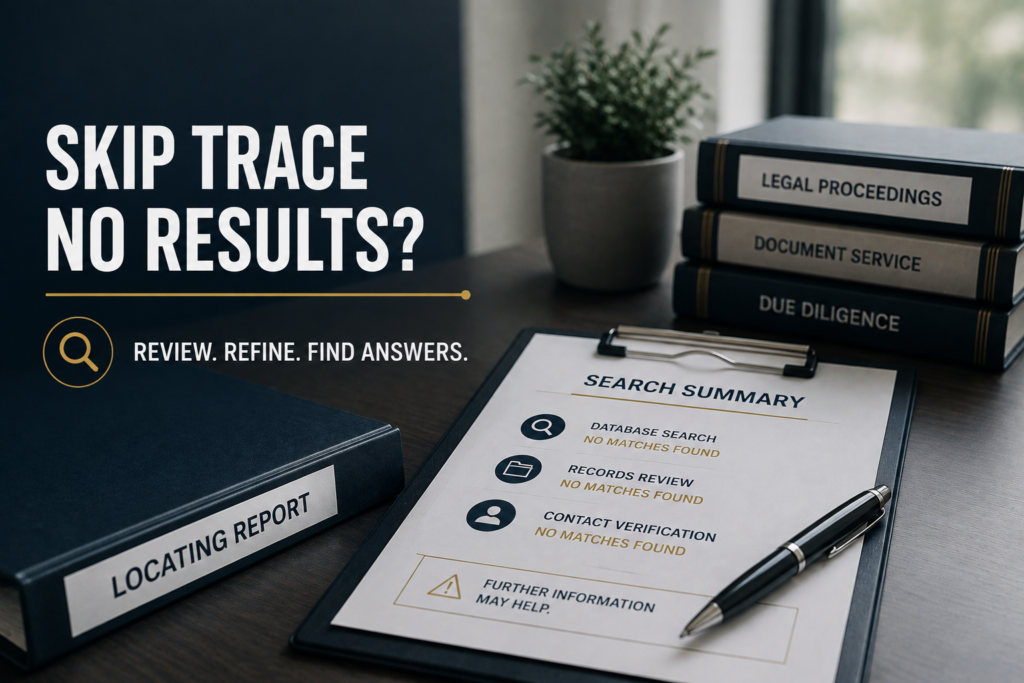
A skip trace no results outcome means the search did not identify enough reliable information to confirm where a person can be located. It does not always mean the person cannot be found. In Ontario, you can review the search, add stronger identifiers, document attempts, and consider appropriate next steps.
Why it matters in Ontario
A skip trace no results outcome can be frustrating when you need to serve documents or move a matter forward.
A skip trace is a locating search. It may use available records and other appropriate sources to identify possible contact information.
A skip trace failed result should not automatically be treated as proof that the person has disappeared.
The search may have been limited by outdated information, a common name, conflicting records, or a lack of useful identifiers.
The purpose of the search also matters.
You may be trying to locate a judgment debtor, confirm an address, or prepare for document service. You may also need a record showing what locating steps were taken.
Privacy should also be considered.
The Office of the Privacy Commissioner of Canada provides guidance on fair information practices. It explains that organizations should identify the purpose for collecting personal information and limit collection to what is needed.
Review the Office of the Privacy Commissioner of Canada’s guidance on fair information principles before providing personal information for further locating work.
The Ontario Rules of Civil Procedure provide procedural rules for civil matters in Ontario. Specific requirements can depend on the document and proceeding.
What it involves in practice
Review what was searched
Start by reviewing the information given to the search provider.
Check the full legal name, previous addresses, telephone numbers, email addresses, employment information, and business connections.
Ask whether any information was missing or unclear.
A common name with no other identifiers can make identity matching harder.
Add stronger identifiers
A skip trace no results outcome may change when better information becomes available.
Consider whether you have:
- A previous address
- An older telephone number
- A date of birth, where relevant and appropriate
- Previous employment information
- Business connections
- Earlier correspondence
- Details from unsuccessful service attempts
Older information can still be useful.
It may help connect a person to newer records, even if the old information is no longer current.
Check previous attempts
Review every earlier attempt to locate or contact the person.
Look at the address used and what happened during the attempt.
For example, a returned document or information from an occupant may provide useful context.
This can help avoid repeating the same unsuccessful locate search.
Document the result
Keep a clear due diligence record.
Record the information provided, the searches performed, and the result received.
If additional information was checked later, keep that information with the file.
A clear record can show that reasonable locating steps were considered.
However, what qualifies as sufficient due diligence depends on the matter.
Consider whether further verification is appropriate
A database search may not answer every locating question.
Depending on the assignment, further verification may be considered.
The purpose is to improve confidence in the information rather than simply produce another possible match.
Any additional search should still have a clear and lawful purpose.
What to do after a skip trace no results
A skip trace no results outcome gives you several questions to consider.
- First, ask whether the starting information was strong enough.
- Second, review whether earlier service attempts were included.
- Third, determine whether additional locating work is appropriate.
- If you cannot locate person information after reasonable attempts, keep the search history together.
- Do not assume that repeating the same search will produce a different result.
- A different approach may be needed if the available information has changed.
- For court matters, you should also avoid assuming that an unsuccessful search automatically allows another form of service.
- Depending on the circumstances, a party may consider options such as a substituted service motion or service by publication.
Those options can have specific procedural requirements.
[VERIFY] Confirm the current requirements with the relevant court or a licensed Ontario lawyer or paralegal before relying on an alternative service method.
Where people commonly go wrong
Treating no result as proof
A skip trace no results outcome does not necessarily prove that someone has no current address.
It means the search did not produce enough reliable information for the requested result.
Providing too little information
A search can be harder when the provider receives only a name.
Provide relevant identifiers already available in your file.
Ignoring old records
Old information can still be useful.
An old address or phone number may help connect multiple records.
Repeating the same search
If an earlier search produced nothing, simply repeating it may not add much.
Explain what was already tried and provide any new information.
Failing to record attempts
If the person remains unlocated, keep documented attempts.
This can help explain what steps were taken before considering another option.
[CONFIRM] From real operating experience, one common source of follow-up is a file that records only “no result” without showing the information supplied or earlier attempts. A clear search history can make the next step much easier to assess.
When to use a professional
Professional support can be useful after an unsuccessful locate search, especially when the person has moved or the available records are old.
Consider professional help when:
- Previous searches produced no reliable result.
- The person has a common name.
- The last known address is outdated.
- Earlier service attempts failed.
- You need a documented locate result.
- The matter may require further service steps.
Select Serve and File Process Server Inc. has served Ontario since 2005. The company provides process serving, court filing, document retrieval, and related locating support.
The practical answer to a skip trace no results outcome is to review the search, strengthen the information, document the attempts, and confirm the appropriate next step.
Need documents served in Ontario? Request a quote or call (647) 568-5700.
If your skip trace no results outcome affects document service, keep the search record and confirm the current procedural requirements before acting.
This article provides general information about process serving and court procedure in Ontario. It is not legal advice and does not create a solicitor client relationship. Court rules and procedures change. Confirm current requirements with the relevant court or consult a licensed Ontario lawyer or paralegal before acting.