
How Social Media Helps in Skip Tracing: Legal & Ethical Ontario Guide
Social media skip tracing can help professionals locate people whose current address or workplace is unknown. Public online information may provide useful leads, but it should be verified before being relied upon. In Ontario, professionals must also consider privacy, lawful access, and responsible handling of personal information.
1. Identify the Correct Social Media Profile
Start by confirming that an online profile belongs to the person you are trying to locate.
Names alone are not enough. Professionals may compare publicly available details such as:
- Profile name
- Public photographs
- Employment information
- Business connections
- Public posts
- Known associates
- Other confirmed information
Accurate identification is the first step in effective social media skip tracing. A similar name or photograph does not prove that a profile belongs to the intended person.
2. Review Publicly Available Information
Public profiles can provide useful locating leads.
During social media skip tracing, professionals may review publicly accessible:
- Employment information
- Business pages
- Public posts
- Public photographs
- Professional profiles
- Public comments
- Public location information
LinkedIn can sometimes help identify a current employer. Public business pages may also confirm an organization’s location or connection to an individual.
Treat these findings as leads rather than confirmed facts.
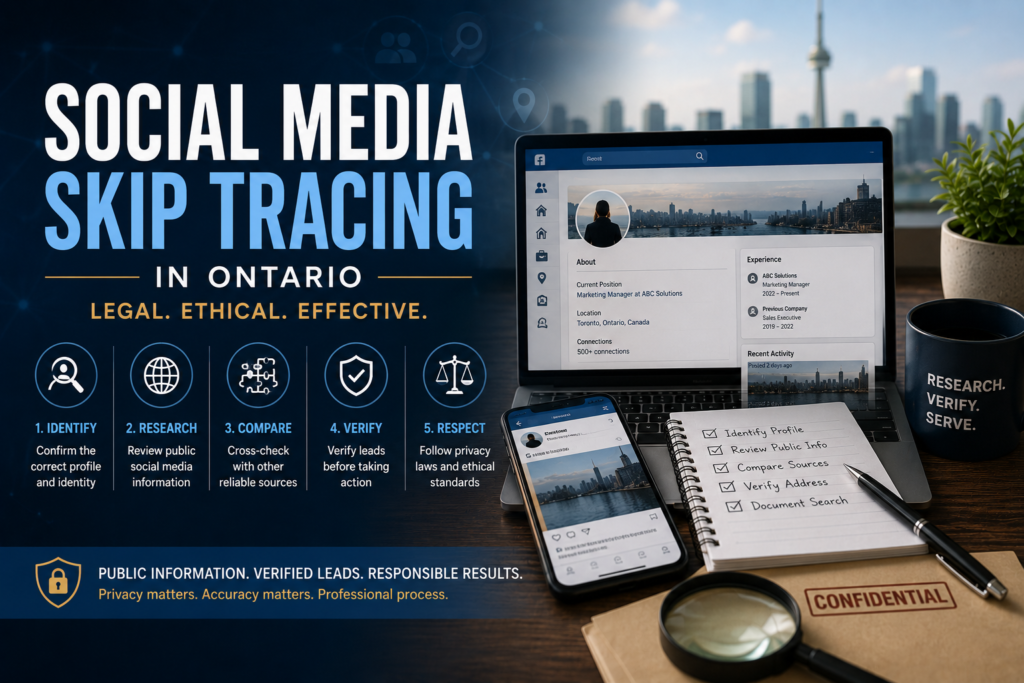
3. Compare Social Media With Other Sources
The strongest social media skip tracing process does not rely on social media alone.
Professionals may compare public online information with:
- Address history
- Business records
- Court information
- Public directories
- Corporate information
- Locate searches
- Lawful field observations
For example, a public employment profile may suggest a workplace. That information can then be checked against other available sources before a service attempt is planned.
4. Verify Information Before Using It
Finding a possible address or workplace does not automatically confirm that the information is current.
Professionals should consider:
- When the information was posted
- Whether multiple sources support it
- Whether the identity matches
- Whether the location appears connected to the person
- Whether newer information contradicts the lead
[CONFIRM] In practical process serving work, relying on a single social media result without cross-checking can lead to failed service attempts. Confirm this observation against your team’s current operating experience.
Verification makes social media skip tracing more useful and reduces the risk of acting on outdated information.
5. Follow Privacy and Ethical Limits
Social media skip tracing should use information that professionals are lawfully permitted to access.
Appropriate research can include reviewing information that is publicly available. Professionals should not:
- Hack accounts
- Bypass privacy settings
- Obtain private account credentials
- Impersonate another person
- Misrepresent their identity to obtain information
- Access restricted databases without authorization
- Obtain confidential financial or health information improperly
The Office of the Privacy Commissioner of Canada guidance on protecting personal information explains principles concerning appropriate collection, use, accuracy, and safeguards.
Privacy obligations can depend on the organization and circumstances, so do not assume that everything available online can be collected or used without limits.
How Social Media Supports Skip Tracing
When properly documented, public online information can help establish useful locating leads.
For example, social media skip tracing may identify:
- A possible employer
- A business connection
- A recent public location
- A possible address lead
- An updated professional profile
These findings can then be assessed alongside other locating work.
Social media evidence does not automatically establish that a person lives at a particular address or authorize a particular method of service.
Can Social Media Help With Alternative Service?
It can sometimes provide information relevant to a procedural application, but the existence of a social media account does not by itself authorize service through that platform.
If personal service cannot be completed, the appropriate next step depends on the proceeding, evidence available, and applicable court rules.
A process serving company can document service attempts and locating efforts. Legal advice about an alternative service motion should come from a licensed Ontario lawyer or paralegal.
Why Combine Social Media Research With Professional Skip Tracing?
Professional social media skip tracing works best as one part of a broader locating process.
Select Serve and File Process Server Inc. provides skip tracing, locate searches, process serving, court filing, and document retrieval. The company has served Ontario since 2005. Combining online research with other locating methods can help identify and verify useful leads before service is attempted. The company can also assist with related process serving and filing requirements, depending on the matter.
Need documents served? Request a quote or call (647) 568-5700.
“This article provides general information about process serving and court procedure in Ontario. It is not legal advice and does not create a solicitor client relationship. Court rules and procedures change. Confirm current requirements with the relevant court or consult a licensed Ontario lawyer or paralegal before acting.”